


 For all latest news, follow the Daily Sun's Google News channel.


Smart Bangladesh Business Conference
Govt eyes overseas bond issuance within three months
Daily Sun Report, Dhaka
Published: 16 Nov 2026, 12:00 AM
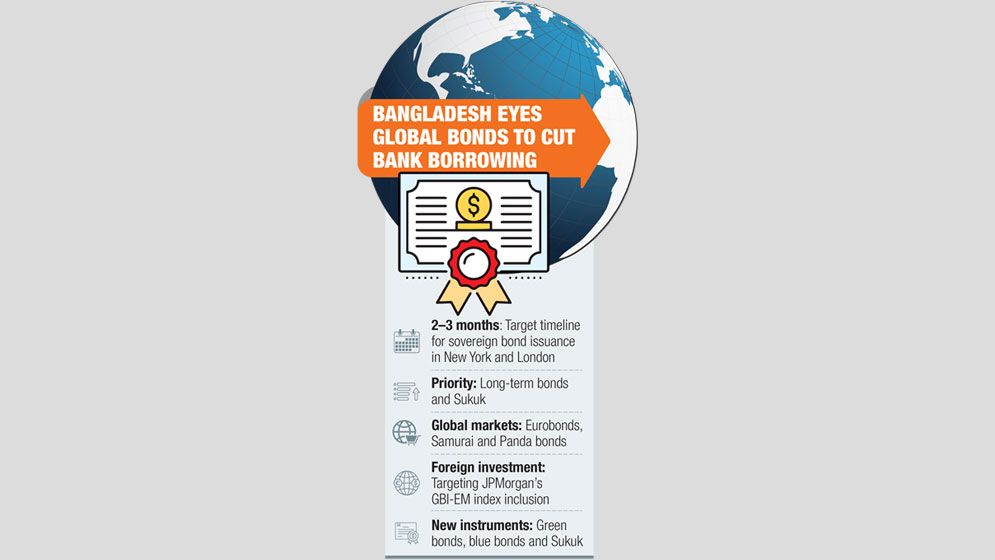
The government plans to issue bonds in international markets within the next two to three months, potentially in New York or London, Prime Minister’s Special Assistant Tanvir Ghani said on Sunday.
However, interest rates and issuance mechanisms have yet to be finalised, he added.
The government aims to reduce its reliance on bank borrowing by strengthening the capital and bond markets to finance large-scale, long-term investments.
As part of the initiative, it plans to increase borrowing through long-term bonds and Shariah-compliant Sukuk rather than relying heavily on short-term Treasury bills, thereby reducing refinancing risks and ensuring sustainable debt management.
Finance and Planning Minister Amir Khosru Mahmud Chowdhury outlined the plans at a press briefing in Cox’s Bazar on Sunday, on the sidelines of the inaugural International Debt Management Conference Bangladesh 2026.
He earlier inaugurated the two-day conference, according to a finance ministry press release.
Ghani said the private sector had traditionally depended on bank loans rather than raising funds through capital markets or issuing bonds.
This increased pressure on banks and forced many businesses to borrow at high interest rates, affecting their financial performance.
He said the government was working to expand alternative financing opportunities, including bond issuance, for both public and private sectors.
The government is also considering entering international capital markets through US dollar-denominated Eurobonds, Sukuk, Japan’s Samurai bonds and China’s Panda bonds at an appropriate time.
Steps to attract foreign investors
The government is working to make Bangladesh’s domestic bond market more accessible to foreign investors, including exploring the inclusion of local bonds in JPMorgan’s Government Bond Index-Emerging Markets (GBI-EM).
It also plans to establish links with international clearing houses Euroclear and Clearstream to facilitate transaction settlements for foreign investors.
Other initiatives include expanding green bonds, blue bonds and Sukuk issuance while attracting pension funds, insurance companies and foreign investors to strengthen the domestic bond market.
Borrowing costs decline
Amir Khosru said the effectiveness of borrowing mattered more than the amount of debt.
“What’s important is not how much debt has been taken, but how effectively that debt has been utilised,” he said.
According to information presented at the briefing, the government’s decision to stop financing budget deficits by printing money through Bangladesh Bank has contributed to macroeconomic stability and lower borrowing costs.
Interest rates on 91-day Treasury bills fell from around 12% in June 2025 to below 10% in June 2026 and currently stand between 8% and 9%.
The government is increasingly turning to long-term bonds and Sukuk to meet its financing needs.
To improve transparency, it has introduced debt reporting measures and modernised the Primary Dealer (PD) system.
It is also preparing an Annual Borrowing Plan and a new medium-term debt management strategy to give market participants advance information about government borrowing.
Public debt reaches Tk18.89 lakh crore in June 2024
The briefing presented a comparison of Bangladesh’s debt position as of 30 June 2024, before the change of government on 5 August that year.
Total public debt stood at Tk18.89 lakh crore, equivalent to 36% of GDP, after increasing by Tk5.45 lakh crore between June 2022 and June 2024.
During the same period, government borrowing from Bangladesh Bank surged from Tk730 crore to Tk56,750 crore, while foreign exchange reserves fell to US$20.5 billion and inflation approached 10%.
The briefing said government borrowing from the central bank subsequently declined significantly to Tk482 crore as of 30 June 2026.
Foreign exchange reserves, meanwhile, exceeded $30 billion under the International Monetary Fund’s BPM6 accounting methodology.
Debt repayment pressure mounts
The finance minister warned that Bangladesh was entering a challenging period of repaying previously contracted loans.
External debt servicing, including principal and interest, was projected at $4.5 billion for FY26 and could peak at $5.5 billion in FY30.
He identified higher government revenue as the most important priority for sustainable debt management.
The government is working to expand the tax net, reduce unjustified tax exemptions and digitise VAT and income tax systems.Other planned reforms include recapitalising state-owned banks, restoring banking sector discipline, establishing an integrated Debt Management Office (DMO) and introducing a revised Public Debt Act.
Targeting a $1 trillion economy by 2034
Amir Khosru expressed hope that the conference would produce practical recommendations to support Bangladesh’s long-term economic goals.
The government aims to build a $1 trillion economy by 2034 and graduate from the United Nations’ Least Developed Country (LDC) category in 2029 as scheduled.
The two-day conference is jointly organised by the Finance Division and the Asian Development Bank (ADB).
Experts from the World Bank, IMF, ADB, the United States, United Kingdom, Malaysia, Indonesia, Pakistan and Sri Lanka are participating.