




 For all latest news, follow the Daily Sun's Google News channel.


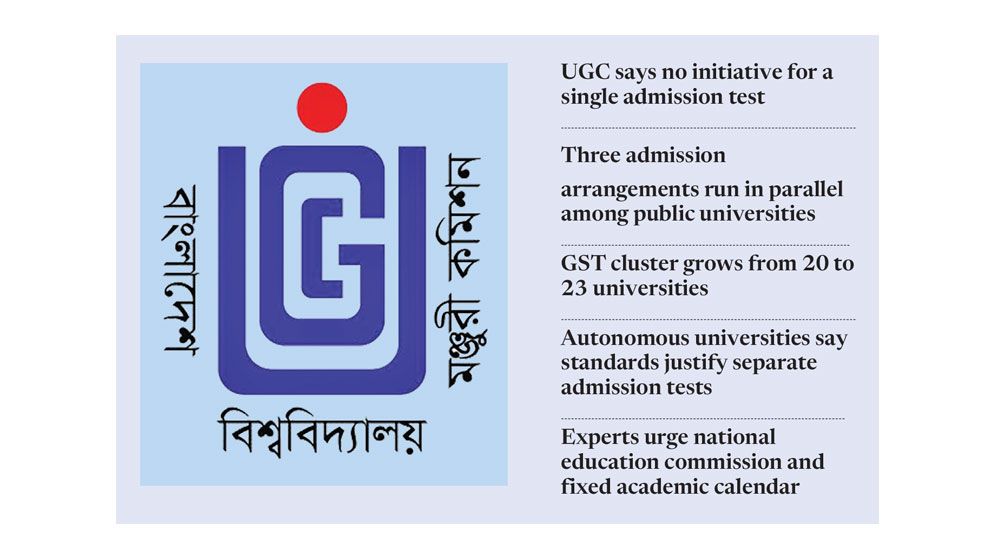
Public university admissions in the country remain divided among three separate systems, with autonomous universities, agricultural universities and a cluster of general, science and technology institutions each holding their own tests, while the University Grants Commission (UGC) says no initiative is under way to introduce a uniform admission test.
Every year, ministry officials, the UGC and university authorities differ over the timeframe of tests, application procedures and whether a common, individual or cluster-based method should be followed.
Repeated attempts by the Ministry of Education and the UGC to introduce a coordinated system have not fully materialised. The latest effort, to coordinate test schedules for the forthcoming 2026-27 academic session, also failed to produce the expected outcome.
Some universities hold tests on the same day, others have opted out of the cluster system, and delays in publishing results and completing admissions continue to affect students.
After their HSC examinations, many candidates travel from one district to another to sit separate tests, and their guardians bear the additional expense.
The idea of a single admission test was raised at the highest levels of the previous Awami League government. The UGC drafted an ordinance on the matter, but the Ministry of Education did not approve it.
The UGC says the country has 61 approved public universities, although academic activities and student admissions have yet to begin at several of them.
Autonomous universities conduct their own tests and agricultural universities follow a separate cluster system.
Twenty general, science and technology universities held tests under the General, Science and Technology (GST) cluster in the previous session.
Dhaka University (DU), Bangladesh University of Engineering and Technology (BUET) and Jahangirnagar University, among others, follow their own admission circulars, application procedures, test schedules and evaluation methods.
Students seeking places at these institutions must apply separately and travel to different test locations, which adds to their costs and time.
Professor Mohammed Almujaddade Alfasane, pro-vice chancellor (administration) of Dhaka University, said the central question surrounding cluster-based admission was who would ensure educational quality: the government or the universities themselves.
“There should be no compromise when it comes to maintaining the standard of admission tests. Established universities strive to uphold their academic standards. For this reason, their admission processes and eligibility criteria may also differ,” he said.
He said the cluster system among agricultural universities was working relatively well because those institutions had similar curricula and academic structures, but introducing it at general universities would be difficult given the diversity of their disciplines and departments.
Speaking to the Daily Sun, he said holding admission tests for all universities at the same time or under a single system was not realistic, as universities differ in academic disciplines, student requirements, departmental needs and learning environments.
Engineering, medical, general and technical institutions have distinct characteristics, he said, and departments within general universities also vary significantly.
Alfasane called for a national-level plan involving all stakeholders, with discussions focusing on how to place leading universities under a separate admission framework while bringing others under a coordinated system.
He added that coordinating admission tests alone would not resolve the problem and that the entire education system, from primary to higher education, needed to be reorganised.
He also called for a specific academic calendar for all universities, with fixed schedules for admission tests, publication of results, enrolment and the start of classes, to reduce session backlogs.
Cluster system: progress and limits
Agricultural universities introduced a cluster-based admission system in the 2019-20 academic session. The GST cluster followed in 2020-21, bringing together general, science and technology universities. The aim was to let students seek admission to several universities through a single test, reducing the burden of separate examinations.
Complications emerged from the beginning, however. Questions were raised over university participation, delays in admission procedures, subject choices, migration, vacant seats and the quality of student selection. At one stage, several universities withdrew from the cluster and resumed independent tests, obliging students again to sit separate examinations.
Three new universities have joined the GST cluster for the 2026-27 session, taking the number from 20 to 23, said Professor Golam Rabbani, vice-chancellor of Noakhali Science and Technology University. He said tests are planned for 20, 21 and 27 March 2027.
“The main objective of the cluster-based system is to provide students with opportunities to secure admission to multiple universities through a single admission test based on merit rankings. This year, students will be able to seek admission to 23 universities through one examination,” he said, expressing hope that the system would reduce hassle for students and guardians.
Calls for consensus
Professor Mohammad Mojibur Rahman of the Institute of Education and Research (IER) at Dhaka University called for a long-term admission policy based on consensus among all stakeholders, saying coordinated efforts were needed to reduce inconsistencies in admission tests.
He said ensuring the credibility of the admission system should be the first priority.
He noted that although students sit for SSC and HSC examinations after years of preparation, universities do not fully rely on board results and conduct separate tests. The reasons for the lack of confidence in board results should also be examined, he said.
Each university and department has its own requirements, selection process and eligibility criteria, and universities in other countries follow similar practices, he said. He cited India's Indian Institutes of Technology (IITs), which select students through standardised admission tests, and said Bangladesh has yet to develop a standardised centralised test acceptable to all universities.
Concerns over question leaks, irregularities and the selection of qualified students were among the reasons established universities remained reluctant to join the cluster system, he said.
He proposed a national education commission with representatives of the Ministry of Education, the UGC, universities, teachers and students to determine the vision for higher education, student selection criteria and the role of universities.