


 For all latest news, follow the Daily Sun's Google News channel.


JULY UPRISING
27 months on, victims still await justice as system struggles
No trial has concluded in regular courts across the country despite nearly 1,900 cases

More than 27 months after the historic July 2024 Mass Uprising, justice remains largely elusive for the victims and families of unarmed and innocent protesters killed and injured during the student-led mass movement.
While nearly 1,900 cases were filed across the country against perpetrators, not a single case has reached a verdict in the regular courts, according to information provided by the law ministry.
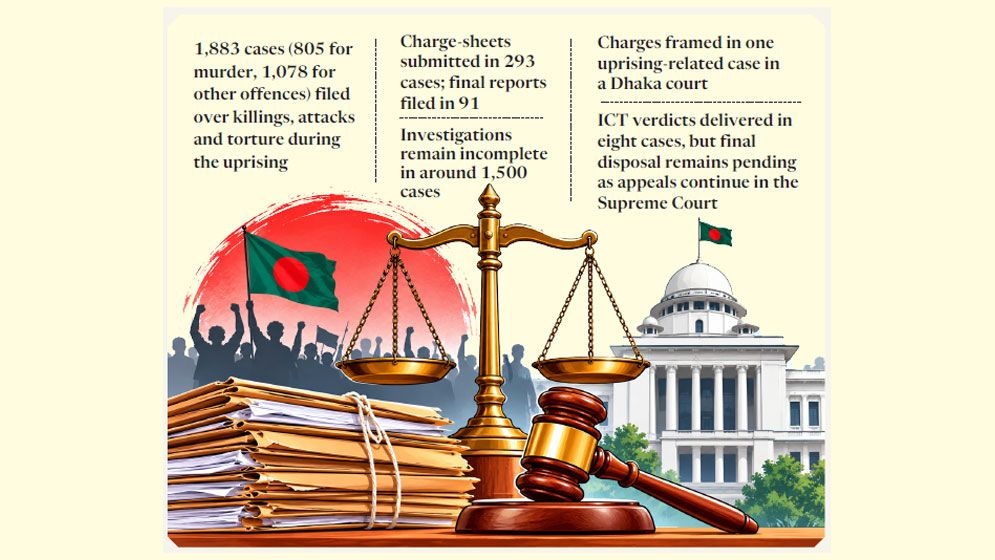
Although the International Crimes Tribunal (ICT) has delivered verdicts in eight crimes against humanity cases – awarding death sentences to 24 individuals, including ousted prime minister Sheikh Hasina for atrocities committed in 2024, the final disposal of the ICT cases remains pending in the Supreme Court.
Meanwhile, the majority of cases filed with police stations across the country are still at the investigation stage.
According to Law Minister Md Asaduzzaman, 1,883 cases have been filed across the country since the July Mass Uprising over killings and other forms of repression committed during the then Awami League government and by members of the ruling party, whose activities are currently banned. Of these, 805 are murder cases, while the remaining 1,078 were filed under other provisions.
Police have already submitted charge-sheets in 293 cases, including 98 murder cases. Although proceedings in these cases are underway, none has yet reached a conclusion in the trial courts.
The investigation process remains incomplete in another 1,499 cases, while final reports have been submitted in 91 cases.
Asaduzzaman acknowledged that investigating such a large number of cases is a complicated and time-consuming process. Police are prioritising the collection of relevant evidence, witness accounts and compliance with legal procedures to ensure that investigations will withstand judicial scrutiny.
He also said that public prosecutors had been instructed to take necessary legal measures to ensure the proper handling and speedy disposal of the cases.
Few cases reach charge-framing
The submission of charge-sheets in just 293 out of the 1,883 cases in over two years highlights the massive judicial backlog. Only a few cases have reached the charge-framing stage. The situation is particularly concerning for families who lost their loved ones during the crackdown on protesters.
As in other parts of the country, proceedings in Dhaka are also moving slowly. Although charges have been framed in one of the July Mass Uprising cases in a Dhaka court, recording of witness testimony has not begun yet.
Omar Faruq Faruqi, public prosecutor (PP) in the Dhaka Metropolitan Court, said that charges would be framed in some other cases soon and formal trials in these cases would begin shortly. He also said that final reports have been submitted in some cases connected to the uprising.
ICT performs comparatively faster
The ICT has made comparatively faster progress in prosecuting those accused of crimes against humanity during the 2024 mass uprising.
A total of 79 cases have so far been filed with the ICT. Of these, verdicts were delivered by two tribunals in eight cases. A total of 73 accused were convicted in the cases. Hasina and 23 others received death sentences, while another 49 were sentenced to various terms of imprisonment, including life imprisonment.
ICT Chief Prosecutor Md Aminul Islam said that 26 cases are now at the trial stage and another 45 are at the investigation stage. However, the eight cases in which the ICT delivered verdicts are now in the appeal stage in the Supreme Court’s Appellate Division.
In the last case, the ICT prosecution filed an appeal in October 2025 to the Appellate Division, seeking the death sentence for former information minister Hasanul Haq Inu, who had received a 10-year jail term from the tribunal. The appeal illustrates that legal proceedings continue even after the tribunal verdict.
While the ICT deals with crimes against humanity, the regular courts handle murder, attempted murder, grievous injury and other offences.
The slow pace of ordinary criminal cases raises questions about the capacity of the regular justice system to deal with mass violence involving numerous victims, witnesses and accused persons.
Advocate Muzahedul Islam Shahin, a lawyer at the Bangladesh Supreme Court, said that the delay also carries consequences beyond the courtroom. Witnesses may become difficult to trace, physical and digital evidence may deteriorate, and victims’ families may lose confidence.
Law Minister Md Asaduzzaman said that the government has pledged to bring those responsible for killings, enforced disappearances, torture and other abuses to justice. He reiterated that commitment in Parliament.
________________________________________________________
The reporter can be reached at: [email protected]