


 For all latest news, follow the Daily Sun's Google News channel.


Tarique seeks 50% climate funds for adaptation
Daily Sun Report, Dhaka
Published: 13 Nov 2026, 12:00 AM
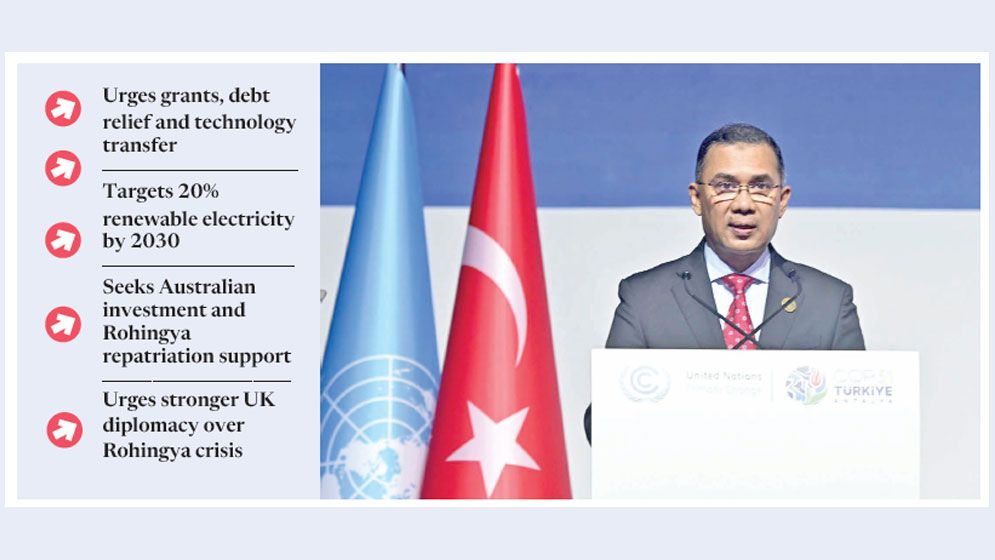
Prime Minister Tarique Rahman on Thursday called for allocating at least 50% of international climate finance to adaptation, urging developed countries to provide grants rather than loans to climate-vulnerable nations already grappling with mounting debt and climate-related losses.
Addressing the High-Level Segment of the 31st UN Climate Change Conference (COP31) in Antalya, Turkiye, he outlined five urgent actions to strengthen global climate cooperation and ensure a fair transition for developing countries.
“Climate-vulnerable countries need grants, not more loans that increase their debt. They also need reliable financial support, access to modern technology and stronger support for adaptation,” the prime minister said, reports BSS.
He said the existing global climate finance system remained inadequate and failed to address the actual needs and priorities of developing countries.
“Climate-related losses and damages are putting a heavy burden on our economies. At the same time, rising debt payments and limited financial resources are making things even harder,” he said.
Invoking the principle of Common but Differentiated Responsibilities and Respective Capabilities, Tarique Rahman proposed five actions: allocating at least 50% of international climate finance to adaptation based on individual countries' priorities; introducing debt-relief measures for vulnerable nations; ensuring fair access to climate-friendly technologies; accelerating the transition to renewable energy; and adopting the Belem-Antalya Action Mechanism for a just transition at COP31.
He called for measures such as Debt-for-Climate Swaps and Climate-Resilient Debt Clauses to ease the financial burden on climate-vulnerable countries.
He also stressed the need for affordable financing, skills development and technology transfer to help developing countries shift towards renewable energy.
The prime minister urged world leaders to ensure the participation of women and young people in climate action, create decent green jobs and reduce global emissions to keep the 1.5-degree Celsius target within reach.
Highlighting Bangladesh's vulnerability, he said the country was on the frontline of the global climate crisis despite contributing less than 0.5% of global greenhouse gas emissions.
“Despite these challenges, we remain committed to building a trillion-dollar, climate-resilient and sustainable economy,” he said.
Outlining the government's development philosophy, Tarique Rahman said economic growth and environmental protection must go hand in hand.
“Guided by our philosophy of 'Bangladesh Before All', we believe economic growth and environmental protection must go hand in hand. Our industrialisation and development must protect nature and maintain ecological balance,” he said.
Green transition plans
The prime minister highlighted several government initiatives to expand renewable energy, promote green industrialisation and protect the environment.
He said Bangladesh aimed to meet 20% of its total electricity demand from renewable sources by 2030, in line with the Paris Agreement and its commitment to achieving net-zero emissions.
The government is working to develop 4,000 megawatts of solar power, backed by special tax incentives, while also promoting waste-to-energy projects, he said.
Tarique Rahman said Bangladesh had nearly 300 Leadership in Energy and Environmental Design (LEED)-certified ready-made garment factories, reflecting progress in green industrialisation.
The government is also promoting environment-friendly transport, including electric vehicles, and encouraging the use of sustainable products such as jute bags. A national framework for carbon trading is being developed, he added.
On environmental conservation, he said the government planned to plant 250 million trees across the country over the next five years.
It was also undertaking the excavation of 20,000 kilometres of rivers and canals, alongside the Padma Barrage and Teesta Barrage Master Plan, to retain water, reduce flood risks, revive wetlands and recharge groundwater.
He said mangroves were being restored on reclaimed coastal land to protect communities and strengthen the country's resilience to climate change.
Expressing hope for a successful COP31, Tarique Rahman said Bangladesh expected the conference to deliver meaningful, balanced and ambitious outcomes, particularly for countries most vulnerable to climate change.
At the beginning of his address, he thanked the Turkish government for hosting the conference and Australia for leading the negotiations.
Seeks Australian investment, Rohingya support
On the sidelines of COP31, Tarique Rahman held a bilateral meeting with Australian Prime Minister Anthony Albanese, seeking Canberra's cooperation in expanding investment in Bangladesh and securing the safe repatriation of Rohingyas to Myanmar.
The meeting took place at 10:30am local time on Thursday, according to Prime Minister's Deputy Press Secretary Hasan Shiplu.
The two leaders discussed climate change, investment opportunities, agricultural development and the Rohingya crisis.
Tarique Rahman highlighted Bangladesh's investment potential, saying the country offered opportunities for foreign investors. They also discussed ways to develop the agricultural sector.
On the Rohingya issue, he urged Australia to strengthen its diplomatic efforts to ensure the safe return of displaced people sheltered in Bangladesh to their homeland.
“The Rohingya crisis originated in Myanmar, and its lasting solution also lies in Myanmar,” he said.
He also briefed Albanese on Bangladesh's renewable energy targets and environmental protection initiatives, including plans to plant 250 million trees and excavate canals across the country.
The two leaders invited each other to visit their respective countries. Albanese expressed hope of visiting Bangladesh next year at a convenient time, while Tarique Rahman also expressed interest in visiting Australia.
UK urged to step up Rohingya diplomacy
The prime minister also sought stronger British diplomatic engagement to ensure the safe, voluntary and dignified repatriation of Rohingyas to Myanmar.
He made the request during a meeting with UK Foreign Secretary Edward Miliband on the sidelines of the climate conference.
Their discussions covered climate adaptation, migration, humanitarian issues and ways to strengthen bilateral economic relations.
Tarique Rahman said Bangladesh had been hosting a large number of Rohingyas for nearly a decade, placing considerable pressure on its economy, society, culture and environment.
He warned that the prolonged crisis could undermine livelihood opportunities for local communities and pose risks to regional security.
Stressing the need for stronger international diplomatic efforts to find a sustainable solution, he urged the UK to play a more active role in facilitating repatriation.
The meeting also highlighted opportunities to deepen cooperation in climate action, humanitarian response, migration and economic partnership.
Series of bilateral engagements
Tarique Rahman arrived in Antalya on Tuesday on a three-day official visit to attend COP31.
Besides meeting the Australian prime minister and the UK foreign secretary, he held bilateral talks with Turkish President Recep Tayyip Erdogan, Chinese Vice President Han Zheng and Uzbek President Shavkat Mirziyoyev.
The discussions focused on strengthening bilateral relations, expanding investment and enhancing cooperation in addressing climate change.
He also held courtesy meetings with several other world leaders and heads of international organisations on the sidelines of the conference.
Meanwhile, Prime Minister's wife Dr Zubaida Rahman attended a luncheon hosted by Turkish First Lady Emine Erdogan at the Regnum Hotel in Antalya.
The luncheon was organised in honour of the spouses of heads of state and government and other distinguished guests attending the conference.
Dr Zubaida, an eminent physician and vice president of the Ziaur Rahman Foundation, was warmly welcomed by Emine Erdogan. The two exchanged greetings and held cordial discussions, according to Deputy Press Secretary Hasan Shiplu.
Spouses of leaders from different countries and other invited guests also attended the event.