



 For all latest news, follow the Daily Sun's Google News channel.


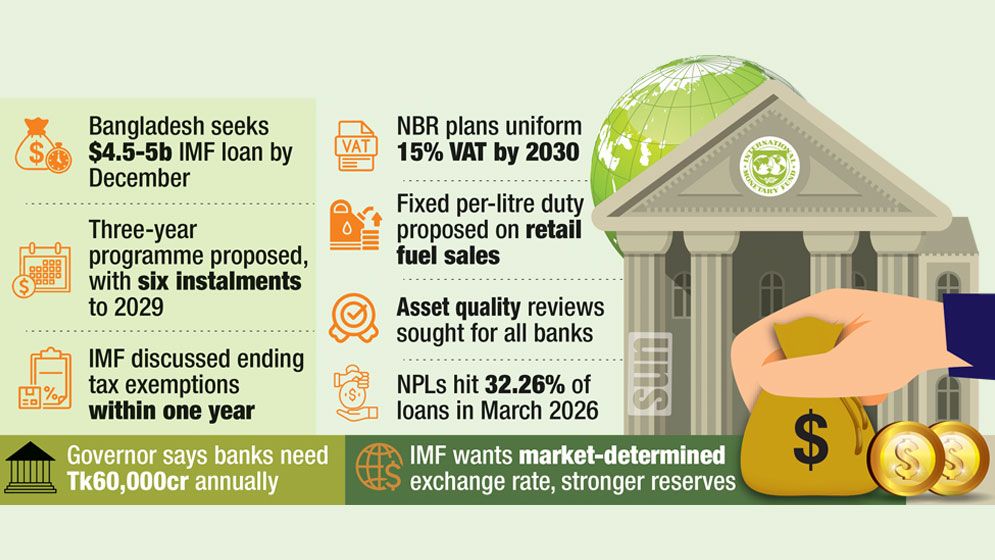
Bangladesh’s push to sign a $4.5-5 billion loan deal with the International Monetary Fund (IMF) by December is putting the banking, revenue and energy sectors under pressure, as the lender seeks the withdrawal of tax exemptions within a year, additional duties on fuel sales and a restructuring of weak banks.
Economists warn that implementing the conditions will be difficult.
Finance Ministry sources said Dhaka has requested around $4.5 billion, which could rise to $5 billion during negotiations.
Discussions are underway on disbursing the money in six instalments between December 2026 and December 2029. The amount, conditions and schedule have not been finalised.
The IMF’s positions emerged at meetings between its visiting mission and Bangladeshi stakeholders.
The delegation includes Maxym Kryshko, the IMF’s resident representative in Dhaka, and economists Ruifeng Zhang and Qiaoe Chen.
Sebastian Eckardt, a World Bank official who has contributed to macroeconomic assessments of Bangladesh, including joint World Bank-IMF debt sustainability analyses, is also part of the mission.
Finance Minister Amir Khosru Mahmud Chowdhury told journalists after meeting IMF Deputy Managing Director Nigel Clarke in Bangkok on 15 October that the loan would carry conditions to be settled through negotiations.
He said Bangladesh agreed with the IMF’s observations on the banking sector, the tax-to-GDP ratio and bank recapitalisation.
The government favours phased implementation, citing high inflation and sluggish investment.
Tax exemptions and VAT
More than 500 goods and services currently receive VAT concessions or full exemptions at varying rates.
The National Board of Revenue (NBR) plans to withdraw these benefits and introduce a uniform 15% VAT on most goods and services by 2030, while retaining exemptions for essential commodities, education, healthcare and transport.
At a meeting with NBR officials, the IMF reportedly discussed withdrawing the exemptions within one year. The NBR argues that abrupt removal could undermine investment and disrupt business planning.
Dr Zahid Hussain, former lead economist at the World Bank’s Dhaka office, told the Daily Sun that tax expenditures amount to about 6.8% of GDP, while actual tax revenue is around 6.4%.
Rationalising exemptions and widening the tax base were essential to narrowing the gap, he said.
Revenue mobilisation, he added, should not rely solely on higher rates, and tackling evasion and strengthening administrative capacity were equally important.
Fuel duties and subsidies
At the same meeting, the IMF proposed a fixed duty on every litre of fuel sold, collected at the retail stage in addition to taxes imposed at import.
It is also pressing for rationalisation of subsidies in the power, gas and agriculture sectors and for continuation of the automatic fuel pricing mechanism. Implementation could raise transport, agricultural and industrial production costs.
Dr Mustafizur Rahman, distinguished fellow at the Centre for Policy Dialogue (CPD), said subsidies needed to be reduced but in a targeted manner. Abrupt additional taxes on fuel, he said, would put further pressure on ordinary people and businesses.
CPD Distinguished Fellow Dr Fahmida Khatun said raising fuel prices amid high inflation could push up the cost of living further.
Banking sector
The IMF wants asset quality reviews of banks, an assessment of their actual capital shortfalls and separate restructuring plans for financially weak institutions.
The proposals also include classifying banks by financial health, controlling non-performing loans (NPLs), addressing capital shortfalls and considering mergers or liquidation where necessary.
Bangladesh Bank data show NPLs accounted for 32.26% of total loans in March 2026, while the sector’s capital adequacy ratio stood at negative 2.64% at the end of December 2025. Restructuring weak banks will require substantial financial resources.
Bangladesh Bank Governor Mostaqur Rahman said at an event in October that the sector would need Tk60,000 crore a year from the national budget for five to eight years to recover from extensive financial looting and structural damage.
Revenue administration and other reforms
The IMF is also pressing for the separation of revenue policy formulation from revenue collection.
The government has begun restructuring the NBR by establishing two separate divisions, but the process has not been fully implemented.
Other priorities include preventing tax evasion, digitalising tax administration, expanding the tax base and modernising duties on tobacco products.
The lender also wants greater exchange rate flexibility, a rebuilding of foreign exchange reserves and a dollar rate determined by market demand and supply.
It has called for an effective bankruptcy law to facilitate the restructuring of defaulting businesses and non-viable enterprises.
Implementation challenges
Experts say the government will face significant challenges in meeting the conditions, chiefly raising revenue, mobilising funds for bank restructuring and containing inflation.
Dr Zahid Hussain said withdrawing tax exemptions and imposing additional fuel duties could increase costs for businesses and consumers, while using public funds to recapitalise banks could add to pressure on the national budget.
The government, he said, must move beyond making commitments simply to secure loans and ensure realistic timelines and accountability for reforms.
He also stressed the need to strengthen social safety net programmes to protect poor and low-income people from the effects of reform.
Several reforms under the previous IMF programme were not implemented within the stipulated deadlines.
Bangladesh signed a $4.7 billion agreement with the IMF in January 2023, and an additional $800 million later raised the programme’s total size to $5.5 billion.
Conditions relating to revenue collection, NBR restructuring, withdrawal of tax exemptions and exchange rate reforms were only partially implemented.