


 For all latest news, follow the Daily Sun's Google News channel.


Baihetan: 16GW of clean power from the River Jinsha
World’s second-largest hydropower plant cuts 51.6m tonnes of CO2 a year
Md Rabiul Islam, back from China
Published: 08 Nov 2026, 12:00 AM
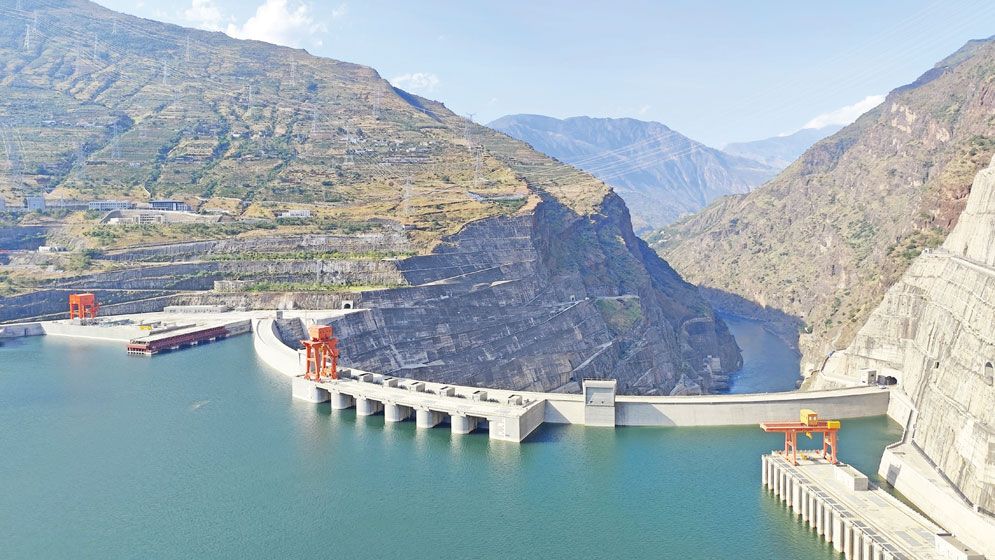
Baihetan Hydropower Station
China’s Baihetan Hydropower Station generates an average of 62.443 billion kilowatt-hours (kWh) of electricity a year and cuts carbon dioxide emissions by about 51.6 million tonnes annually, according to project data shared with a visiting delegation of Bangladeshi journalists.
Located on the River Jinsha, on the border between Ningnan County in Sichuan Province and Qiaojia County in Yunnan Province, the 16-gigawatt (GW) facility is the world’s second-largest hydropower station after the Three Gorges Dam. Project information describes it as the “Mount Everest of the global hydropower industry”.
Wangying, an official in charge of introducing the plant, told the delegation at the dam site that the project marked a major step in China’s efforts to expand clean energy generation, cut emissions and strengthen its energy supply.
The station has 16 generating units of 1GW each, the largest single-unit capacity for a hydropower generator in the world. It became fully operational on 20 December 2022.
According to project data, the plant saves about 19.68 million tonnes of standard coal a year. It also cuts annual emissions of sulphur
dioxide by 170,000 tonnes, nitrogen oxides by 150,000 tonnes and soot by 220,000 tonnes. Over the past five years, it has reduced carbon dioxide emissions by more than 200 million tonnes.
A day of full-capacity operation can generate enough electricity to meet the daily needs of nearly 150 million people, project information says. The station had produced a cumulative 250 billion kWh by August 2026.
Two ultra-high-voltage direct-current transmission lines carry power more than 2,000 kilometres to the Yangtze River Delta, delivering over 60 billion kWh a year and supporting the region’s industry and green transition.
The project is a key part of China’s West-to-East Power Transmission Programme, which supplies energy-hungry eastern provinces including Jiangsu and Zhejiang.
Engineering challenges
Developed by China Three Gorges Corporation, the project has a 289-metre-high concrete double-curvature arch dam and a reservoir with a storage capacity of 20.627 billion cubic metres.
The site presented severe natural and geological challenges. Air temperatures reach 43°C, ground-surface temperatures approach 70°C and wind speeds reach Beaufort Force 13. The dam sits in a steep, asymmetrical V-shaped valley, with its foundation built on highly fractured columnar-jointed basalt. Its underground powerhouse cavern complex, the world’s largest of its kind by span, posed major rock-stability challenges. The area is also prone to landslides, debris flows and earthquakes, requiring stringent safety measures.
Two underground powerhouses stand on opposite banks of the river, each housing eight units. Dongfang Electric Corporation and Harbin Electric Corporation made the turbines, and all 16 units were developed and manufactured domestically.
Construction began in July 2017 after national approval. The first units started operating in June 2021, and all 16 were commissioned by December 2022. The journal Engineering, published by the Chinese Academy of Engineering, named Baihetan among the world’s top 10 engineering achievements of 2023.
Baihetan is the second of four major hydropower projects on the lower Jinsha, alongside Wudongde, Xiluodu and Xiangjiaba, which together form a clean energy corridor in southwest China. Besides generating power, it contributes to flood control, navigation, river-flow regulation and sediment management.
Reshaping a remote county
The project has also changed Qiaojia County in Yunnan, once an isolated mountainous area. The county’s built-up area has grown to 7.96 square kilometres from under four, and its urban population has nearly doubled to 93,900. New infrastructure includes the county’s first expressway and a wetland park.
More than 50,000 people displaced by the project have been resettled in riverside housing with schools, healthcare facilities and markets nearby. Qiaojia has completed ecological restoration across 2,333 hectares and built 23 wastewater treatment plants. Water quality in the reservoir has stayed at Grade II or above, with a reported 100% compliance rate.
Tourism and agriculture
The county has become a winter tourism destination in southwest China, drawing recreational-vehicle travellers and visitors seeking a warmer climate. In 2025 it recorded about 5.46 million tourist visits and 4.05 billion yuan (about $597 million) in tourism revenue, up 7.24% and 7.68% respectively on the previous year.
Agriculture has also expanded, with crops suited to the warm climate. Sugarcane covers around 933 hectares this year, with expected annual output of 10,000 tonnes and a combined output value of about 400 million yuan. The county’s brown sugar has received national geographical indication recognition. Orchards of mango, banana, loquat and other warm-climate fruit have expanded, generating a combined output value of more than 100 million yuan.