


 For all latest news, follow the Daily Sun's Google News channel.


Bangladesh’s imports of petroleum products, edible oil, wheat, chemicals, fertiliser and other essential commodities and industrial raw materials rose significantly in August, accounting for a substantial share of the import bill, according to Bangladesh Bank data.
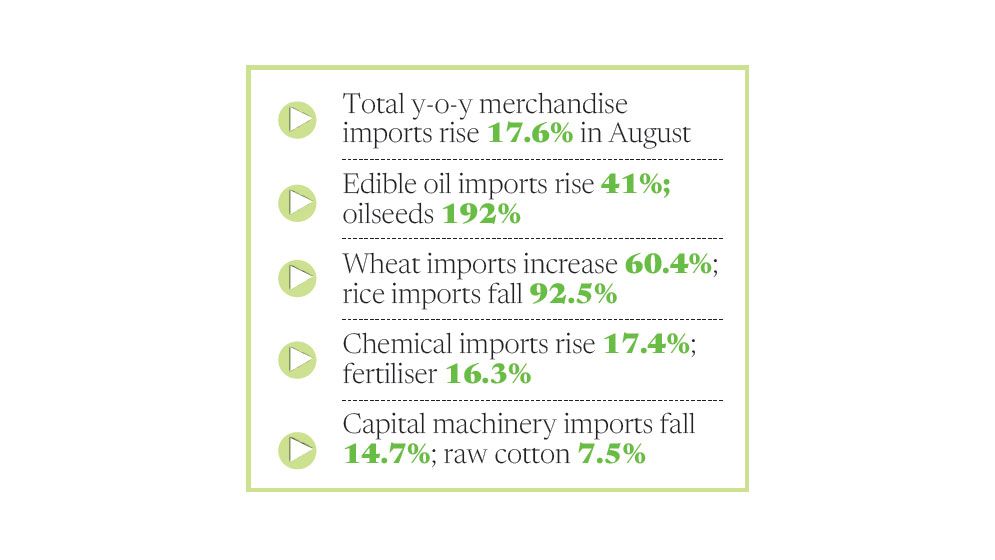
The total merchandise imports rose to Tk72,038 crore in August of the 2026-27 fiscal year, up 17.6% from Tk61,254 crore in the same month a year earlier.
The latest figures from Bangladesh Bank's Monthly Economic Trends, October 2026, show that imports of edible oil increased to Tk3,123 crore from Tk2,215 crore, while oilseed imports surged to Tk1,432 crore from Tk491 crore during the same period.
Wheat imports stood at Tk1,283 crore in August, compared with Tk800 crore a year earlier. However, rice imports remained relatively low at Tk15 crore, against Tk200 crore in August 2025.
Among other food commodities, imports of milk and cream amounted to Tk421 crore, spices Tk350 crore and pulses Tk436 crore during the month. Sugar imports stood at Tk900 crore, while imports of clinker, a key raw material for cement production, amounted to Tk446 crore.
The data also showed increased imports of industrial raw materials. Chemical imports rose to Tk3,574 crore in August from Tk3,043 crore a year earlier, while fertiliser imports increased to Tk2,064 crore from Tk1,775 crore.
Imports of plastic and rubber articles reached Tk3,365 crore, compared with Tk2,887 crore in the corresponding month of the previous fiscal year.
Meanwhile, imports of textile articles increased to Tk8,168 crore from Tk7,282 crore, while yarn imports rose to Tk3,607 crore from Tk3,400 crore.
Imports of iron, steel and other base metals stood at Tk5,411 crore, up from Tk4,741 crore a year earlier.
However, capital machinery imports declined to Tk2,122 crore in August from Tk2,487 crore in the same month last year, indicating a fall in imports of machinery used for industrial investment. Imports of raw cotton also declined to Tk2,629 crore from Tk2,842 crore during the period.
Economist and researcher Dr Jahangir Alam Khan told the Daily Sun that Bangladesh remains heavily dependent on imports for several essential commodities, including wheat, edible oil, sugar, pulses and petroleum products.
Therefore, an increase in imports of these commodities can help maintain adequate supplies in the domestic market and prevent sudden shortages and price hikes, he said.
“However, the government needs to ensure that imports are properly managed in line with domestic demand, production and existing stock levels. Excessive dependence on imports also exposes the country to fluctuations in international prices and exchange rates, putting additional pressure on foreign exchange reserves,” he said.
At the same time, the decline in capital machinery imports deserves attention, as sustained investment in industrial production is important for reducing import dependence and strengthening the domestic economy, said the economist.
According to the Bangladesh Bank report, total imports in August were slightly lower than the Tk72,469 crore recorded in July of the current fiscal year.
The figures indicate a mixed trend in the country's import structure, with higher spending on petroleum, food-related commodities and several industrial inputs, while imports of capital machinery and raw cotton declined.