


 For all latest news, follow the Daily Sun's Google News channel.


Shifting textbook history leaves learners unsure what to believe
Accounts of the Language Movement, Liberation War revised repeatedly over 3 decades as the incumbent govt is ‘taking steps towards an impartial national history’

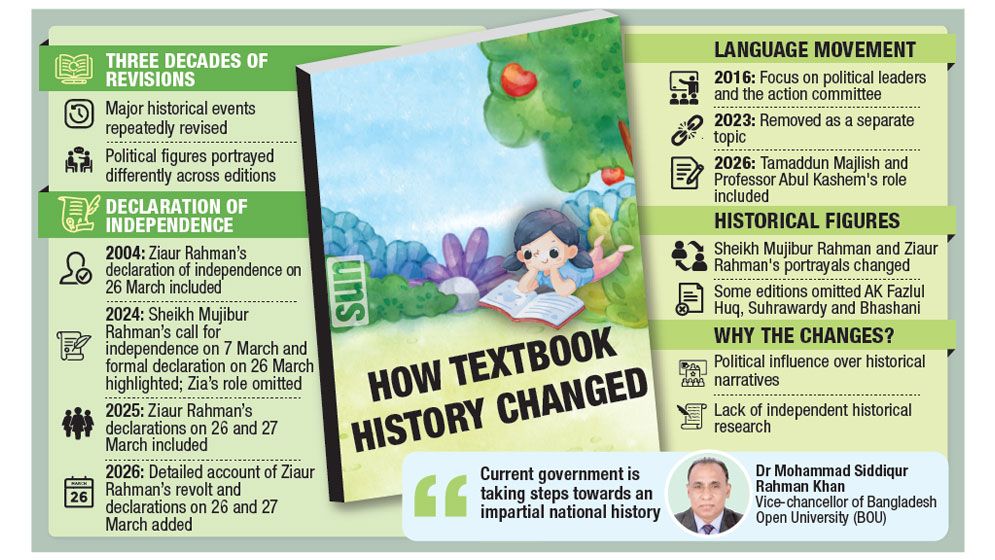
Textbook accounts of major events in Bangladesh’s history, including the declaration of independence, have been revised several times over three decades. Students are now asking which version is true, according to an analysis by Daily Sun and education experts.
The current government is taking steps towards an impartial national history, said Dr Mohammad Siddiqur Rahman Khan, vice-chancellor of Bangladesh Open University (BOU).
Daily Sun examined the history content in the class seven and class nine textbooks, “Bangladesh and Global Studies (BGS) and History of Bangladesh and World Civilisation”.
Over three decades, the books changed their titles and text several times. The events whose presentation shifted include the Language Movement, the 1954 Jukta Front's election, the Six-point Movement, the 1969 mass uprising, the declaration of independence, the 7 March speech and the Liberation War.
The portrayal of prominent political figures, including Sheikh Mujibur Rahman and Ziaur Rahman, also changed.
Language Movement
The 2016 edition of the class seven BGS textbook presented the Language Movement mainly through political leaders and the All-Party State Language Action Committee. It highlighted the organisational roles of Kazi Golam Mahbub, Shawkat Ali, Gaziul Haque, Mohammad Toaha, Abdul Matin and Sheikh Mujibur Rahman.
When the new curriculum was introduced in 2023, the book was renamed “History and Social Science” and the Language Movement was removed as a topic. In its place came a chapter titled “Emergence of Independent Bangladesh in the Bengal Region over the Course of a Millennium and Bangabandhu Sheikh Mujibur Rahman”, which focused on Sheikh Mujibur Rahman. Later editions, including the 2026 textbook, introduced the role of Tamaddun Majlish and its founder, Professor Abul Kashem, in the movement’s early history.
United Front election and Liberation War
The 2016 class seven edition treated the 1954 United Front election mainly as a political event. It covered the 21-point programme, the Muslim League’s landslide defeat and the formation of the United Front government. Later editions give more detailed accounts of the manifesto, the roles of different parties and the historical context.
Earlier editions, including 2016, described the Liberation War through the established narrative. This covered the Pakistani military’s attack on the night of 25 March 1971, the participation of people from all walks of life and the victory after nine months of war. The 2026 edition adds material on military strategy, the war’s sectors and local resistance.
Declaration of independence
The treatment of the declaration of independence has changed most visibly. Abul Hasnat, a private-sector employee, studied in class seven in 2004 that Major Ziaur Rahman declared independence from Kalurghat Radio Station on 26 March.
In 2024, teaching the class six “History and Social Science” book to his younger brother Sahriar Mahmud, he found a different text. It read, “On 7 March 1971, Bangabandhu Sheikh Mujibur Rahman, the undisputed leader of Bangladesh’s independence movement, called for independence and formally declared the country’s independence on 26 March.”
After the 2025 curriculum revision, Sahriar’s class seven BGS book stated, “On 26 March, Major Ziaur Rahman declared Bangladesh’s independence from the Kalurghat Radio Station in Chattogram. On 27 March, he made another declaration of independence on behalf of Bangabandhu Sheikh Mujibur Rahman.” The class eight description is the same.
Next year, in the class nine BGS book, Sahriar will read a further version. It says Major Ziaur Rahman, second-in-command of the 8th East Bengal Regiment, revolted in Chattogram on the night of 25 March after learning of the Pakistani forces’ genocide, declaring, “We revolt.” At 2:15am on 26 March, it says, he assembled the battalion’s Bengali officers and soldiers, declared independence and announced the start of the war. After Swadhin Bangla Betar Kendra was established at Kalurghat, the text says, he declared independence at 6:30pm on 27 March as provisional president and supreme commander of the Liberation Army. He then made a second declaration on behalf of Sheikh Mujibur Rahman as acting supreme commander.
“When I teach my brother, he asks why the same text frequently changes. Sometimes I am confused about what is true. At that point students will be most confused,” Abul Hasnat told Daily Sun.
An NCTB officer involved in revising BGS content, speaking on condition of anonymity, said the Awami League government had misled students with incorrect history. “We revised the text for the upcoming year,” the officer said, adding that it now states Major Ziaur Rahman was provisional president and supreme commander of the Liberation Army.
According to the officer, he used that title in the first declaration but not in the second. The officer said the revised text follows the account in historical books.
Earlier editions and omissions
Daily Sun’s analysis found that prominent figures including AK Fazlul Huq (Sher-e-Bangla), Huseyn Shaheed Suhrawardy, Abdul Hamid Khan Bhashani, Sheikh Mujibur Rahman and Ziaur Rahman were sometimes left out of textbook accounts.
The Social Science textbook for classes nine and ten, first published in March 1996 and revised in 2008, said Sheikh Mujibur Rahman was arrested at midnight on 25 March. It said he declared independence in the early hours of 26 March before his arrest by Pakistani troops. He conveyed the declaration by wireless to party leaders in Dhaka and associates in Chattogram, and instructed Awami League leader MA Hannan to broadcast it. The declaration was broadcast in his name from Chattogram Radio Station on 26 March. That evening, several radio workers and artists set up a temporary station at Kalurghat. On the evening of 27 March, Major Ziaur Rahman read the declaration on Sheikh Mujibur Rahman’s behalf.
The 2024 class seven “History and Social Science” textbook, published during the Awami League government, described the 25 March genocide against unarmed Bengalis. It stated that Sheikh Mujibur Rahman declared independence on 26 March. Major Ziaur Rahman’s name was absent from the account throughout the Awami League’s 17 years in power, despite his role as a sector commander in the Liberation War.
During the interim government’s tenure, references to Sheikh Mujibur Rahman and related essays were removed from textbooks. The changes were then explained as efforts to remove exaggerated or excessive narratives.
‘Lack of professional research’
Dr Mohammad Siddiqur Rahman Khan, who is also a professor of Islamic History and Culture at the University of Dhaka and the author of a book on the history of Bangladesh, said the country had yet to develop an objective and balanced national historical narrative 54 years after independence.
“One of the main reasons is that, immediately after independence, historical narratives on the Liberation War and other national issues were shaped by political decisions. Government decisions were given greater importance than research by professional historians,” he said.
“As a result, the practice of writing national history based on professional historical research did not develop adequately in post-independence Bangladesh. Instead, the history of the Liberation War was presented in textbooks according to the perspectives of the governments in power.”
He said the pattern had led to changes in narratives whenever governments changed. “Successive ruling parties have attempted to present history in line with their political ideologies and perspectives, often using historians to support their narratives. Consequently, some figures who should have been recognised as heroes have been portrayed as villains, while others have been elevated from heroes to national icons,” he said.
“This is a serious problem for a nation. Professional historians, who should have played a central role in writing history, have not been given adequate independence and opportunities. To present history objectively and free from political influence, professional historians must be allowed to conduct research and write history independently.”
Dr Mohammad Siddiqur Rahman Khan expressed confidence in the present government. “I firmly believe that the current government will take effective measures to ensure an impartial and objective account of Bangladesh’s history. As far as I know, the government has already taken necessary steps towards this goal.”