


 For all latest news, follow the Daily Sun's Google News channel.


Dollar rises as fuel import costs strain forex market
Higher import payments outpace dollar inflows despite growth in remittances and exports; forex reserves decline

Rising fuel import costs have put fresh pressure on foreign exchange market, pushing up the US dollar against the taka after a prolonged period of relative stability.
Demand for dollars has increased as import paymvents, particularly for fuel and essential commodities, have outpaced foreign currency inflows.
The British pound, Australian dollar, Canadian dollar and Chinese yuan have also strengthened against the taka over the past year, while the euro and Indian rupee have weakened slightly.
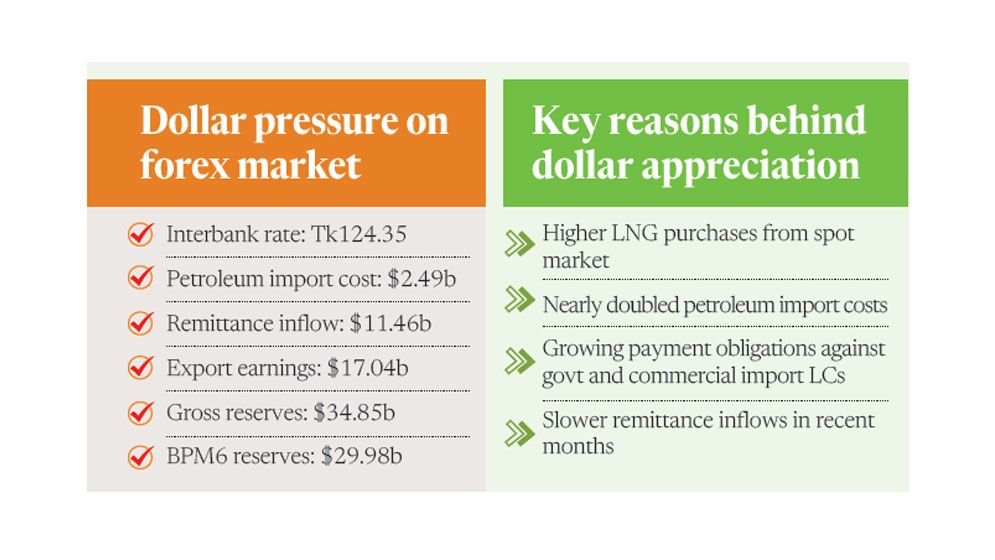
According to Bangladesh Bank data, the interbank exchange rate of the US dollar reached Tk124.35 on Thursday, up from Tk124.30 over the previous two days.
Several commercial banks also purchased remittances at rates of up to Tk124.70 per dollar during the period.
The interbank rate stood at Tk122.03 a year ago, marking an increase of Tk2.32.
Among other major currencies, the British pound rose to Tk167.52 from Tk160.35 over the past year, while the Australian dollar climbed to Tk87.13 from Tk79.79.
The Canadian dollar strengthened to Tk88.96 from Tk86.82, and the Chinese yuan increased to Tk18.63 from Tk17.12.
In contrast, the euro declined to Tk139.64 from Tk140.60, while the Indian rupee fell to Tk1.31 from Tk1.37.
Bangladesh Bank spokesperson and Executive Director Arief Hossain Khan said the country had been forced to purchase liquefied natural gas (LNG) at significantly higher prices from the spot market to address the energy shortage.
“This has increased demand for dollars, which may have pushed up the exchange rate to some extent,” he said.
Bankers attributed the pressure largely to rising fuel import bills, particularly payments by the Bangladesh Petroleum Corporation (BPC) and Petrobangla.
They said dollar inflows from exports, remittances and foreign loan disbursements had not kept pace with growing import obligations, creating an imbalance between demand and supply.
Fuel import bills nearly double
According to Bangladesh Bank data, import payments rose 12.10% year-on-year to US$12.20 billion in July-August, the first two months of the current fiscal year.
Petroleum import costs nearly doubled to $2.49 billion during the period, compared with $1.25 billion a year earlier.
Of the total, payments for petroleum, oil and lubricants (POL) reached $2.28 billion, up from $1 billion in the corresponding period of the previous fiscal year.
The sharp increase in fuel import bills has intensified demand for dollars and added pressure on foreign exchange reserves.
Bankers said the trend continued in subsequent months. Letters of credit (LCs) worth more than $8 billion were opened in September, while payments against import LCs exceeded $6.5 billion.
Officials at several commercial banks said pressure from fuel import payments could persist until 15 November.
Dollar maintains upward trend
The interbank dollar rate has risen gradually over recent months after remaining relatively stable for around one and a half years following the fall of the Awami League government.
During that period, the exchange rate largely fluctuated between Tk121 and Tk122.30.
The dollar began strengthening in early March, reaching Tk122.75 on 12 March, where it remained until 25 June.
On 28 June, the rate increased by 10 paisa to Tk122.85 before climbing to Tk123.82 by the end of July.
It subsequently eased to Tk123 at the end of August but rose again to Tk123.15 by the end of September.
The upward trend accelerated in October, with the rate reaching Tk123.99 on the month’s final working day before climbing to Tk124.35 on Wednesday.
Remittances grow, but dollar supply remains tight
Despite the pressure, Bangladesh recorded growth in both remittances and export earnings during the first four months of the current fiscal year.
According to central bank data, expatriate Bangladeshis sent home $11.46 billion in July-October, up 13% from the corresponding period last year.
Export earnings also increased by 6% to $17.04 billion.
However, bankers said remittance inflows had slowed in recent months, while export earnings remained below expectations.
Syed Mahbubur Rahman, managing director of Mutual Trust Bank, said the slowdown in remittances, coupled with growing import obligations, had increased pressure on the dollar market.
“Besides, there is additional pressure from payments against government LCs. Lower remittance inflows and higher payment obligations are pushing up the dollar price,” he said.
The dollar’s appreciation has also coincided with a decline in foreign exchange reserves.
Gross reserves fell to $34.85 billion from $37.41 billion on 1 September, according to Bangladesh Bank.
Under the International Monetary Fund’s Balance of Payments and International Investment Position Manual, Sixth Edition (BPM6) methodology, reserves declined to $29.98 billion from $32.50 billion during the same period.
Gross reserves had crossed $37 billion on 29 June for the first time since September 2022. The country’s reserves previously reached a record of more than $48 billion in August 2021.
Central bank intervention fails to ease pressure
Bangladesh Bank has moved to sell dollars from its reserves to contain exchange rate volatility, but its interventions have so far had limited impact.
According to BB, The Central Bank Wednesday sold another $100 million from its foreign exchange reserves through an auction.
Last week, Bangladesh Bank sold $122 million against demand of around $800 million from commercial banks.
The intervention met only a fraction of the market’s demand, leaving a substantial supply gap.
Bankers said continued pressure from fuel import payments and relatively slower dollar inflows could keep the foreign exchange market volatile despite the central bank’s efforts.