


 For all latest news, follow the Daily Sun's Google News channel.


Locally made aluminium pots can leach lead into food: Study
Daily Sun Report, Dhaka
Published: 06 Nov 2026, 12:00 AM
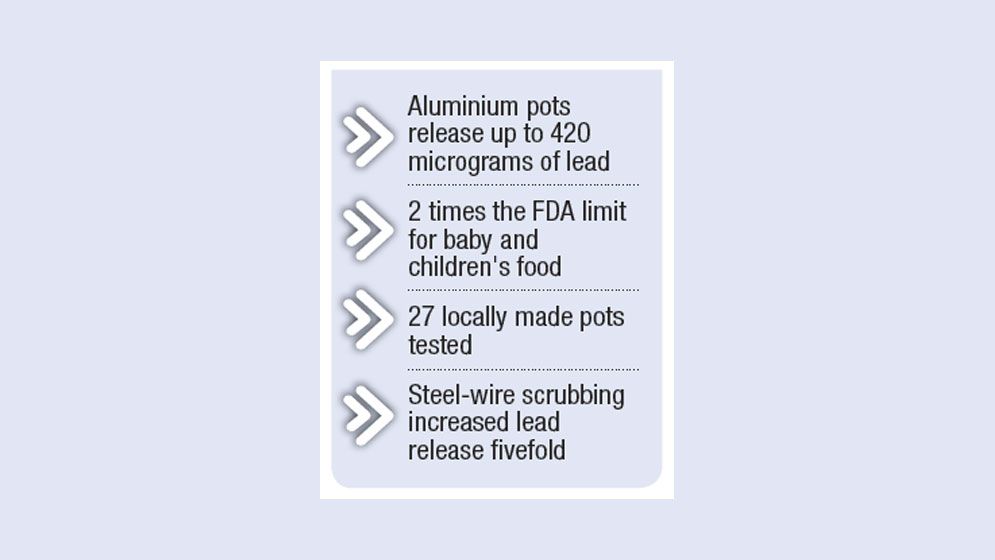
Cooking food in locally made aluminium pots in Bangladesh can release up to 420 micrograms of lead, a toxic metal, per kilogram of food during their first use, potentially threatening children's brain development, a study by icddr,b and Stanford University has found.
The level is 42 times the US Food and Drug Administration's (FDA) 10-microgram limit for food intended for babies and young children. The researchers called for safer cookware and clearer guidance for households.
Published in the “Journal of Exposure Science & Environmental Epidemiology", the study tested lead levels in seven used and 20 new pots before cooking rice and khichuri in them and measuring lead in the food and cooking liquids.
During the first use of new pots, rice contained up to 305 micrograms of lead per kilogram, while khichuri contained up to 420 micrograms. Lead levels reduced over repeated cooking but were still detectable on the third time. Rice cooked in six of the seven used pots also contained lead.
“We measured lead in both the pots and the food cooked in them to see how an everyday cooking pot becomes a source of exposure,” said Dr Jenna Forsyth, director of Project Unleaded at Stanford University’s Human and Planetary Health programme.
Scrubbing new pots with steel-wire sponges released about five times more lead than leaving them unscrubbed, while using metal spatulas also increased release, the study finds.
Based on typical rice consumption among rural Bangladeshi children, the researchers estimated that a child could ingest over five times the FDA’s limit.
Researchers claim that many pots in Bangladesh are made by melting scrap metal without checking its quality, potentially allowing lead to enter finished products.
Dr Jesmin Sultana, assistant scientist in Environmental Health and WASH at icddr,b, advised households to choose cookware with credible food-safety evidence as well as avoid steel-wire scrubbers and acidic dishes, although these precautions cannot reliably make contaminated cookware safe.
“Lead can't be seen, smelled or tasted, so a pot that looks perfectly good can still be adding it to a family's food,” Dr Jenna said.
The researchers also noted that lead exposure in Bangladesh has several sources, including contaminated turmeric.
They urged the Bangladesh Food Safety Authority (BFSA) and Bangladesh Standards and Testing Institution (BSTI) to establish and enforce measures, including screening scrap metal, testing finished pots and helping small manufacturers access safer materials and testing facilities.
“Affordable cookware should also be safe cookware. Better manufacturing and effective oversight can help families prepare daily meals without this avoidable risk,” said Dr Md Mahbubur Rahman of icddr,b’s Environmental Health and WASH programme.
The researchers acknowledged that the study was small and laboratory-based. The estimated lead intake among children was based on a model rather than direct measurements, requiring further research into other cookware and everyday cooking practices.
The study was supported by the Stanford University King Center on Global Development.
Read More