



 For all latest news, follow the Daily Sun's Google News channel.


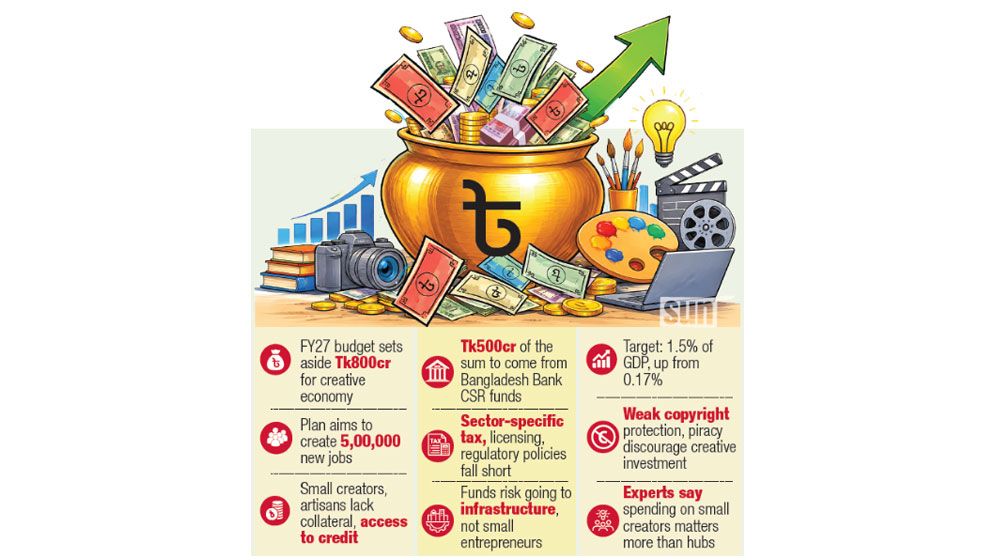
The government aims to lift the creative economy’s GDP share from 0.17% to 1.5% and create 500,000 jobs, but economists say gaps in policy, financing and copyright enforcement stand in the way.
The national budget for the ongoing 2026-27 fiscal year (FY27) earmarks an initial Tk800 crore for the sector. Tk300 crore is a direct budget allocation, while Tk500 crore is expected to be mobilised from Bangladesh Bank’s corporate social responsibility (CSR) funds.
The money is meant for creative hubs, skills development, innovation, export-oriented projects and the promotion of Bangladeshi creative products abroad.
A feasibility study is under way for a central creative hub on 160 acres in Purbachal.
The government also plans to market films, music, design, digital content and traditional products internationally under the “Created in Bangladesh” brand.
Where the sector stands
A report based on Bangladesh Bureau of Statistics (BBS) Economic Census data shows the creative or “orange” economy, covering arts, entertainment and related activities, generated Tk9,193 crore in FY25, about 0.17% of GDP. The figure was 15.4% higher than in the previous fiscal year.
Employment in the relevant segment stood at 1,12,829 in 2024, up 237% from 33,441 in 2013. These figures are based on specific industry classifications and may not fully match the government’s broader definition of the sector.
Reaching 1.5% would require the sector’s share of the economy to grow nearly 8.8 times.
Economists say this would mean integrating software, gaming, digital content, design, publishing, cultural tourism and other creative services into production, business and export activities, in addition to film, music and handicrafts.
Dr Zahid Hussain, former lead economist at the World Bank’s Dhaka Office, told Daily Sun, “The transition towards a creative economy was timely and necessary, but strong policy support and institutional reforms were essential for successful implementation.”
He said Bangladesh needed to broaden its exports beyond readymade garments and remittances, with greater investment in skills, innovation and creative industries to generate jobs and attract investment.
Global demand
The UN Conference on Trade and Development’s Creative Economy Outlook 2024 puts global exports of creative services at $1.4 trillion in 2022 and creative goods at $713 billion.
Compared with 2017, exports of services rose 29% and goods 19%. Software, research and development, advertising, architecture and audiovisual services are among the main components of services exports.
Young people’s skills in freelancing, software development, animation, graphic design and video production could generate foreign exchange.
Handloom goods, shital pati mats, satranji rugs, pottery, bamboo and cane products, and handmade jewellery could also fetch higher prices in international markets.
Stakeholders say tapping this demand requires international quality standards, consistent supply, effective marketing, digital payment facilities and stronger enforcement of copyright and contractual rights.
How the money is spent
Economists and industry stakeholders say the plan’s results will depend on how the funds are used rather than on the size of the allocation.
If spending is concentrated on infrastructure and does not reach small entrepreneurs, artists, designers, content creators and rural artisans, the employment and export targets may be difficult to meet.
Mustafizur Rahman, distinguished fellow at the Centre for Policy Dialogue (CPD), said, “Content creators and freelancers have the potential to establish new businesses. With appropriate support, the creative sector could become an important source of self-employment and entrepreneurship. Ensuring the effective use of allocated funds, however, remains essential.”
Mostafa K Mujeri, executive director of the Institute for Inclusive Finance and Development (InM), told Daily Sun, “creating 5,00,000 jobs is an ambitious target, but implementation will be the key challenge. Rural artisans, designers, filmmakers and digital content creators need access to finance, training, technology, intellectual property protection, e-commerce and market linkages. Without these facilities, creative hubs risk remaining infrastructure projects rather than becoming effective centres for business development.”
Tax, copyright and finance
Stakeholders say film, over-the-top (OTT) platforms, publishing, music and digital content operate differently from traditional industries, yet taxation, licensing, regulatory and investment policies do not always reflect those differences. They say reforms in taxation, licensing and modern infrastructure are needed for the film and OTT sectors.
Weak intellectual property protection is a further concern. When songs, films, books, designs or digital content are used or reproduced without permission, creators and businesses lose royalties, which discourages investment in new work. Stakeholders call for stricter enforcement of copyright law, stronger action against piracy and better royalty collection mechanisms.
Access to finance is another constraint. Many small entrepreneurs, freelancers and rural artisans lack collateral, formal business documents or experience of bank borrowing. Creative businesses rely more on ideas, designs, software and other intellectual assets than on physical ones, which does not fit conventional lending practices.
Stakeholders say the government should introduce easier financing terms, project-based grants, startup support and business advisory services.