


 For all latest news, follow the Daily Sun's Google News channel.


RMG wage deal agreed at maiden board meeting; clashes continue
Daily Sun Report, Dhaka
Published: 05 Nov 2026, 12:00 AM
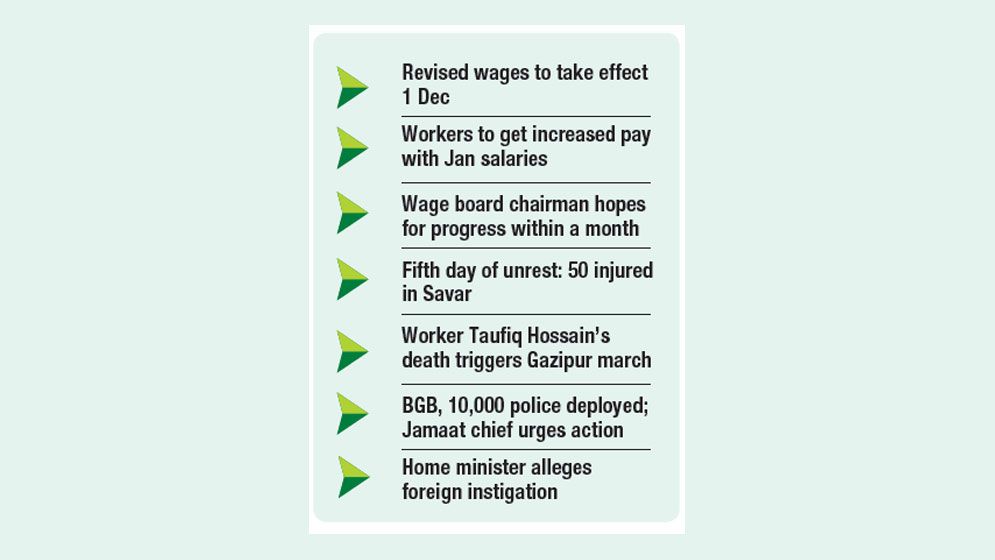
Representatives of garment factory owners and workers agreed on Wednesday that revised minimum wages will take effect from 1 December and be paid with January salaries, as clashes between workers and law enforcers continued in Savar, Gazipur and Narayanganj on the fifth consecutive day of unrest.
The understanding came at the first meeting of the eighth minimum wage board for the readymade garment (RMG) sector, held at the board’s office in Segunbagicha, Dhaka, with chairman Syed Azad Subhani, a district and sessions judge, in the chair.
Workers will receive the increased amount within the first seven working days of January.
Wage board
The government formed the board on 1 November and convened its first meeting three days later.
The meeting discussed the legal procedures and methods for determining minimum wages, and worker and employer representatives shared their views and experiences.
Speaking to journalists afterwards, Subhani expressed optimism that the board would make significant progress towards preparing its recommendations within a month.
“We hope to make significant progress towards preparing the wage recommendations at our next meeting. We may also seek written proposals and recommendations from both sides,” he said.
Asked how many meetings might be needed, compared with seven in the previous wage-setting process, he said such exercises generally have a six-month timeframe.
He hoped this one would take less time, given the government’s prompt formation of the board and its early start.
Asked whether the wages would be announced by December, he gave no specific deadline but expressed optimism about a positive outcome soon. The next meeting could be held next week, he said, giving both sides time to consult their organisations and experts before submitting proposals.
He cautioned that rushing the process might not produce the desired outcome.
The board will prepare its recommendations after considering both sides’ proposals and submit them to the government.
Addressing workers who have been demonstrating, the chairman urged them to have confidence in the board, saying its work plan and procedures were in their interests. He also called on them to continue working, citing their contribution to the economy.
Worker representative Babul Akhtar said both sides had reached the understanding on the effective date and payment, and that worker representatives wanted the process completed within December. An employers’ representative also agreed to completing the process within December and ensuring workers receive the increased amount with their January salaries.
Babul Akhtar said both sides had discussed the workers’ demands in a cordial atmosphere and thanked the chairman for convening the meeting quickly.
He urged workers to remain calm and avoid being influenced by any third party or political interest, saying the interests of workers and employers were linked to the survival of the garment industry.
He also asked the government to address other longstanding grievances, including the implementation of labour laws, trade union rights, leave facilities and alleged harassment of workers and labour leaders.
Different labour organisations had proposed varying wage demands, he said, and the federations would sit together to formulate a common proposal for the board. He also urged the board’s independent member to prepare an independent proposal.
Clashes
The Border Guard Bangladesh (BGB) deployed 24 platoons in RMG-based areas of Dhaka, Gazipur and Narayanganj, while more than 10,000 police were deployed in Dhaka’s greater Mirpur area. Workers were not seen demonstrating in Mirpur on Wednesday.
In Savar, workers from various factories blockaded the Dhaka-Aricha highway at Hemayetpur in the morning, halting traffic in both directions.
Locals said a clash began at about 10am, with workers and police chasing one another.
Police fired tear gas and sound grenades, and BGB personnel later arrived to assist. Workers hurled brick chips and set fire to a police vehicle used by the Savar OC.
At least 50 people were injured, according to police and locals. Seven police officers were hurt, among them Saiful Alam, officer-in-charge of Savar Model police station, said Mosharraf Hossain, inspector (investigation) at the station. Traffic resumed at about 11:30am. Eleven factories in the Hemayetpur and Poddar Mor areas declared a general holiday to avoid further confrontation, police said.
On Tuesday afternoon, workers had lifted a blockade of nearly two hours after the administration gave assurances. No serious incidents were reported in nearby Ashulia, where BGB and additional police remained deployed. Police said workers from one or two factories tried to come out but were contained.
In Narayanganj, repeated clashes took place in the Katherpul area. Workers from Microfiber, Liberty and nearby factories gathered on the road in the morning to demand a Tk30,000 wage.
Police said workers threw stones at neighbouring factories to force employees there to join them, and lit fires at several points along the Hajiganj-Post Office road.
When the group tried to march towards Shibu Market on the Dhaka-Narayanganj Link Road, industrial police and local police blocked their path. Chases and counter-chases followed, and police fired tear gas and sound grenades.
Order was restored by 12:30pm, and security forces remained at the scene, said Abdullah Al Mahmud, superintendent of police of the Narayanganj Industrial Police unit.
Six people have been detained so far, said Tarek Al Mehdi, an additional superintendent of police. Over the previous two days, workers had also blockaded the Shibu Market and Jalkuri areas of the link road.
Gazipur death
In Gazipur, police fired tear gas and sound grenades at workers who marched over the death of a colleague, Taufiq Hossain. Taufiq, a worker at Laila Styles Limited, was attacked on Monday while filming a clash on his mobile phone, according to police and his family.
He was beaten with sticks and bricks and died in hospital from head injuries on Tuesday night.
Workers from his factory began a procession on Wednesday morning, joined by colleagues from nearby plants. Tension rose when they encountered a group of outsiders, and police then fired tear gas.
“Outsiders obstructed our rally, detained several of our workers, and assaulted them,” said Monowar Hossain, a Laila Styles worker. Another worker, Monira, said the tear gas made the situation worse. The demonstrators said several workers were injured by the outside group.
Taufiq was buried in his home village in Gaibandha. A local official said he was the sole breadwinner for his family and leaves a pregnant wife and a son aged one and a half. His brother, Harun Mia, called for those responsible to be brought to justice.
Mirpur
Joint Commissioner of the Dhaka Metropolitan Police Mohidul Islam said strict legal action was being taken against those blocking roads and damaging property, and that workers at many factories had returned to work. He said many people had been arrested but gave no figure.
Those found to have no involvement, including workers and pedestrians, were being released, he said.
Home minister’s allegation
Home Minister Salahuddin Ahmed alleged on Wednesday that some individuals were trying to destabilise the country in the name of a workers’ movement, claiming they were being instigated by a neighbouring country.
“This is not a movement of workers,” he told reporters at the Secretariat. He urged workers to return to work, saying the wage board had already begun determining a new pay structure.
Jamaat chief’s call
Opposition Leader and Bangladesh Jamaat-e-Islami Ameer Dr Shafiqur Rahman urged the government in a video message on Wednesday to address the workers’ wage demands before further damage and unrest spread.
Warning that a delayed decision would deepen industry losses, he said, “Industries will survive if workers survive.”
He said low-paid workers were finding it harder to make ends meet amid rising commodity prices, and that the wage structure should have been revised promptly through discussions with workers and employers.
He called on workers to protect their workplaces, saying he stood by their legitimate rights, and asked factory owners to treat workers as members of their own families.
Shafiqur Rahman also condemned the death of Taufiq Hossain and demanded a fair investigation.
Describing the garment sector as the country’s main export industry, he said any major disruption would hurt the overall economy, and urged the government and others concerned to remain vigilant so that opportunists could not exploit the situation.