



 For all latest news, follow the Daily Sun's Google News channel.


The incumbent BNP-led government is moving towards introducing major amendments to the current constitution and intends to initiate this process by tabling the proposed “18th Constitutional Amendment Bill” in the first parliamentary session of 2027.
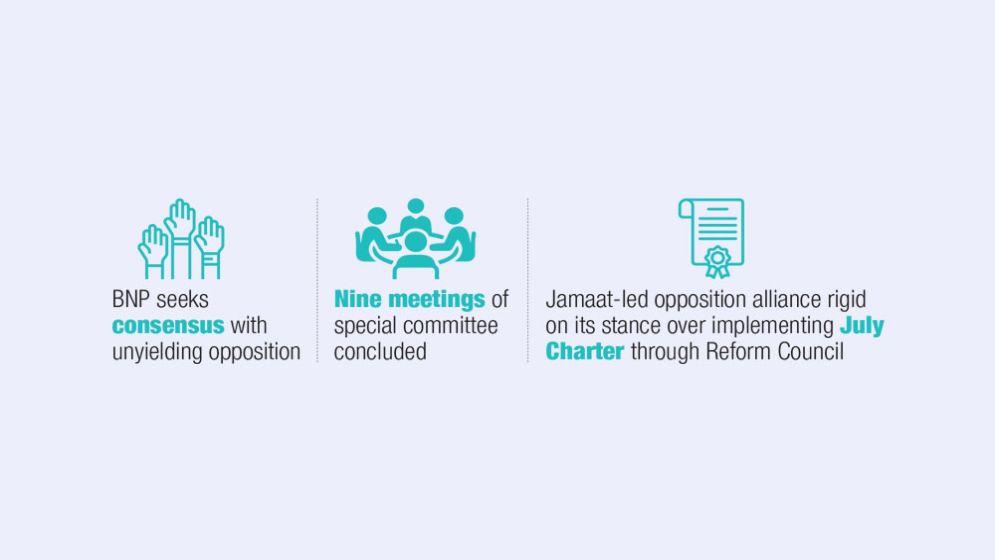
Its efforts to secure political consensus are facing a hurdle as the main opposition Bangladesh Jamaat-e-Islami and the 11-party alliance led by it remain rigid in their stance over implementing the July National Charter 2025 through a Constitutional Reform Council.
However, BNP wants to bring major amendments to the constitution through a political compromise with the unyielding opposition.
“We want to adopt constitutional amendments through consensus, with the participation of both the ruling and opposition parties. We would proceed with the amendments to implement the July Charter,” said Home Minister Salahuddin Ahmed, who is also chairman of the Special Committee on Constitutional Amendment of the 13th Jatiya Sangsad, recently.
The 12-member parliamentary special committee has so far held nine meetings to examine constitutional reform proposals, consult stakeholders and work towards preparing recommendations for amendments to the Constitution. Its first meeting was held on 4 August and the latest meeting took place on 28 October. The committee will hold several other meetings.
The committee wants to complete its deliberations and submit a report by the end of December. The parliamentary committee is now also working to develop a political formula acceptable to the opposition, which has rejected the government’s parliamentary approach to implementing the reform agenda.
Ahsanul Mahboob Zubair, an assistant secretary general of Bangladesh Jamaat-e-Islami, said that his party does not want to participate in this game of amending the Constitution according to the government’s wishes by disregarding the decision of the “July referendum”. The ongoing parliamentary process could not replace the constitutional reform process endorsed by voters, he added.
The government wants to advance the reform process through Parliament. It is also keen to avoid a confrontation over constitutional reform that could deepen the political divide between the treasury and opposition benches, said political analysts.
Unity in focus
In its meetings, the special committee held discussions with political parties, editors, journalists, academics, university vice-chancellors, representatives of ethnic minorities, working-class people, victims of the 2024 mass uprising, their families, constitutional experts and senior lawyers.
At its inaugural meeting, the committee decided to review the Constitution in line with the July Charter. The committee also expressed its willingness to accommodate opposition representatives, although the opposition had not nominated members to the committee.
The committee, however, held meetings with several other political parties that had signed the July Charter. The absence of Jamaat-e-Islami, the National Citizen Party (NCP) and some other opposition alliance partners cleared some of the political difficulties surrounding the process.
Editors of newspapers, senior journalists and representatives of journalists' organisations joined the third meeting and emphasised the importance of national consensus and urged the government to bring the opposition into the process.
Discussions covered the balance of power between the President and the Prime Minister, the caretaker government system, neutrality in government appointments and the need for a referendum on fundamental constitutional changes.
The proposed upper house of Parliament and a 10-year limit on a prime minister’s tenure were also discussed in the meetings. Other discussions focused on judicial review, judicial independence, the appointment of judges and statutory bodies.
However, no final decision had been reached on how a caretaker government would be formed and other issues. The committee will decide on these issues following further discussions.
Salahuddin Ahmed said the committee wants to submit its report by December, paving the way for the introduction of an amendment bill in January 2027. He also indicated that certain fundamental changes, including amendments to the Preamble and relevant constitutional provisions, would require a referendum before presidential assent.
Despite nine meetings and consultations with a wide range of stakeholders, the special parliamentary committee has failed to secure the participation of the opposition alliance.
The Jamaat-e-Islami-led 11-party alliance argues that the government cannot bypass the implementation mechanism envisaged in the July Charter. According to the charter, a Constitution Reform Council is supposed to be formed through the elected parliament. Opposition lawmakers took both parliamentary and reform-council oaths.
The disagreement has therefore created a political dilemma. Against this backdrop, Home Minister Salahuddin Ahmed, after the seventh meeting on 13 October, said that the government would proceed with constitutional amendments even without the opposition’s participation.
The reporter can be reached at: [email protected].