


 For all latest news, follow the Daily Sun's Google News channel.


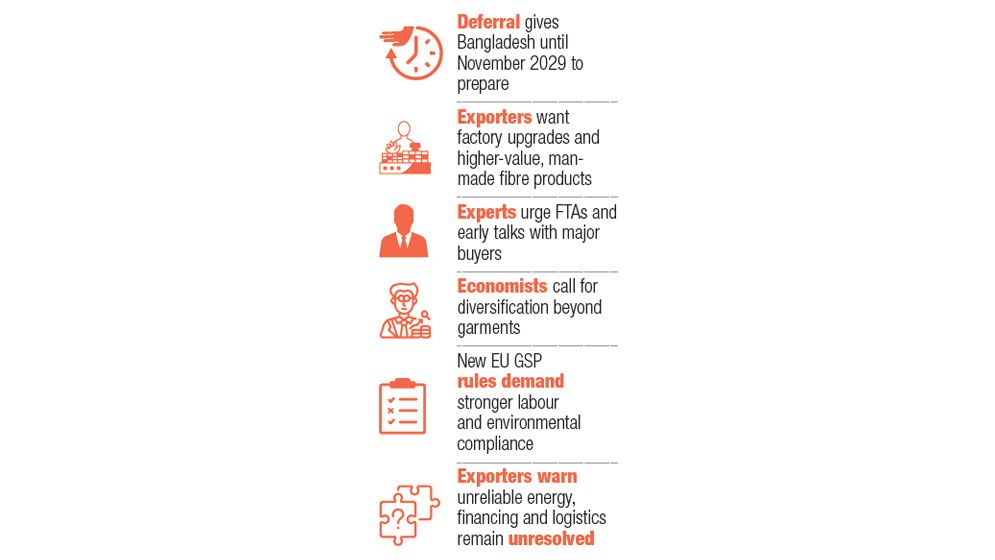
The three-year deferral of Bangladesh’s graduation from the Least Developed Country (LDC) category gives the country time to address energy, logistics and financing constraints and to negotiate trade deals before it loses duty-free access, say exporters and economists. They stress that the time will count only if reforms begin now.
The United Nations General Assembly in early hours on Friday (Bangladesh time) moved the graduation date from 24 November 2026 to 24 November 2029. Nepal received the same extension.
Prime Minister's Adviser Mahdi Amin said the extra time would allow the government to prepare the economy, industries, export-import sector, businesses and employment for the transition.
"The significance of this decision lies in continuing inclusive development, so that LDC graduation cannot create unexpected pressure on the country's economy and peoples' livelihoods," he said.
In a social media post, he said the outcome reflected Prime Minister Tarique Rahman's "effective leadership" in building global support for policies to protect Bangladesh's interests.
What is at stake
According to government estimates, Bangladeshi exporters have duty-free access to 38 countries and trade blocs under LDC-specific arrangements, and about 73% of total exports benefit from such preferences.
The government estimates that graduation could expose exports to an average tariff of around 12.5%, though the impact would vary by product and destination.
Bangladesh exported goods worth $48 billion in FY26, of which readymade garments (RMG) accounted for about 81%.
Time to modernise industry
Shovon Islam, managing director and owner of Sparrow Group and a former director of the Bangladesh Garment Manufacturers and Exporters Association (BGMEA), told Daily Sun the extension offered "valuable breathing space to protect employment, strengthen competitiveness and prepare for a sustainable transition".
He said manufacturers could use the period to modernise factories, raise productivity and diversify into man-made fibres and higher-value apparel. The extension would also give investors and international buyers greater certainty for sourcing decisions, he added.
BGMEA President Mahmud Hasan Khan said the industry had long sought more preparation time. He said the country must use it to improve infrastructure and logistics.
Mohiuddin Rubel, another former BGMEA director, called for stronger backward linkages, better infrastructure and a more varied export basket. He described the extension as a "lifeline" and said Bangladesh might not get another such opportunity.
Room to negotiate market access
Several of those interviewed said the period should be used to secure market access through negotiations.
Mahmud Hasan Khan said the country should pursue free trade agreements (FTAs) with major trading partners where necessary. Rubel said competitor countries were already seeking bilateral arrangements to protect their market access, and Bangladesh should do the same.
Fahmida Khatun, distinguished fellow at the Centre for Policy Dialogue (CPD), said Bangladesh should engage early with major export destinations to prepare for possible changes in tariffs and trade preferences after graduation.
Rubel noted that graduation would not automatically end all duty-free access, as trading partners have different preferential arrangements.
Mustafa Abid Khan, chief executive of the Bangladesh Foreign Trade Institute (BFTI), said the additional time would help the country prepare for changes in trade rules, particularly on intellectual property. Certain LDC-specific flexibilities under World Trade Organization rules will lapse after graduation, requiring stronger intellectual property protection and enforcement capacity, he said. Trade negotiations would be central to retaining preferential access to major destinations, he added.
Diversification and the EU framework
Fahmida said the extension would not by itself resolve structural weaknesses. "Effective reforms are needed in trade, revenue collection, banking and infrastructure," she said. She urged greater investment in pharmaceuticals, agro-processing, leather, light engineering, jute products and information technology to reduce dependence on garments.
The European Union, Bangladesh's largest export destination, offers a three-year transition under its Generalised Scheme of Preferences (GSP) after LDC graduation. Bangladesh will also need to meet the conditions for retaining preferential access, including possible qualification for GSP+.
The new EU GSP framework, due to apply from January 2027, places greater emphasis on implementing international conventions on labour rights, human rights, environmental protection and governance. Improvements in labour standards, environmental compliance and institutional governance will therefore bear directly on Bangladesh's position in the European market.
Warnings against delay
Exporters cautioned that the deferral does not remove existing constraints.
"The deadline has changed, but our weaknesses remain: unreliable energy, high financing costs, slow logistics and insufficient productivity," Shovon said.
He noted that buyers' expectations on labour rights, sustainability and supply-chain traceability would keep rising, and that competitor countries would keep strengthening their positions.
"Our biggest risk is complacency," he said.
He urged that the extension be treated as a firm reform deadline, with priority for reliable energy, competitive raw-material sourcing, faster customs clearance and port operations, technological upgrading and workers' skills.
Rubel said the focus should be on action. "Rather than becoming overly excited about the postponement, we must immediately start working on the necessary reforms and preparations," he said.
Background
Bangladesh first met all three LDC graduation criteria in March 2018 and retained its eligibility in the 2021 triennial review. In the 2024 review, its gross national income per capita was $2,684, against a threshold of $1,306. Its Human Assets Index score was 77.5 against a required 66, and its Economic and Environmental Vulnerability Index score was 21.9 against a ceiling of 32.
Bangladesh applied to the UN Committee for Development Policy on 18 February 2026 under its crisis-response mechanism. The committee recommended favourable consideration, and the Economic and Social Council recommended on 21 July that the General Assembly decide the matter. The country had earlier received a two-year extension of its preparatory period because of the COVID-19 pandemic.