


 For all latest news, follow the Daily Sun's Google News channel.


THAKURGAON-1 BY-ELECTION
BNP’s landslide win raises questions over Jamaat’s political appeal
Daily Sun Report, Dhaka
Published: 31 Oct 2026, 12:00 AM
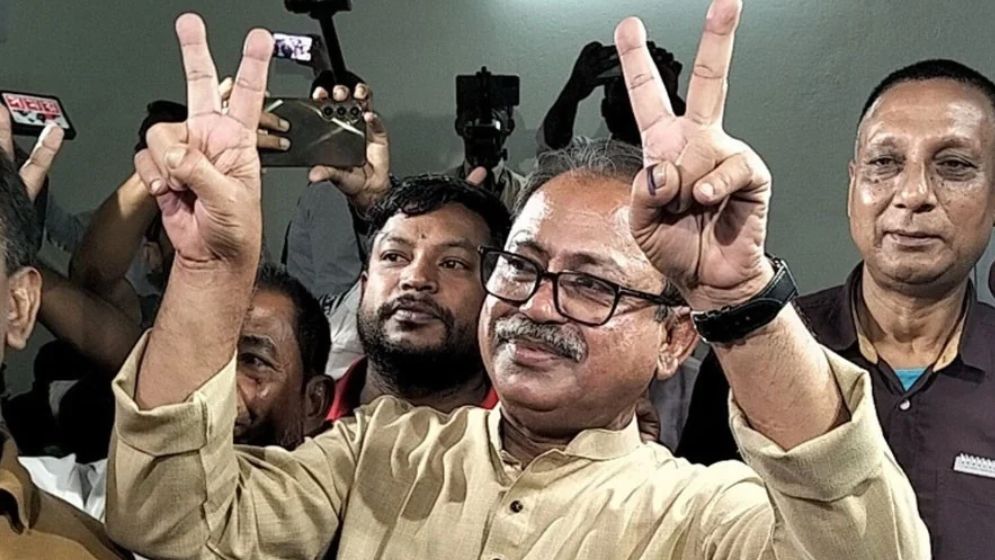
The Bangladesh Nationalist Party (BNP) has secured a landslide victory in the Thakurgaon-1 by-election, defeating Jamaat-e-Islami by a wide margin in a constituency where the two parties have showed enough potential to strengthen footprints.
BNP-nominated candidate Mirza Faisal Amin, contesting with the sheaf of paddy symbol, received 227,917 votes, while his nearest rival, Jamaat-e-Islami candidate Delwar Hossain, secured 96,513 votes.
The by-election, held on 29 October, was contested by five candidates. It followed the vacancy of the constituency after its elected MP, Mirza Fakhrul Islam Alamgir, assumed the office of president.
The result has drawn attention to the BNP's organisational strength, the popularity of its local leadership and the political standing of Jamaat-e-Islami, which had been expected to perform strongly amid the usual anti-incumbency sentiment against a ruling party.
Political assessments suggest that the BNP's victory may reflect a combination of local organisational strength, candidate acceptability, voter expectations and the government's development priorities under Prime Minister Tarique Rahman.
Several development initiatives in Thakurgaon have featured prominently in the political narrative surrounding the election. These include the laying of the foundation stone of Thakurgaon University on 7 September, plans to establish a medical college, upgrading the 250-bed general hospital to 500 beds and reopening the long-closed Thakurgaon Airport.
The government has also taken initiatives to expand administrative services in the region. At its 120th meeting on 7 May, the National Implementation Committee for Administrative Reorganisation (NICAR) approved the elevation of Ruhia and Vulli into separate upazilas.
Other initiatives include allocating Tk1.14 crore for re-excavating 5.8 kilometres of the Neha River and providing an additional 2,000 tonnes of TSP and 1,000 tonnes of MOP fertiliser to farmers.
The government has also extended nearly Tk20 crore in assistance to 294 religious and social institutions, including 195 mosques and 89 temples, alongside financial support for disaster-affected families and people with disabilities.
The election result has also raised questions about Jamaat-e-Islami's political strategy, leadership and grassroots acceptance. Its candidate's defeat in all nine polling centres in his home area of Begunbari Union has been cited as an indication of limitations in his local electoral appeal.
The outcome suggests that ideological identity and traditional political support alone may not guarantee electoral success, while leadership credibility, public engagement and practical welfare-oriented programmes remain important factors in winning voters' confidence.
The Election Commission conducted the election under its constitutional authority. The document describes the process as an important test of institutional neutrality, restoration of voting rights and public confidence in the electoral system under the current government.
For the BNP, the victory offers a positive political signal, but it also raises expectations for the government to translate its commitments on good governance, economic recovery, social protection and public welfare into tangible results.
For Jamaat-e-Islami, the defeat presents an opportunity to reassess its political approach, leadership and engagement with voters beyond its traditional support base.
Ultimately, the by-election has underscored that electoral support is not a permanent asset for any political party but must be sustained through responsible leadership, public accountability and consistent engagement with people's concerns.