


 For all latest news, follow the Daily Sun's Google News channel.


Country’s first modern sewerage treatment project progresses 78%
Installing underground pipelines along busy, narrow roads emerges as key challenge

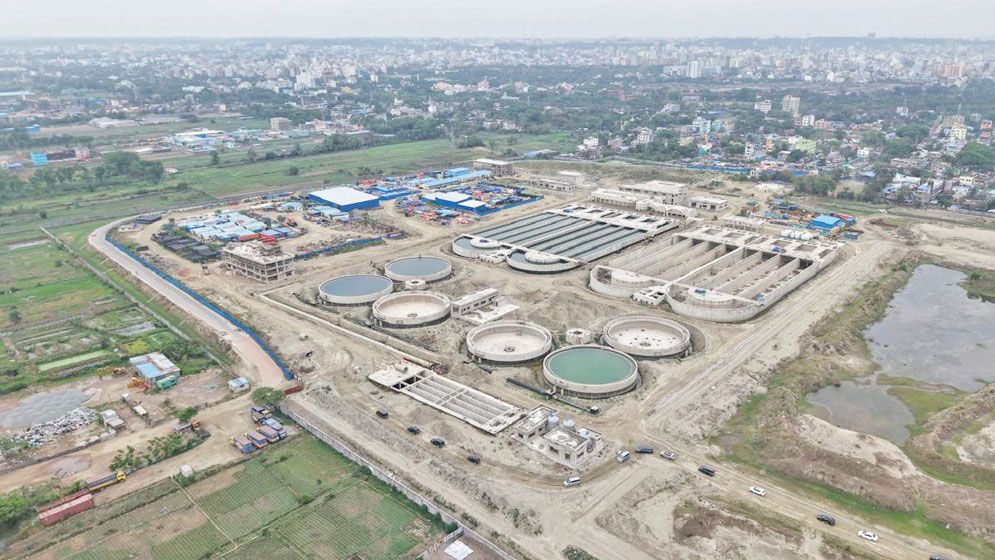
Overcoming challenges, work on setting up the country’s first modern, full-fledged sewerage treatment plant in Chattogram city has achieved 78% physical progress, with Chattogram WASA expecting to begin partial operations by June next year. - RABIN CHOWDHURY
The country’s first modern, full-fledged sewerage treatment project in Chattogram city has achieved 78% physical progress in eight years.
Despite earlier criticism over slow progress and current challenges, Chattogram Water Supply and Sewerage Authority (Chattogram WASA) expects to launch partial operations by June next year.
Untreated liquid waste is a major source of pollution in the city and the economically vital Karnaphuli and Halda rivers. Without a sewerage management system, wastewater from septic tanks in over 90% of city buildings and houses flows into the rivers through drains and canals daily.
Chattogram WASA launched the “Project for Establishment of Sewerage System in Chattogram Metropolitan (1st Phase)” in 2018. The Executive Committee of the National Economic Council (ECNEC) approved it for around Tk3,808 crore on 7 November that year, with Tk3,758 crore to come from the government and Tk50 crore from WASA. The cost was revised to Tk5,219 crore in April last year.
The project aims to develop sanitation facilities, provide sewerage services to 20 lakh people, reduce reliance on soak wells and treat fecal sludge generated in Chattogram and its suburbs.
It includes a sewage treatment plant with a daily capacity of 10 crore litres, a fecal sludge treatment plant with a daily capacity of 300 cubic metres and 200 kilometres of sewerage pipelines. A total of 28,000 households in 21 wards of Chattogram City Corporation (CCC) are to be connected.
Project Director Engineer Mohammed Ariful Islam said that by September this year, physical progress had reached 78% and financial progress 68.45%. Of the targeted 28,000 household connections, 11,412 had been completed, and 170.55 kilometres of pipelines installed. Construction of the two treatment plants was 83% complete, with partial operation expected by June next year.
Work in full swing overcoming challenges
The project deadline is June 2028, but installing underground pipelines along major, busy and narrow roads remains a key challenge, Ariful said. WASA has discussed the issue with CCC, as 20 kilometres of newly constructed roads cannot be dug up immediately. All other work is progressing at full pace to meet the deadline, he added.
Chattogram WASA’s 2017 Sanitation Master Plan found that 86% of city establishments used hygienic latrines, but 64% discharged untreated toilet wastewater directly into drains, bypassing septic tanks.
Black water (toilet water), grey water (kitchen and bathroom wastewater) and rainwater flow through drains and canals into the Karnaphuli and Halda rivers daily. Toxic, foul-smelling liquid and solid waste continue to pollute the city and severely contaminate the rivers.
WASA sources said the city discharged 288 million litres of wastewater daily in 2017, a volume projected to rise to 515 million litres by 2030. Septic tanks generated 539 cubic metres of fecal sludge daily in 2017, a volume expected to increase to 715 cubic metres by 2030.
The government has also approved similar projects for Kalurghat and East Bakalia, but physical work has yet to begin.