


 For all latest news, follow the Daily Sun's Google News channel.


PM pitches Bangladesh as Japan’s next manufacturing base
Daily Sun Report, Dhaka
Published: 29 Oct 2026, 12:00 AM
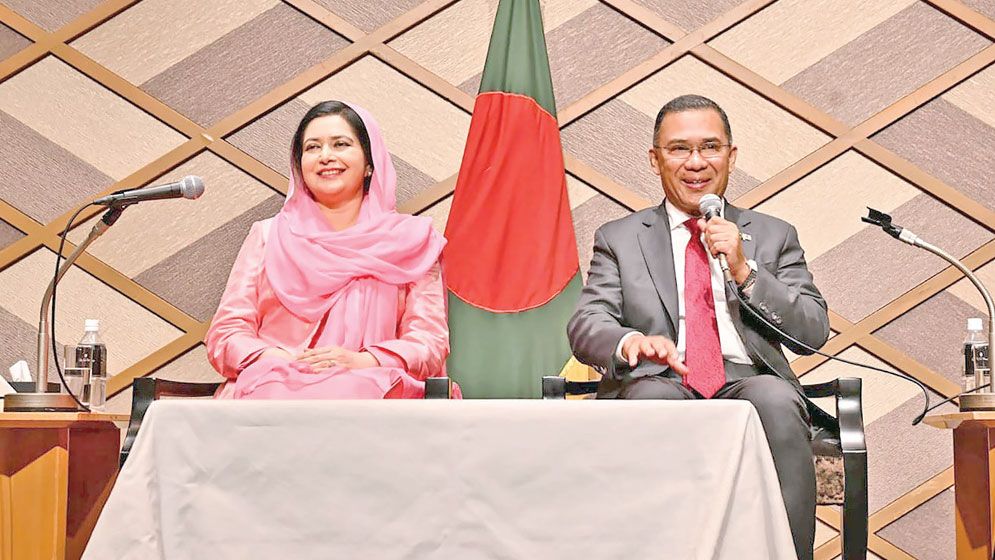
Prime Minister Tarique Rahman takes part in an exchange of views with expatriate Bangladeshis at the Hotel New Otani in Tokyo on Wednesday. His wife, Dr Zubaida Rahman, was also present. - PID PHOTO
Prime Minister Tarique Rahman has invited Japanese companies to invest in energy, automotive manufacturing, technology, renewable power and high-speed rail, pledging policy reforms to improve the business environment.
On the third day of his four-day visit to Japan, he met senior Japanese government officials and business leaders, promoted Bangladesh as an investment destination and outlined plans to expand cooperation in trade, skills development, education and technology.
The visit comes as Bangladesh seeks to turn its longstanding relationship with Japan into greater private investment, jobs and export diversification. The two countries signed an Economic Partnership Agreement (EPA) in February.
Addressing the Bangladesh-Japan Economic Forum Dialogue at the headquarters of the Japan External Trade Organization (JETRO) in Tokyo on Wednesday, the prime minister said Bangladesh wanted a stronger partnership with
Japan through trade and investment.
“Bangladesh now seeks substantial investment rather than aid,” he said, citing the country's large domestic market, young workforce and growing middle class.

Investment across key sectors
In his keynote speech at JETRO Hall, he said: “I invite Japanese companies to explore five key areas for future cooperation and business opportunities for mutual benefits.”
The areas he named were automotive manufacturing, energy, information and communication technology, artificial intelligence, robotics, electronics, space technology, agriculture-related industries and logistics.
Tarique said Bangladesh had a market of more than 180 million people and a median workforce age of 27. He said the country was expected to become the world's ninth-largest consumer economy by 2030, with annual gross domestic product projected to exceed US$1 trillion by 2034.
The government wants to make Bangladesh a global manufacturing hub, allowing investors to serve the domestic market and use the country as an export base. Japanese automotive manufacturers, large retailers and agricultural machinery developers are already taking steps to set up factories in the Japanese Economic Zone in Araihazar, he said, pledging government support.
He acknowledged Japanese companies' concerns over reliable energy supplies, efficient infrastructure, predictable customs clearance and taxation. The government had addressed some of these issues and was working on the rest, he said. “I fully understand that businesses need certainty. Investors need confidence. Our job is creating the right environment to deliver both.”
EPA and trade
Under the EPA, 7,379 Bangladeshi products will have duty-free access to the Japanese market, while Japanese goods, including steel, automotive parts and electronic components, will receive preferential access to Bangladesh. Tarique said simplified rules on investment, services and customs procedures would benefit businesses on both sides.
Meeting JETRO President Susumu Kataoka, the prime minister sought Japan's cooperation in diversifying Bangladesh's export basket and attracting investment in manufacturing, ICT, automobiles, renewable energy and agro-processing. Kataoka described Bangladesh as a promising investment destination, citing its economic growth and geographical position, and said government initiatives had generated interest among Japanese companies. Tarique thanked JETRO for promoting Japanese investment and invited Kataoka to visit Bangladesh.
At the forum, Finance and Planning Minister Amir Khosru Mahmud Chowdhury spoke about building an investment-led economy, while Invest Bangladesh Authority Chairman Ashik Chowdhury outlined reforms and initiatives to facilitate investment. Representatives of Mitsui and YKK Corporation shared their experiences in Bangladesh and discussed business prospects.
Japan signals interest
Japanese Minister of Economy, Trade and Industry Akazawa Ryosei told Tarique that Japan was keen to increase investment in Bangladesh and viewed it as an attractive destination for Japanese businesses. At their meeting on Wednesday, the two sides agreed to advance cooperation in areas discussed at the recent bilateral summit between Tarique and Japanese Prime Minister Sanae Takaichi. They also stressed the importance of capitalising on growing interest among Japanese business leaders.
Tarique thanked the Japanese government for its continued support for Bangladesh's development and invited Akazawa to visit. Recalling his parents' contributions to bilateral relations, he said his father, former President Ziaur Rahman, and his mother, former Prime Minister Khaleda Zia, had each visited Japan twice. He said he intended to carry that legacy forward.
Technology, rail and energy
The prime minister proposed a Bangladesh-Japan Technology Park focusing on artificial intelligence, cloud computing, robotics and electronics manufacturing, involving Japanese companies, universities and investors.
He also invited Japanese institutions to cooperate in space science, satellite engineering and related fields.
He proposed a nationwide elevated high-speed rail network connecting six major divisional cities.
The government plans to prepare a national master plan, assess passenger and freight demand, identify priority routes and conduct feasibility studies, he said, calling on Japanese institutions to take part.
In energy, he invited Japanese companies to explore energy infrastructure, efficient power generation and renewable energy projects to help meet Bangladesh's future needs.
Language training and jobs
Tarique called for cooperation in establishing Japanese-language training centres and expanding technical education so that Bangladeshi workers could access jobs in Japan and help meet its demand for skilled personnel.
Speaking at an exchange with Bangladeshi expatriates organised by Bangladesh Community, Japan, he said the government planned to introduce Japanese, German and French as third-language options in schools from next year, alongside English and students' mother tongue.
Work on the plan had begun, he said, and stronger language skills would help young people pursue higher education and employment abroad.
The government also intends to give greater emphasis to vocational education and make sports, arts and culture integral parts of education.
Workers should be properly prepared before being sent overseas, including through language and cultural training, he said.
He urged Bangladeshis who had returned from Japan, or who faced visa difficulties, to contact the relevant ministries to explore possible opportunities.
Healthcare and environment
Outlining domestic reform plans, the prime minister said the government aimed to upgrade existing 50-bed upazila health complexes into 150-bed hospitals over the next five years, with dialysis units, paediatric services and gynaecology departments.
He also announced plans to recruit 100,000 health workers, at least 80 percent of them women, to promote preventive healthcare and raise awareness of diseases such as diabetes and heart conditions.
He said this would ease pressure on major hospitals, where patient numbers often exceed capacity, and reduce the distances rural residents travel for treatment.
On the environment, he said he wished to make Dhaka as clean as Tokyo, citing the need for better waste management, reduced air pollution and more tree planting.
He described a cleaner environment and improved public health as reforms that would directly benefit ordinary people.
He called on Bangladeshis at home and abroad to contribute to national development, saying a better Bangladesh would benefit citizens wherever they lived.
He also urged collective efforts to implement reforms in education, healthcare and the environment so that their benefits reached the grassroots.
Final day
Today, the last day of the visit, the prime minister will travel from Tokyo to Nagoya by bullet train to visit Toyota Motor Corporation's Motomachi Plant. He will attend a luncheon hosted by Toshimitsu Imai, president and chief executive officer of Toyota Tsusho Corporation, and visit the Toyota Commemorative Museum of Industry and Technology before returning to Tokyo by bullet train. He will then board a Biman Bangladesh Airlines flight at Narita International Airport and is scheduled to arrive in Dhaka at 10:35pm today.