


 For all latest news, follow the Daily Sun's Google News channel.


Debt repayments double fund inflows in Q1
Debt servicing rises 5.56% as foreign financing disbursements plunge 42.3% in July-September

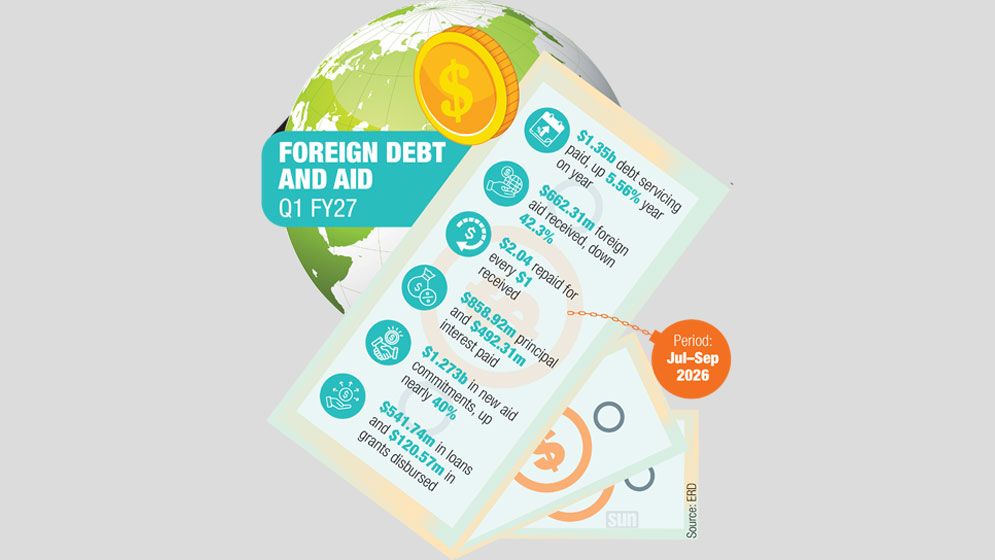
Bangladesh’s foreign debt servicing exceeded foreign financing receipts by more than double in the first quarter of the fiscal 2026-27, driven by surging repayment schedules and a sharp drop in aid disbursements.
According to provisional Economic Relations Division (ERD) data released Monday, the country paid US$1.351 billion in principal and interest during the July-September quarter, compared to just $662.31 million received in development partner loans and grants.
The resulting $689 million deficit means Bangladesh spent $2.04 on foreign debt servicing for every dollar it received in external aid.
“Debt repayments are largely fixed by prior agreements,” said Dr Mustafa K Mujeri, former chief economist of Bangladesh Bank, speaking to the Daily Sun. “The immediate challenge is securing fresh financing and accelerating aid disbursements.”
Debt payments rise as aid inflows fall
Foreign debt servicing rose 5.56% year on year to $1.351 billion in the first quarter of FY27, compared with $1.280 billion during the same period last year.
Principal repayments increased to $858.92 million from $816.99 million, while interest payments climbed to $492.31 million from $462.96 million.
In local currency, total debt servicing reached Tk16,646.46 crore, up from Tk15,591.69 crore a year earlier.
Meanwhile, foreign assistance disbursements plunged 42.3% to $662.31 million from $1.149 billion in the corresponding quarter of FY26.
Of the latest disbursements, $541.74 million came as loans and $120.57 million as grants, including $10 million in food assistance.
The sharp decline in disbursements, coupled with rising repayment obligations, has widened the gap between foreign financing inflows and debt servicing outflows.
Political transition slows financing
Mujeri said the transition to a newly elected government following the February election had contributed to delays in development assistance.
Development partners needed time to assess the new administration’s policy priorities and negotiate financing arrangements, slowing the release of funds, he explained.
Bangladesh is currently negotiating with the International Monetary Fund (IMF), World Bank and Asian Development Bank (ADB) over financial assistance.
Mujeri said progress in negotiations with the IMF could influence financing decisions by other development partners. However, the timing of disbursements remains uncertain because of policy conditions and approval procedures.
He cautioned that the decline in quarterly disbursements did not necessarily indicate a permanent reduction in development partners’ support.
Rather, the slowdown reflected the time required for negotiations, approvals and project implementation before committed funds could be released.
Aid commitments rise despite falling disbursements
Despite the sharp fall in actual inflows, foreign assistance commitments increased nearly 40% to $1.273 billion in the first quarter of FY27, compared with $910.67 million a year earlier.
According to ERD data, the latest commitments included $1.148 billion in loans and $125.45 million in grants.
However, the increase in commitments failed to translate into higher disbursements during the quarter.
While commitments represent agreements to provide financing, disbursements refer to funds actually released by development partners.
The contrasting trends highlight the government’s challenge of securing fresh financing while ensuring the timely release of funds already committed.
At the same time, rising debt repayments are adding pressure on foreign currency resources as the country continues to meet obligations arising from earlier borrowing.
Focus on productive borrowing
Beyond the immediate financing slowdown, Mujeri stressed the importance of ensuring that foreign borrowing generates sufficient economic returns to justify repayment obligations.He warned that wasteful spending, corruption, cost overruns and poorly performing projects could increase debt pressures without delivering corresponding economic benefits.
Foreign loans must be repaid in foreign currency, while many development projects generate revenue primarily in taka, making the country’s capacity to earn or save foreign exchange particularly important.
Mujeri said borrowing should prioritise essential, economically viable projects that boost exports, reduce import dependence or deliver broader economic benefits.
“Bangladesh has limited flexibility in meeting scheduled repayments on existing loans, as failure to honour obligations could undermine its credibility with international lenders and complicate future financing.”
Although the first-quarter figures do not establish a long-term debt crisis, they underscore the immediate challenge of managing rising repayment obligations amid weaker development assistance inflows, Mujeri added.
The outlook will depend partly on the pace of financing negotiations and future disbursements, while longer-term debt sustainability will hinge on productive investment and the country’s capacity to meet its foreign currency obligations, he said.
Read More