




 For all latest news, follow the Daily Sun's Google News channel.


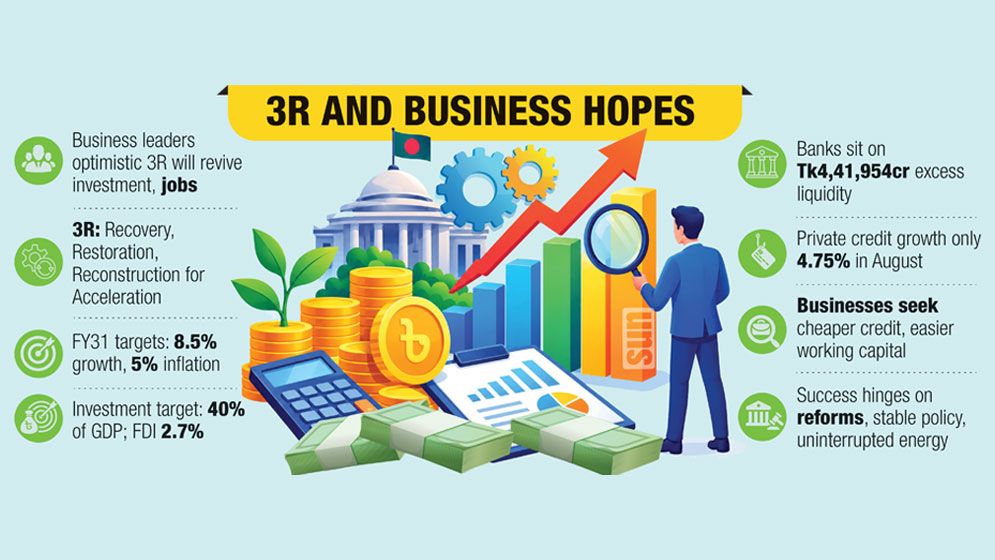
Business leaders have expressed optimism that the government’s 3R strategy will help revive investment and create jobs, though they say success will depend on effective budget implementation, banking sector reforms, easier financing and uninterrupted gas and electricity supplies.
The confidence comes despite excess bank liquidity rising to Tk4,41,954 crore in August, while private sector credit growth stood at just 4.75%.
Excess liquidity was up Tk20,994 crore from Tk4,20,960 crore at the end of July, Bangladesh Bank data show. Total deposits reached Tk21,32,521 crore, up 11.96% year-on-year, and outstanding loans stood at Tk26,03,214 crore. Private sector credit growth was 4.47% in June and 4.62% in July.
Entrepreneurs are holding back on new industries and factory expansion amid business uncertainty, energy shortages, rising production costs and weak demand.
Banks have meanwhile put a large share of surplus funds into government treasury bills and bonds, which offer relatively secure returns. Scheduled banks’ liquid assets totalled Tk7,81,214 crore at the end of August, of which Tk6,40,756 crore, or around 82%, was held in approved securities.
The 3R strategy
The government announced the three-phase strategy, Recovery and Stabilisation, Restoration, and Reconstruction for Acceleration, in the national budget for 2026-27 fiscal year (FY27) and has been implementing it since July.
The first phase aims to restore recovery and macroeconomic stability within a year. The second seeks to strengthen the economy’s foundations over one to three years. The third focuses on reconstruction to accelerate growth over five years. By FY31, the government aims to raise growth to 8.5%, bring inflation down to 5%, lift total investment to 40% of GDP and raise foreign direct investment’s contribution to 2.7% of GDP.The strategy prioritises revitalising private investment, reforming the banking and financial sectors, improving revenue administration, diversifying exports and increasing investment in energy and infrastructure.
Business leaders and economists say announcing plans will not by itself revive investment. They cite the need for effective budget implementation, policy continuity, transparency in the tax system, lower operating costs and measures to restore investor confidence.
In May, Bangladesh Bank set up a Tk62,000 crore incentive fund to boost private sector lending. It also cut the policy rate by 50 basis points to 9.50% to lower borrowing costs. Neither step has yet brought a significant change in credit demand.
Business concerns
Anwar-ul Alam Chowdhury (Parvez), president of the Bangladesh Chamber of Industries (BCI), said high lending rates, shorter repayment periods and a shortage of working capital were making Bangladeshi entrepreneurs less competitive than their counterparts in China, India and Vietnam.
“Bank lending rates in Bangladesh currently stand at around 14-16%, increasing production costs for industries. Meanwhile, the period of delay in loan instalment payments before a loan faces classification as default has been reduced from six months to three months, putting additional pressure on businesses already struggling with financial difficulties,” he told the Daily Sun.
He said the taka’s depreciation against the US dollar had raised import costs without a matching rise in working capital.
“A company had working capital of Tk50 crore when the dollar was valued at Tk84. Although the dollar now costs Tk122, the company’s working capital remains unchanged at Tk50 crore. As a result, businesses can import less raw material with the same amount of money, disrupting production and operations and putting many companies under pressure to repay their loans,” he said.
Parvez called for realistic adjustments to repayment periods and classification rules, more working capital financing and lower borrowing costs. He said the central bank’s incentive fund, the measures to cut borrowing costs and the investment-friendly policies must be implemented effectively.
He also urged lower industrial production costs, uninterrupted gas and electricity, and easier access to financing, which he said could restore confidence and pave the way for new investment, industrial expansion and employment.
Mohammad Hatem, president of the Bangladesh Knitwear Manufacturers and Exporters Association (BKMEA), expressed cautious optimism that the 3R strategy, investment incentives and planned banking and financial sector reforms could help revive private investment.
He said that, if implemented effectively, the initiatives could restore business confidence, encourage entrepreneurs to expand existing industries and attract new domestic and foreign investment.
Economists and bankers
Mustafa K Mujeri, former lead economist of the central bank, said, “Removing weaknesses in the banking sector, easing access to credit, ensuring tax policy stability, facilitating refunds of advance taxes, improving borrowing costs and repayment terms, and resolving energy supply constraints could help channel excess bank funds into productive sectors.”
He added, “This would create opportunities for establishing new industries, expanding factories, increasing exports and generating employment. Otherwise, reviving investment momentum would remain difficult despite the substantial amount of excess liquidity in the banking system.”
Arief Hossain Khan, executive director and spokesperson of Bangladesh Bank, said the central bank had taken several initiatives to increase private sector credit and that implementation was already under way. He expressed hope that credit demand would pick up soon.
Syed Mahbubur Rahman, former chairman of the Association of Bankers, Bangladesh (ABB) and managing director of Mutual Trust Bank, said maintaining banking sector stability solely through interest rates or investment in government securities was not enough, and that the government needed to take necessary measures.
He said banks had earned profits from foreign exchange transactions and government securities in recent years, while their core lending and borrowing business had suffered a severe setback.
The decline in net interest income, he said, was an alarming signal for the entire sector.