



 For all latest news, follow the Daily Sun's Google News channel.


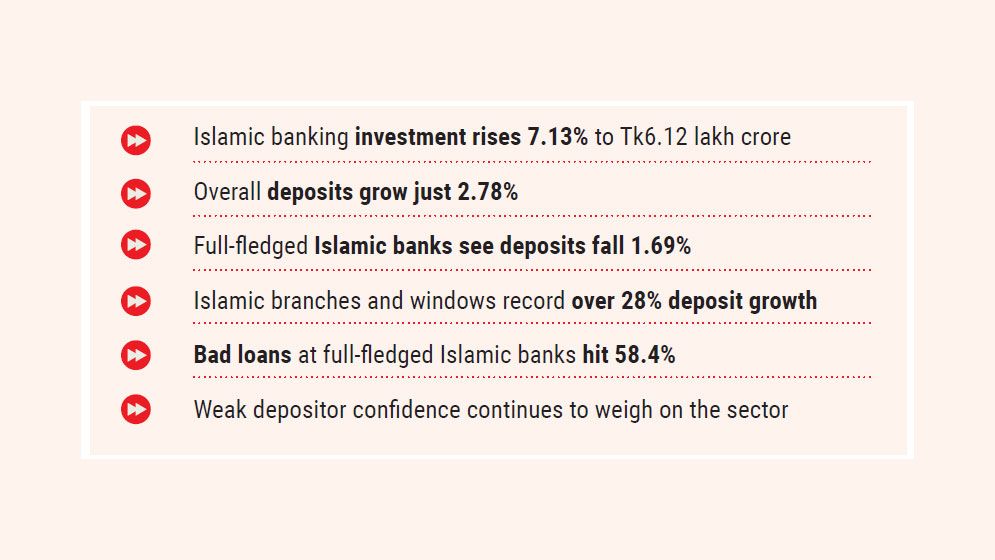
Money is flowing into investments at Islamic banks, but depositors appear less willing to trust them with their savings, raising fresh questions about the sector’s recovery from a prolonged confidence crisis.
While Islamic banking investment rose 7.13% year-on-year to Tk6.12 lakh crore in August, deposits grew just 2.78%, according to the latest Bangladesh Bank data.
More strikingly, deposits at full-fledged Islamic banks declined 1.69%, even as Islamic branches and windows of conventional banks recorded growth of 32.53% and 28.13%, respectively.
The contrasting trends suggest that customers are not abandoning Islamic banking altogether but are increasingly turning to conventional banks for Shariah-compliant services amid lingering concerns over financial stability and the safety of their savings.
Overall, Islamic banking accounted for 23.83% of total banking sector investments and 20.76% of total deposits.
The shifts reflect ongoing challenges and shaky depositor confidence following financial irregularities, liquidity strains, and proposed mergers involving five financially troubled Islamic banks.
While overall investment continues to grow, industry insiders express caution regarding the long-term sustainability of this expansion.
Investment grows faster than deposits
According to Bangladesh Bank, total Islamic banking investment reached Tk6.12 lakh crore at the end of August, up 7.13% from a year earlier, although it remained largely unchanged from July.
By comparison, investment by conventional banks grew 12.75% year-on-year, outpacing Islamic banking.
The 10 full-fledged Islamic banks continued to dominate the segment, accounting for Tk5.42 lakh crore, or 88.54% of total Islamic banking investment.
Bai-Murabaha remained the most widely used investment mode, accounting for 41.58% of the total, followed by Hire Purchase under Shirkatul Melk and Bai-Muajjal.
Investment remained concentrated in industry, trade and commerce, reflecting the sector’s role in financing business and productive activities.
Deposits shift towards conventional banks
Deposit mobilisation remained a major challenge for Islamic banking, particularly for full-fledged Islamic banks.
Total deposits in the sector stood at Tk4.75 lakh crore at the end of August, up 1.31% from July and 2.78% from a year earlier.
However, deposits at full-fledged Islamic banks declined to Tk3.92 lakh crore from approximately Tk3.99 lakh crore a year earlier, representing a 1.69% contraction.
In contrast, Islamic branches of conventional banks held deposits of Tk51,661 crore, up 32.53% year-on-year, while deposits at Islamic windows rose 28.13% to Tk31,412 crore.
The contrasting trends suggest that customers are increasingly choosing Shariah-compliant services offered by conventional banks rather than depositing funds with standalone Islamic institutions.
A report titled A Big Shift Opens in Islamic Finance, published in September, identified a similar trend.
It showed that deposits at Islamic branches and windows of conventional banks more than doubled from approximately Tk37,000 crore in March 2024 to Tk78,000 crore in June 2026.
Over the same period, deposits at full-fledged Islamic banks fell to approximately Tk3.90 lakh crore.
Financial weaknesses undermine confidence
The Islamic banking sector has faced growing scrutiny since July 2024, following revelations of financial irregularities, liquidity shortages and difficulties faced by some institutions in meeting withdrawal demands.
Bangladesh Bank previously acknowledged that these developments had weakened depositor confidence and affected deposit mobilisation.
More recently, Islami Bank Bangladesh experienced withdrawals amounting to Tk4,240 crore within seven days following protests over the appointment of its chairman.
The bank’s then acting managing director acknowledged the pressure from deposit withdrawals.
Asset quality has also deteriorated sharply at several Islamic banks.
According to another Bangladesh Bank report, the non-performing loan ratio at full-fledged Islamic banks climbed to 58.4% in March 2026 from 29.2% a year earlier.
Their advances-to-deposit ratio also rose to 120.3%, indicating significant liquidity pressures as outstanding financing exceeded the deposit base.
Asset growth trails conventional banks
Total assets of the Islamic banking sector reached Tk10.05 lakh crore at the end of August, up 0.92% from July and 6.57% year-on-year.
Islamic banking accounted for 16.46% of the total assets of scheduled banks.
By comparison, conventional banks held assets worth Tk51.01 lakh crore, recording monthly growth of 1.94% and annual growth of 11.56%.
Bangladesh Bank attributed the relatively slower asset growth in Islamic banking partly to limited operational scale, insufficient product diversification and persistent challenges facing the sector.
Remittances recover, export earnings decline
Islamic banks recorded some improvement in remittance inflows in August, mobilising $630 million, up 16.01% from July and 3.29% from a year earlier.
However, their share of total remittances stood at 21.24%, reflecting continued competition from conventional banks.
Conventional banks collected $2.34 billion in remittances during the month, recording year-on-year growth of 29.01%.
Islamic banks also handled $736 million in export proceeds in August, accounting for 19.05% of total export receipts.
Although export receipts through Islamic banks increased 7.56% from July, they declined 5% compared with August 2025.
On the import side, payments handled by Islamic banks reached $984 million, representing 16.86% of total import payments. The figure rose 5.52% month-on-month and 10.16% year-on-year.
Agent banking remains a strength
Despite weaknesses in conventional banking operations, Islamic banks maintained a strong presence in agent banking.
Deposits mobilised through Islamic agent banking stood at Tk25,328 crore at the end of August, accounting for 48.45% of total agent banking deposits.
The figure increased 1.71% from July but declined 2.63% from a year earlier.
By comparison, conventional banks held approximately Tk26,900 crore in agent banking deposits, recording annual growth of 28.49%.
Employment in the Islamic banking sector also declined.
The sector employed 44,782 people at the end of August, down 6% year-on-year, although the number of specialised Islamic banking and finance professionals increased to 580.
The 10 full-fledged Islamic banks operated 1,699 branches. Including Islamic branches and windows of conventional banks, the sector’s service network comprised 2,418 branches and windows.
Governance reforms key to recovery
Bangladesh Bank said stronger regulatory supervision had begun to address the instability that emerged after July 2024 and support efforts to restore confidence in Islamic banking.
However, conventional banks continued to outperform Islamic banks on several major indicators, including investment, asset growth and remittance mobilisation.
The central bank emphasised the need for Islamic banks to diversify Shariah-compliant financial products, accelerate digitalisation, strengthen professional skills and improve competitiveness in remittance and export services.
It also identified agent banking as an area with potential for further expansion.
Dr Masrur Reaz, chairman of Policy Exchange Bangladesh, said improvements in management, governance and compliance could help rebuild confidence in Islamic banking.