



 For all latest news, follow the Daily Sun's Google News channel.


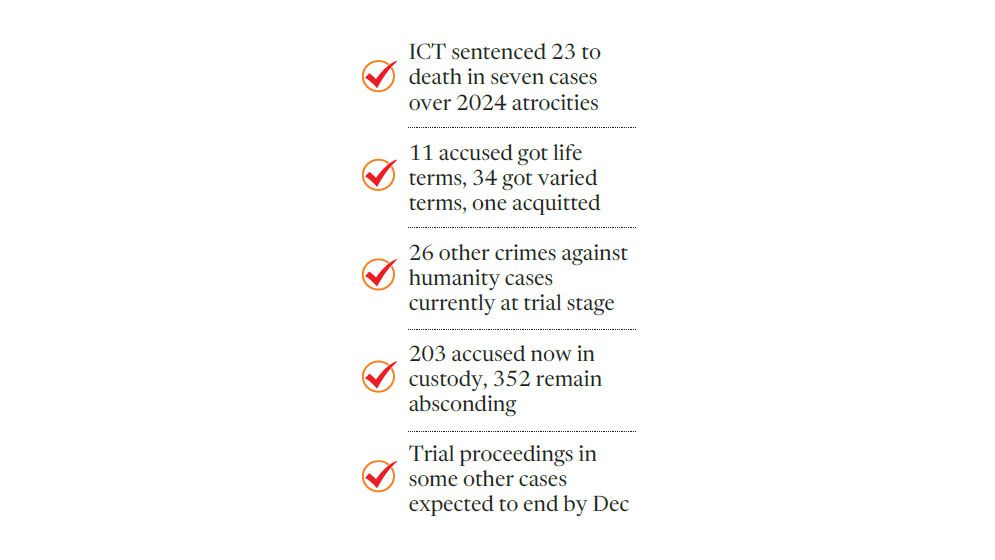
Since resuming operations in October 2024, the two reconstituted tribunals of the International Crimes Tribunal (ICT) have delivered verdicts in seven cases regarding crimes against humanity committed during the 2024 mass uprising.
Among the verdicts, three judgments came from the ICT-1 and four from the ICT-2. A total of 68 individuals have been found guilty in the cases.
Among them, 23 convicts received the death penalty, while 11 were handed life-imprisonment and 34 others received varied terms. To date, an accused has been acquitted and another was sentenced to time already served during custody. On the other hand, one accused has died of natural causes.
Sub-Inspector Sheikh Abzalul Haque is the first accused in the crimes against humanity case to be released from jail following acquittal. He was released from Kashimpur Central Jail-2 in Gazipur on 13 October.
A total of 203 accused have been arrested and are in custody, while 352 remain absconding.
ICT Prosecutor Gazi Monawar Hossain Tamim confirmed this information. He said that two years after the tribunals were reconstituted, the judicial process has expanded significantly, with 70 cases involving 558 accused at different stages of proceedings.
Of the 70 cases filed in connection with crimes against humanity, 26 are currently at the trial stage. The ICT-1 is handling 12 of these cases, while the remaining 14 are before the 2nd tribunal.
Another 44 cases, involving 160 people, are categorised as miscellaneous awaiting the initiation of trial proceedings. The coming months will be crucial in determining how quickly the tribunals can translate investigations and prosecutions into final judicial outcomes.
The cases involve allegations of killings, mass atrocities and other crimes against humanity committed during the 2024 uprising that led to the fall of the Awami League government. Some of the cases involved allegations of enforced disappearances and state-sponsored killings during the 16 years of Awami League reign.
However, a substantial number of accused remain beyond the reach of law, while dozens of cases are yet to go to full trial.
Chief Prosecutor Md Aminul Islam said the tribunals were reconstituted with a commitment to ensure justice for those martyred or injured during the 2024 mass uprising. “We can now proudly state that our tribunals have delivered verdicts in seven major cases,” he added.
The first landmark verdict from the reconstituted ICT came on 17 November 2025 as the ICT-1 sentenced ousted prime minister Sheikh Hasina and former home minister Asaduzzaman Khan Kamal to death. Former inspector general of police Chowdhury Abdullah Al-Mamun, who turned state witness, received a five-year jail term.
Subsequent ICT verdicts covered the killings in Chankharpul and Ashulia, the killing of Abu Sayed in Rangpur, the Rampura shooting, mass killing in Kushtia and crimes involving senior Awami League leaders.
On 15 September, the ICT-2 sentenced seven people, including former Awami League general secretary Obaidul Quader, to death in a crimes against humanity case for 2024 atrocities.
ICT prosecution expects to complete trial proceedings in several other high-profile cases by December. The trial proceedings of former ministers Quamrul Islam, Rashed Khan Menon and Anisul Huq, former prime minister’s adviser Salman F Rahman, former state minister Zunaid Ahmed Palak and Sheikh Hasina’s son Sajeeb Wazed Joy are likely to be completed this year. The case involving sacked Army officer Ziaul Ahsan is also nearing end.
Fugitive accused remain a major challenge for trial in the ICT. Many of the fugitives, particularly who get death sentences, facing the most serious charges have been tried in absentia.
Regarding the more than 300 fugitive accused, the chief prosecutor said efforts are underway to bring them to justice.
Meanwhile, the investigation into the Awami League as an organisation has also begun. Investigators are collecting and reviewing information from different parts of the country, although the prosecution cannot yet estimate when the investigation will be completed.