



 For all latest news, follow the Daily Sun's Google News channel.


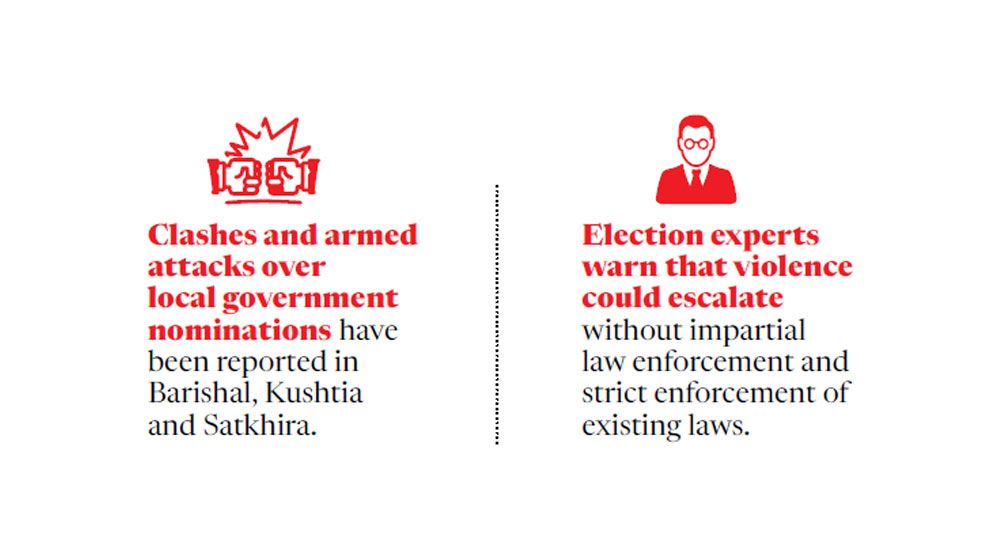
As Bangladesh approaches local government elections, clashes, armed attacks and vandalism linked to prospective candidates and supporters are raising concerns over electoral violence. Human rights data show violence emerging before the formal process begins, prompting concerns over whether political parties and law enforcement agencies can prevent further escalation.
The Human Rights Support Society (HRSS) recorded at least six incidents of election-related violence between July and September 2026, leaving 45 people injured. Linked to prospective candidacies and efforts to garner public support, clashes, attacks, vandalism and arson involving candidates and supporters of different political groups occurred in several districts, continuing as the polls approached.
On 26 July, two BNP factions clashed in Hizla upazila, Barishal, over upcoming union parishad elections. The clash involved supporters of Gaurabdi Union BNP convener and prospective chairman candidate Farid Uddin Bepari and former district Jatiyatabadi Chhatra Dal member Ismail Molla, aligned with upazila BNP joint convener Altaf Hossain Khokon. At least 10 leaders and activists, including Farid, were injured.
On 5 August, Nafiz Ahmed Khan Raju, Khoksa municipal mayoral candidate and former senior joint convener of Khoksa upazila BNP, was seriously injured in an armed attack outside his Thanapara home in Kushtia. Gunfire and crude bomb explosions spread panic among residents.
On 11 August, an armed attack targeting prospective Nagarghata Union Parishad chairman candidate Ebadul Islam in Satkhira’s Tala upazila injured at least eight people, including the candidate and his supporters. Victims and residents alleged involvement by Nagarghata Union BNP President and former chairman Mahabbat Hossain, organising secretary Akter, Chhatra Dal leaders Lucky, Raihan and Sakib, and other Jubo Dal activists. The allegations remain independently unverified.
No break from election violence
Data from previous electoral cycles also suggest that the problem is not confined to local government polls. Rather, election periods have repeatedly been marked by clashes between rival political factions, attacks on candidates and supporters, and violence against homes, businesses and party offices.
According to HRSS, the 13th parliamentary election earlier this year was accompanied by clashes, attacks, vandalism and arson involving different political parties, their nominated candidates and the supporters of those who were denied nominations. The violence continued even after the election.
In February, at least 285 election-related violent incidents left 1,555 people injured and five killed, according to the organisation. More than 450 business establishments, homes and election offices were also attacked, vandalised, looted or set on fire during the pre- and post-election periods.
In October, November and December of 2025, at least 54 nomination-related violent incidents left 494 people injured and three killed, HRSS data showed.
The clashes involved prospective candidates and supporters of those who were denied party nominations.
Separate figures from Ain o Salish Kendra (ASK) paint a broader picture of the problem.
According to the rights organisation, political violence in 253 incidents in 2026 has left 24 people dead and 1,852 injured. In 2025, a total of 401 incidents of political violence killed 102 people and injured 4,744.
Against this backdrop, election experts warn that the emerging clashes over local government nominations could intensify unless the authorities take effective preventive measures and ensure that the law is applied equally to all political parties.
Dr Badiul Alam Majumdar, an election expert and secretary of Shushashoner Jonno Nagorik (SHUJAN), told the Daily Sun that violence tends to increase whenever elections are held in Bangladesh, with local government elections often proving even more volatile. He said the Election Commission (EC) had limited capacity to prevent such violence, making the role of law enforcement agencies particularly important.
“If the turf wars we are witnessing now are merely the prelude to the local government polls, the actual voting days will be an absolute bloodbath,” he warned.
Dr Omar Faruk, a crime analyst and professor in the Department of Criminology and Police Science at Mawlana Bhashani Science and Technology University, said the electoral environment often brings out violent tendencies among people, particularly when political competition is allowed to escalate unchecked.
He told the Daily Sun that the government must adopt a strong and impartial stance to prevent election-related violence, ensuring that all political parties are treated equally and that the same rules apply to every side.
More importantly, he stressed, existing laws must be enforced firmly rather than remaining on paper.
“Bangladesh has many good laws, but the lack of their enforcement is what has brought the situation to such a deplorable state,” he said.