



 For all latest news, follow the Daily Sun's Google News channel.


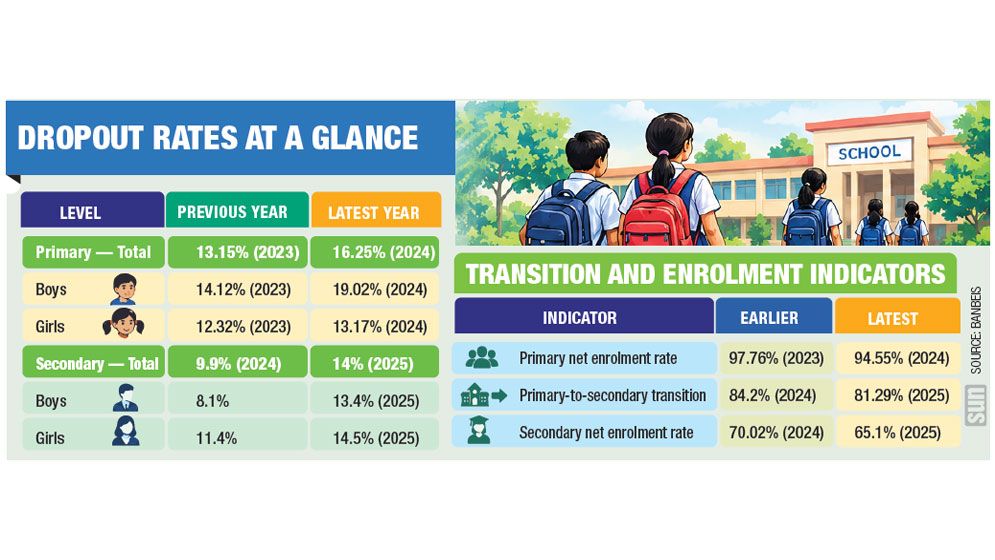
The education system in the country is losing students at almost every stage, with dropout rates rising in primary and secondary schools, fewer primary graduates progressing to secondary education and participation in tertiary education remaining low.
The primary education cycle dropout rate rose to 16.25% in 2024, from 13.15% in 2023, while the secondary dropout rate jumped to 14% in 2025, from 9.9% in 2024, according to official Education Statistics 2025 published by the Bangladesh Bureau of Educational Information and Statistics (BANBEIS).
At primary level, boys recorded a higher dropout rate, at 19.02% in 2024. At secondary level, however, girls were more likely to drop out, with their rate reaching 14.5% in 2025, compared with 13.4% among boys.
The primary net enrolment rate also fell sharply, to 94.55% in 2024 from 97.76% in 2023. The transition from primary to secondary education weakened further, with the proportion of primary graduates moving on to Grade Six falling from 84.2% in 2024 to 81.29% in 2025.
That means nearly one in five primary graduates did not make the transition to secondary education. At secondary level, the net enrolment rate declined to 65.1% in 2025, from 70.02% a year earlier. The rate for boys was particularly low at 58.04%, indicating that a large proportion of boys of secondary-school age were not enrolled in general secondary education.
Girls continued to outnumber boys at the secondary and higher secondary levels, but the trend was reversed in tertiary education. The gross enrolment ratio in tertiary education fell slightly to 19.8% in 2025, from 20.03% in 2024, with enrolment at 23.93% for males and 16.52% for females.
The gender parity index stood at 0.87, indicating lower female participation in higher education. The education system has also been hit by disasters.
According to the 2025 data, 5,631 educational institutions were affected by disasters, resulting in 48,246 students dropping out.
Stakeholders said many initiatives previously introduced to reduce dropout rates have largely stalled, while the disruption caused by the COVID-19 pandemic continues to affect secondary-level students.
For girls, child marriage remains a major barrier to continuing education. Eve-teasing and safety concerns on the way to school also contribute to girls dropping out.
Poverty and declining household purchasing power are making it increasingly difficult for families to meet education costs. Many parents are being forced to reduce spending on their children’s education as they prioritise basic necessities such as food and clothing.
Stakeholders also said government stipends at secondary level remain insufficient to meet students’ needs.
They called for better protection for students at school and on their way to educational institutions, higher stipends and other financial incentives, as well as greater involvement of local government institutions.
State Minister for Planning Md Zonayed Abdur Rahim Saki also raised concerns over dropout at a national dialogue on primary education.
He said total student enrolment in the country, excluding Qawmi madrasahs, stood at around two crore in 2026, while only around 18.5 lakh students sat for the SSC examinations this year.
He described the gap as evidence of the scale of the dropout problem and said effective measures were needed to identify and address its causes.
He stressed that poverty and the opportunity cost of schooling are major factors behind dropout, with many children from low-income families entering income-generating activities at an early age.
Saki called for quality midday meals, a more enjoyable school environment, sports and extracurricular activities to keep students engaged and protect them from drugs and other harmful activities.
He also stressed the need to improve educational infrastructure and ensure the effective use of education funds.
Dr Mostafizur Rahaman, deputy director (research and advocacy) at the Campaign for Popular Education (CAMPE), told the Daily Sun that the government should make the midday meal programme universal at primary level and increase stipend amounts to reduce dropout.
“Poor families should be given priority in the distribution of family cards. Local government institutions should also be integrated into these initiatives to ensure that children from disadvantaged families receive the necessary support,” he said. “At secondary level, it is essential to increase stipends, particularly for girls, and ensure their safety both at school and on their way to school. Effective measures must be taken to prevent child marriage and eve-teasing. At the same time, parents should be more closely engaged with schools through guardians’ meetings and mothers’ gatherings.
“There is currently a significant gap in communication between many parents and schools. Many parents believe their children have gone to school when, in reality, they may have become involved with juvenile gangs. To prevent such situations, regular communication between schools and parents, along with closer monitoring, must be strengthened.
“Without coordinated efforts to address poverty, safety concerns and the growing disconnect between families and schools, reducing student dropout will remain difficult,” he added.