




 For all latest news, follow the Daily Sun's Google News channel.


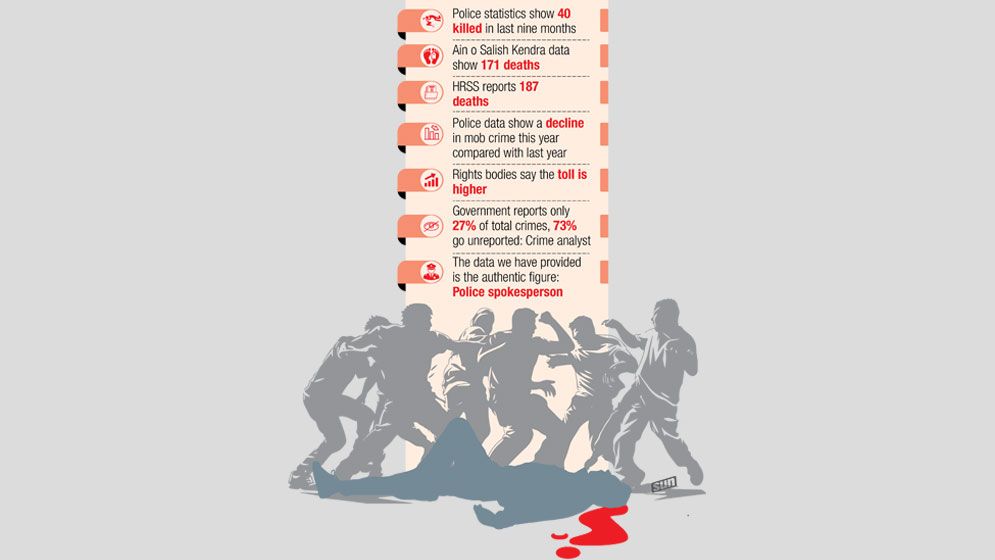
A significant discrepancy has emerged between the mob violence figures compiled by Police Headquarters and rights organisations.
The Ministry of Home Affairs sent statistics compiled by Police Headquarters (PHQ) to the media on Tuesday, saying that 40 people were killed in 63 such incidents of violence across the country during the nine months from January to September this year.
But the Ain o Salish Kendra statistics show that at least 171 people were killed in mob violence incidents during the same period, while the Human Rights Support Society (HRSS) data show that at least 187 people were killed and 401 injured in 398 incidents of mob violence.
The mob violence occurred over various allegations, including theft, robbery, snatching, altercations, establishing dominance, religious defamation, rape and attempted rape, according to the HRSS.
The PHQ statistics show that mob violence decreased this year compared with 2025.
A total of 63 people were killed and 82 wounded in 107 incidents of mob violence from January to September 2025.
A total of 44 incidents, 23 deaths, and 17 injuries, were reported in the first nine months of the current year, indicating a decrease compared with the same period last year, according to the PHQ.
But the data of the Ain o Salish Kendra state that at least 152 people were murdered in mob violence incidents from January to September last year, while the HRSS data say that at least 130 people were killed and 212 wounded in 239 incidents during the same period.
According to Ain o Salish Kendra, it compiled the data from 10 national newspapers, several online portals and its own sources.
Regarding the HRSS data, its Executive Director, Ijajul Islam, told the Daily Sun that the organisation compiled the statistics from reports in 16 national dailies and information provided by its volunteers.
Asked about the significant discrepancy between police and rights organisations’ data, Bangladesh Police spokesperson Kamarum Munira, also an assistant inspector general, said, “The data we have provided is the authentic figure and there is no other data beyond that. Where other organisations obtained their figures is a matter for them. They would be in a better position to explain how they collected their data.”
She further said, “Our data is not based solely on cases and complaints. We have prepared the figures after taking all relevant factors into consideration. There is no scope for error in our data.”
‘Crimes often go unreported’
Crime analyst Dr Omar Faruk, also professor in the Department of Criminology and Police Science at Mawlana Bhashani Science and Technology University, told the Daily Sun that governments generally tend to report lower crime figures than the actual number of crimes committed.
“This practice is not new; it has been going on for a long time, not only in Bangladesh but also in other countries. In one of our studies, we found that the government reports only 27% of total crimes, while the remaining 73% go unreported in official figures.”
“Mob violence is an issue directly linked to the government's performance and accountability. Therefore, it is only natural for the government to report a lower figure.
“I believe the data compiled by other rights organisations is credible to a considerable extent. In reality, the number of crimes is even higher. People often refrain from reporting incidents due to social stigma, meaning many cases remain unknown to us,” he said.
Crime analyst Dr Tawohidul Haque, also an associate professor at the Institute of Social Welfare and Research at Dhaka University, told the Daily Sun that the normalisation of mob violence is a glaring indictment of our collapsing criminal justice system.
When citizens bypass the law to execute a suspect in broad daylight, it signifies a complete breakdown of public trust in law enforcement, he added.