


 For all latest news, follow the Daily Sun's Google News channel.


BPC seeks fuel stabilisation fund, 90-day reserve
Daily Sun Report, Dhaka
Published: 21 Oct 2026, 12:00 AM
The Bangladesh Petroleum Corporation (BPC) has proposed establishing a fuel stabilisation fund and building strategic reserves sufficient to meet 90 days of demand to strengthen the country’s energy security amid volatile international oil prices.
The state-owned corporation has also called for expanding domestic refining capacity, accelerating the Single Point Mooring (SPM) project, modernising fuel distribution and increasing the government’s share in the liquefied petroleum gas (LPG) sector.
The proposals were presented at the first meeting of the Parliamentary Standing Committee on Public Undertakings held recently, where the BPC outlined its financial losses, rising import costs and operational challenges.
BPC Chairman Dr Md Rafiqul Islam said the proposed fuel stabilisation fund was still at the conceptual stage, with its modalities yet to be finalised. The government was laying the groundwork for the fund, which could help the corporation tackle unexpected situations, he said.
He added that the BPC was working to increase fuel storage capacity to cover three months of demand.
Petrobangla Chairman Md Abdul Mannan Patwary stressed the need to expand fuel reserves to handle emergencies, warning that inadequate stocks could leave the country unable to cope with unexpected situations.
The BPC said rising global petroleum prices had caused losses since March 2026 and that it had sought government support to keep fuel affordable despite higher import costs.
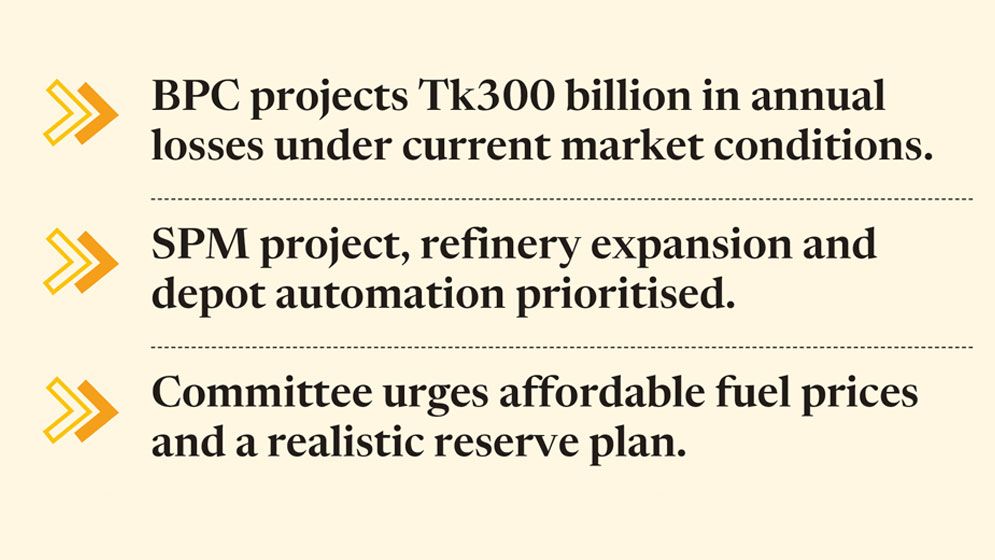
The corporation said diesel could break even at a Platts benchmark of around $110 per barrel, but the average reached $165.82 between 1 and 23 September 2026. It estimated a loss of Tk54.62 per litre of diesel, amounting to around Tk840 million daily, Tk25 billion monthly and Tk300 billion annually under prevailing market conditions.
The BPC said the government raised diesel prices by Tk20 to Tk135 per litre amid mounting losses. Additional financial aid and a stabilisation fund could help manage global price fluctuations, keep fuel affordable and ensure the supply system’s financial sustainability.
The parliamentary committee urged authorities to devise a realistic plan to keep fuel affordable and present details of fuel demand, storage capacity and institutional preparedness for future demand at its next meeting.
SPM project, refining capacity in focus
The BPC prioritised fast-tracking the Single Point Mooring (SPM) system to cut the time and costs of unloading imported petroleum from large vessels. Its pumping stations and tank farm are expected to improve crude oil and fuel handling efficiency, reducing delays and expenses.
BPC Chairman Rafiqul Islam said the Notification of Award had been accepted, with the contract expected to be signed within 28 days. The corporation also proposed expanding domestic refining capacity, extending pipelines and accelerating depot automation to reduce reliance on imported fuels.
It operates 29 depots across the country, including railhead and river-based facilities that support the distribution of petroleum products to different regions and economic sectors.
The BPC said manual processes for receiving, storing and distributing fuel remained a major operational challenge. Automating the network could reduce delays, improve efficiency and strengthen accountability.
Other proposed measures include modernising strategic storage infrastructure, improving the management of fuel imports and distribution, and developing a time-bound action plan to build reserves covering 90 days of demand.
Pricing mechanism and financial pressure
The BPC also outlined the existing framework for determining petroleum prices. The Energy and Mineral Resources Division sets retail prices for diesel, octane, petrol and kerosene, while the Bangladesh Energy Regulatory Commission determines prices for certain other products, including furnace oil, LPG and jet fuel. The BPC sets prices for products such as bitumen and SBPAs.
The government introduced an automatic fuel pricing mechanism in March 2024 to adjust domestic prices in line with international market movements. However, the corporation said domestic prices were not fully adjusted in line with its proposed rates during the sharp international price increases in 2026, contributing to its losses.
Alongside a stabilisation fund and larger reserves, the BPC has proposed increasing the government’s share in the LPG sector as part of broader efforts to strengthen the fuel supply system.
The proposals aim to improve the country’s ability to withstand international supply disruptions and price shocks. Their implementation will depend on government decisions, financing arrangements and the development of time-bound plans for expanding storage, refining and distribution capacity.