


 For all latest news, follow the Daily Sun's Google News channel.


Tk2 to 100 quintillion: money at its extremes
From a Hungarian note with twenty zeroes to a Hong Kong note worth a fraction of a penny, the story of denominations is the story of trust, and of what happens when it collapses
Daily Sun Report, Dhaka
Published: 16 Oct 2026, 12:00 AM
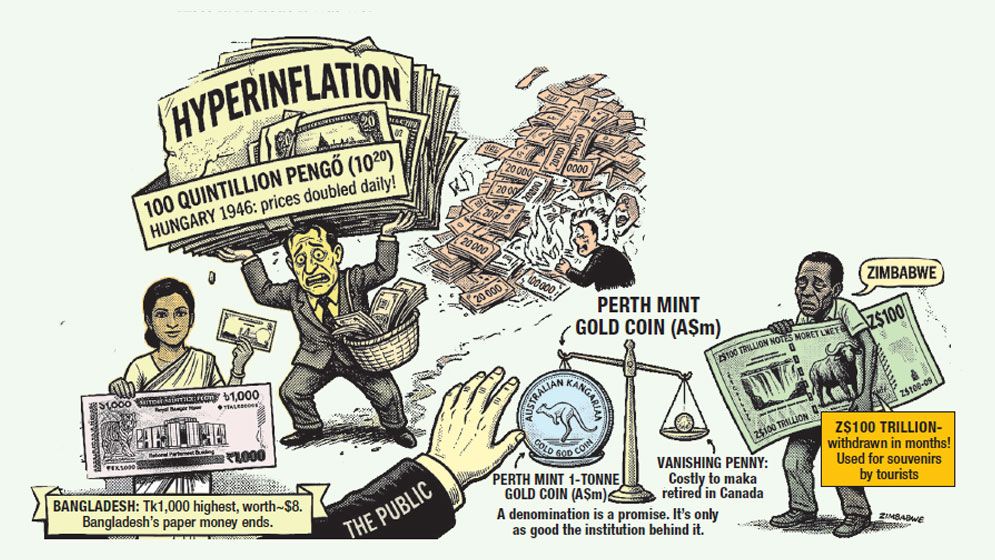
Pull a Tk2 note and a Tk1,000 note from your wallet and you are holding the two ends of Bangladesh’s paper money, the lowest and highest denominations in the current series. The Tk1,000 is worth roughly US$8 at recent rates. Since June 2025 it has carried a new design, with a Royal Bengal tiger watermark and the National Parliament Building on the reverse. It belongs to a series themed on the country’s historical and archaeological architecture. The Tk2 sits at the bottom of the same family, alongside the Tk5 and Tk10; the Tk10 was redesigned in June 2026 to include July uprising graffiti. Older notes and coins remain legal tender.
Set against the rest of the world’s money, though, even Tk1,000 looks modest.
Twenty zeroes: the age of hyperinflation
The highest-denomination banknote ever issued is Hungary’s 100 quintillion pengő (10²⁰), released in June 1946 amid the wreckage of the Second World War. Guinness World Records recognises it. At issue it was worth only about US$0.20, because prices were doubling every day or so. An even larger note, 1 sextillion pengő (10²¹), was printed but never released. The forint replaced the pengő within weeks.
Zimbabwe produced the best-known modern equivalent. The Reserve Bank’s Z$100 trillion note (100,000,000,000,000) is the largest face value of any “dollar” note. It was dated 2008 but entered circulation on 16 January 2009, after prices had been doubling roughly daily at the November 2008 peak. It bore a buffalo and Victoria Falls, and was withdrawn about three months later, when Zimbabwe abandoned its own currency for the US dollar and the South African rand. Today it sells to tourists and collectors as a souvenir.
These are not isolated cases. Weimar Germany issued a 100 trillion mark note in 1924, and Yugoslavia reached 500 billion dinars in 1993. The pattern is the same: when a central bank finances deficits by creating money, the notes get bigger while the purchasing power shrinks.
When big notes were real money
Large denominations have not always signalled disaster. The US$10,000 Federal Reserve Note was the highest denomination ever circulated publicly in the United States. It was printed until 1934 and withdrawn in 1969. A US$100,000 gold certificate also existed, but it was restricted to transfers between official institutions.
Today the most valuable notes in regular use are the Brunei and Singapore US$10,000-equivalent notes, each worth about US$8,000. Singapore stopped printing its S$10,000 note in 2014, citing money-laundering concerns, while Brunei kept its own.
The tiniest notes
The opposite extreme is just as curious. Guinness World Records lists Indonesia’s one-sen note, a hundredth of a rupiah, as the lowest-valued legal tender banknote. In June 1996 it took 358,624 of them to equal one pound sterling.
Hong Kong issued a one-cent note from 1941, during a wartime coin shortage. It was printed on one side only and survived until 1995.
Romania’s 10 bani note of 1917 is recognised as the smallest paper money by physical size, with a printed area of 27.5 by 38 millimetres, about a tenth the size of a US dollar bill. It carried a portrait of King Ferdinand I. Some German emergency notes, or “Notgeld”, were smaller still, such as the one-third pfennig notes of Passau in 1920–21. They were privately issued, however, so they do not count as national currency.
The Bank of England’s lowest-denomination notes were the half-crown notes of 1941. Few survive, and collectors pay at least £1,500 for one.
In Vietnam, the VND100 note still exists, but shopkeepers often hand out sweets instead of small change, a practice that has caused public debate.
Coins: giants and vanishing pennies
Coins have their own record-breakers, though these are showpieces rather than pocket money. The largest ever struck is the Perth Mint’s one-tonne Australian Kangaroo gold coin of 2011, listed by Guinness. It weighs about 1,012 kilograms, measures roughly 80 centimetres across, and has a face value of A$1 million. Its gold content is worth many times that.
The previous record belonged to the Royal Canadian Mint’s Big Maple Leaf of 2007. It weighs 100 kilograms, is 99.999% pure gold, and carries a face value of C$1 million. Only a handful were made, and one was stolen from Berlin’s Bode Museum in 2017. The Austrian Mint, for its part, scaled up its Philharmonic to 1,000 troy ounces, with a face value of €100,000.
At the opposite end, there is no single celebrated record for the lowest-denomination coin. Instead, small coins are slowly being retired because they cost more to make than they are worth. Canada, for example, stopped minting its one-cent coin in 2012. Bangladesh Bank has said that existing coins will remain in circulation alongside the new notes.
What the numbers really tell us
A denomination is a promise, and it is only as good as the institution behind it. The Hungarian and Zimbabwean notes are remembered because they broke that promise, while the Tk1,000 note, like any stable currency’s top note, shows nothing more dramatic than a state confident enough to keep its zeroes in check.
(This report is based on information sourced from the internet.)