



 For all latest news, follow the Daily Sun's Google News channel.


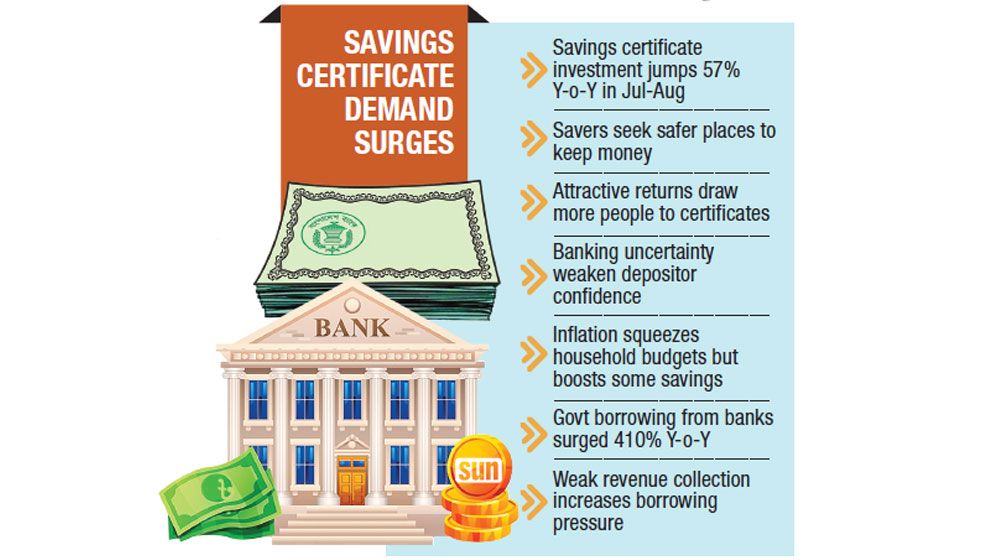
A mix of banking uncertainty, relatively attractive returns and a shortage of alternative investments is driving more savers towards government-backed savings certificates, with net investment rising 57% year-on-year in the first two months of the ongoing 2026-27 fiscal year (FY27).
For Tahera Akhter, a disappointing return on a bank deposit was enough to reconsider where she puts her money.
The homemaker from Mirpur visited Sonali Bank’s Local Office in Motijheel on Wednesday to invest Tk5 lakh in savings certificates, attracted by what she sees as better returns and greater security.
“I plan to liquidate my previous investment and allocate the proceeds towards purchasing savings certificates. Family schemes seem to yield better returns, and the added security is reassuring,” she told the Daily Sun.
Tahera’s decision reflects a wider shift among savers seeking to protect their principal and secure predictable returns amid lingering concerns about the banking sector.
According to Bangladesh Bank data, the government’s net borrowing through savings certificates reached Tk2,463 crore in July-August, up from Tk1,572 crore in the same period a year earlier.
Net investment stood at Tk2,059 crore in July, compared with Tk1,293 crore a year earlier, marking a 59.2% increase. In August, it rose to Tk403 crore from Tk278 crore, an increase of about 45%.
Net investment represents fresh sales of savings certificates after repayments of principal and interest on existing instruments. The amount retained by the government counts as borrowing and helps finance public expenditure, including development projects.
Security and returns attract savers
Economists and banking sector insiders attribute the renewed interest to the search for safer investments, comparatively attractive returns, limited alternatives and persistent inflation. Uncertainty in the banking sector has also weighed on depositor confidence.
Zahid Hussain, former lead economist at World Bank’s Dhaka office, said inflation had intensified economic hardship but had also enabled some people to accumulate savings.
“High inflation has inadvertently channelled more money into the market, allowing some individuals to amass savings. This, in turn, has spurred an interest in investing these savings in bonds, altering the financial landscape,” he told the Daily Sun.
Dr Mustafa K Mujeri, former chief economist of Bangladesh Bank, said the banking sector had yet to achieve full stability, leaving depositors uncertain about the safety of their money.
People were turning to savings certificates to protect whatever funds they could set aside after meeting expenses amid inflationary pressures, he said.
Mujeri added that the instruments carried virtually no risk of losing the principal, could be encashed when needed and offered comparatively attractive returns. Together, these features had strengthened their appeal.
Government borrowing rises
The increased demand comes as the government faces mounting pressure to finance public spending amid weak revenue collection and growing reliance on domestic borrowing.
The pressure is particularly significant in the current fiscal year, which coincides with an election year and brings competing demands to maintain development and other expenditure.
Government borrowing from the banking sector surged to Tk16,601 crore in July-August FY27, from Tk3,256 crore a year earlier – an increase of about 410%. After repaying Tk3,728 crore to Bangladesh Bank, net borrowing from the banking sector stood at Tk12,872 crore.
Banking sector insiders attributed the increase largely to revenue collection falling short of targets, forcing the government to borrow more to meet operational and development spending needs.
Weak business conditions, compounded by gas and electricity shortages, have constrained economic activity and further complicated revenue mobilisation.
The government has set a bank borrowing target of Tk1,12,000 crore for FY27. Alongside bank loans, savings certificates and bonds remain important sources of domestic financing.
Although savings certificates carry relatively high interest costs, the government may continue to rely on them as an alternative to money creation, which could intensify inflationary pressure.
For FY26, the government initially targeted Tk12,500 crore in borrowing through savings certificates before lowering the figure to Tk11,500 crore. However, repayments exceeded new investment by Tk436 crore over the fiscal year.
The borrowing target has since been cut further to Tk8,500 crore for FY27, even as savers show renewed interest in the instruments.