



 For all latest news, follow the Daily Sun's Google News channel.


Changing global weather patterns are posing fresh challenges for Bangladesh’s food security and import planning by affecting crop yields in major agricultural economies, according to a recent study by the US Department of Agriculture (USDA).
In its latest World Agricultural Production report, released on Friday, the USDA projects lower rice, wheat and palm oil output in several key producing countries.
It points to a mixed outlook for global agricultural production, with drought, excessive rainfall and changes in soil composition, affecting yields across different cultivating regions.
For Bangladesh, these developments warrant close monitoring as the country relies on both domestic production and imports to meet its demand for food grains and edible oils, the report shows.
Changes in exportable supplies from major producing countries could affect procurement costs, sourcing decisions and the timing of government imports.
Besides, the USDA’s findings indicate that Bangladesh’s rice production may decrease 1.99% in the September-October period of 2026-27, highlighting the importance of tracking international supplies.
Jahangir Alam Khan, an economist and agricultural researcher, said concern is warranted as Bangladesh is still heavily reliant on imports of wheat, corn, edible oils, pulses and other food products.
“As global prices are high, Bangladesh will have to pay more to import food, limiting our purchase capacity,” he said. “If we cannot import enough, we will face two consequences: food security risks and a significant rise in domestic prices.”
Citing how Bangladesh has grappled with high food inflation over the past four years, Jahangir said a World Bank assessment indicates that the country is already in the red zone.
So, if food inflation rises further, the situation will persist for even longer, he added.
Against this backdrop, Jahangir suggested the priority should be achieving greater self-sufficiency in food-grain production.
“We need to focus on increasing domestic production by providing farmers with more support, such as by increasing subsidies, so that our dependence on the global market declines,” he said.
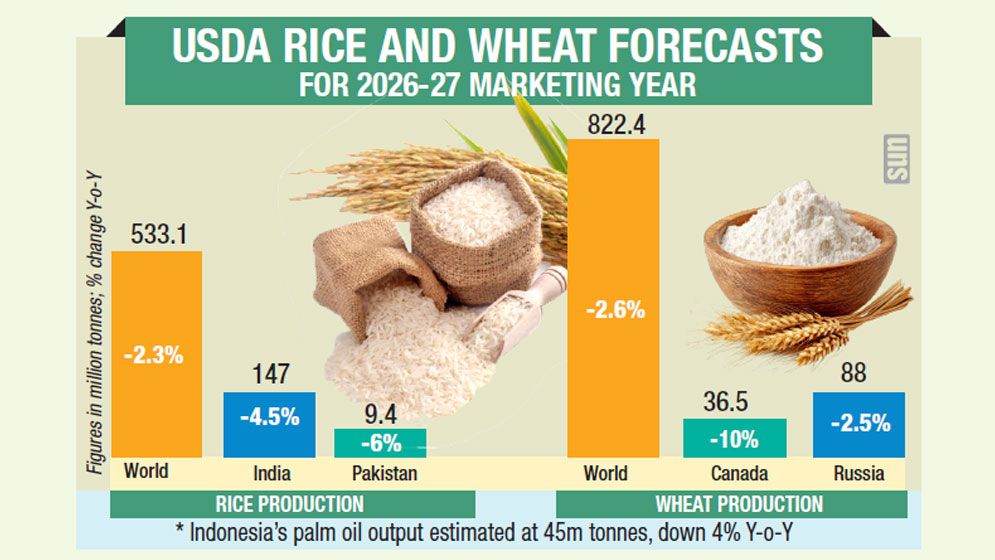
Global rice production is projected at 533.1 million tonnes for marketing year 2026-27, indicating a decline of 2.31% from 2025-26, as per the USDA report.
India, one of the largest rice producers and a key regional supplier, is projected to produce 147 million tonnes of milled rice in 2026-27, down 4.5% from the previous year.
Pakistan’s rice production is also expected to fall 6% to 9.4 million tonnes in 2026-27. Meanwhile, the Philippines’ output for the current marketing year is estimated at 12.1 million tonnes, down roughly 2% from 2025-26.
The global wheat outlook is also uneven, with USDA projections indicating that global production of the staple grain may recede 2.57% to 822.4 million tonnes in the ongoing marketing year.
Canada’s is forecast to produce 36.5 million tonnes of wheat in 2026-27, down 10% from the previous year’s record harvest. Similarly, Australia’s production is estimated at 31 million tonnes, indicating a decline of nearly 14%.
Russia’s wheat production is projected at 88 million tonnes, down by about 2.5 percent from the previous year of 2025-26.
On the other hand, Argentina’s output of the staple grain is estimated to decline almost 23% to 21.5 million tonnes.
However, India’s wheat production is projected to rise 2.6% year-on-year to about 121 million tonnes. Likewise, Pakistan’s wheat output for 2026-27 is estimated at 29 million tonnes, up about 2 percent from the year prior.
Furthermore, Turkey is expected to produce a record 23 million tonnes of wheat, supported by favourable rainfall and improved yields.
This mixed outlook means Bangladesh’s wheat import costs will not only depend on global production totals, but also which exporters have available supplies as well as international prices, freight rates and terms of individual purchases.
Also, the USDA estimates Indonesia’s palm oil output for 2026-27 will be 45 million tonnes, down by 5% from its September forecast and 4% year-on-year.
Indonesia’s output matters as the archipelago is a major supplier of palm oil while Bangladesh depends on imports for a vital portion of its demand for the key cooking ingredient.