



 For all latest news, follow the Daily Sun's Google News channel.


Fewer traffickers convicted despite surge in prosecutions
Bangladesh steps up anti-trafficking efforts, but gaps persist: US report
Daily Sun Report, Dhaka
Published: 10 Oct 2026, 12:00 AM
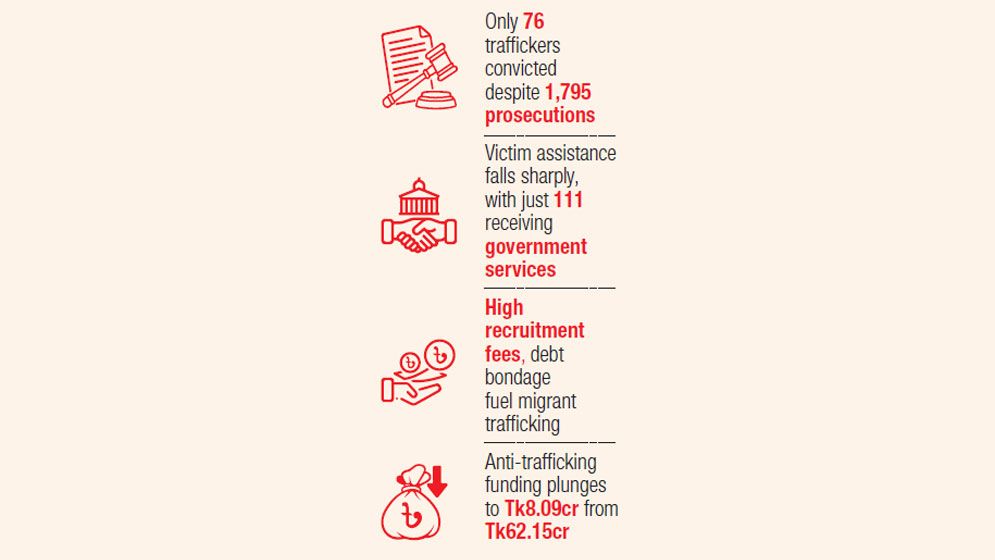
Bangladesh convicted just 76 human traffickers despite a sharp rise in prosecutions, while victim identification and access to government assistance declined, according to the US Department of State’s 2026 Trafficking in Persons Report.
The report said Bangladesh had not fully met the minimum standards for eliminating human trafficking but was making significant efforts, retaining its Tier 2 ranking.
Although investigations, prosecutions and legal reforms increased, gaps persisted in tackling domestic trafficking, protecting victims and regulating recruitment fees charged to migrant workers.
Authorities initiated prosecutions against 1,795 suspects during the reporting period, up from 452 previously. However, convictions fell to 76 from 103 in 2024 and 407 in 2023.
Courts sentenced only 35 convicted traffickers to prison terms ranging from three months to life, alongside fines of Tk5,000 to Tk5 lakh. Sentencing details for the remaining offenders were unavailable. The report warned that fines in place of proportionate prison terms weakened deterrence.
Authorities investigated 961 cases involving 5,263 suspects, up from 811 cases previously. These included 137 sex trafficking cases, 443 involving forced labour and 381 involving unspecified forms of trafficking. Investigations into 1,135 earlier cases and prosecutions against 1,683 suspects from the previous period continued.
Limited investigative expertise, inadequate evidence and reliance on victim-witnesses hampered cases. Poor police-prosecutor coordination caused delays, while some judges and prosecutors needed further training.
In January 2026, the government introduced an ordinance on preventing and suppressing human trafficking and migrant smuggling, expanding the definition of exploitation to include forced criminality and updating investigative procedures. Parliament enacted it into law in April.
Victim identification and support decline
Authorities identified 1,135 victims, including 199 of sex trafficking, 510 of forced labour and 426 of unspecified forms, down from 1,462 previously. Civil society organisations and international bodies identified another 4,758 victims.
The government referred 745 victims to care, less than half the previous 1,607, while just 111 received government services, down from 883. Although Tk21.28 crore was allocated for victim services, NGOs questioned whether all the funds benefited trafficking victims, citing possible expenditure on the Rohingya refugee response.
Shelters remained inadequate, particularly for men and victims outside Dhaka. Fear of retaliation, insufficient police protection and lengthy proceedings further restricted access to justice.
Courts ordered 48 convicted traffickers to pay Tk13.2 lakh in restitution, but all appealed. Compensation from the government’s victim fund remained rare, while out-of-court settlements often required victims to withdraw testimony, undermining prosecutions.
Recruitment costs fuel exploitation
High recruitment fees, deceptive job offers and debt bondage continued to expose migrant workers to trafficking. Although the Overseas Employment and Migrants Act 2013 criminalises fraudulent recruitment and unlawful fees, legal migration costs ranged from Tk85,000 to Tk2.62 lakh, depending on destination.
Many workers paid more than permitted, often borrowing heavily. Sub-agents, or dalals, charged additional fees and sometimes supplied fake visas or misleading job information. Rules introduced in July 2025 allowed registered sub-agents to collect fees equivalent to six to eight months’ salary, potentially increasing migrants’ debt burdens.
Recruitment agency classification rules amended in October 2025 to promote skilled migration, complaint mechanisms and employer-paid recruitment remained unimplemented.
Charges were filed against nearly 100 agencies over excessive fees, but all cases remained pending. No investigations, prosecutions or convictions of government employees for trafficking-related involvement were reported, despite concerns about alleged official complicity.
Bangladesh signed additional labour agreements with Saudi Arabia, Italy, South Korea and Japan. A digital overseas employment platform launched in December 2025 aimed to streamline recruitment and eliminate a mandatory Tk1,350 migration fee per worker.
Rohingya refugees and children at risk
The report criticised inadequate investigations and prosecutions of trafficking crimes involving Rohingya refugees. More than one million refugees live in 34 camps in Cox’s Bazar and on Bhasan Char, where traffickers exploit them through forced labour and sex trafficking, including along routes to India, Malaysia and Nepal.
Restricted employment, limited economic opportunities, inadequate camp oversight, distrust of security services and unclear reporting mechanisms increase their vulnerability and impede access to justice.
Children also faced widespread exploitation. An estimated 3.4 million children were homeless, with some forced into begging, criminal activities and drug transportation. About 30,000 girls were estimated to be victims of child sex trafficking.
The Department of Inspection for Factories and Establishments removed 5,122 children from hazardous conditions, up from 3,697 previously. However, staffing and resource shortages constrained inspections, particularly in the informal sector, where an estimated 93% of child labour occurs.
Government spending on anti-trafficking prevention fell sharply to Tk8.09 crore from Tk62.15 crore in the previous reporting period.
The report called for stronger prosecutions, better-funded victim services, action against exploitative recruitment and accountability for officials implicated in trafficking.