


 For all latest news, follow the Daily Sun's Google News channel.


THE DISAPPEARING CLASSROOMS OF THE DELTA
How climate shocks are pushing Bangladesh’s children out of school – and out of the system

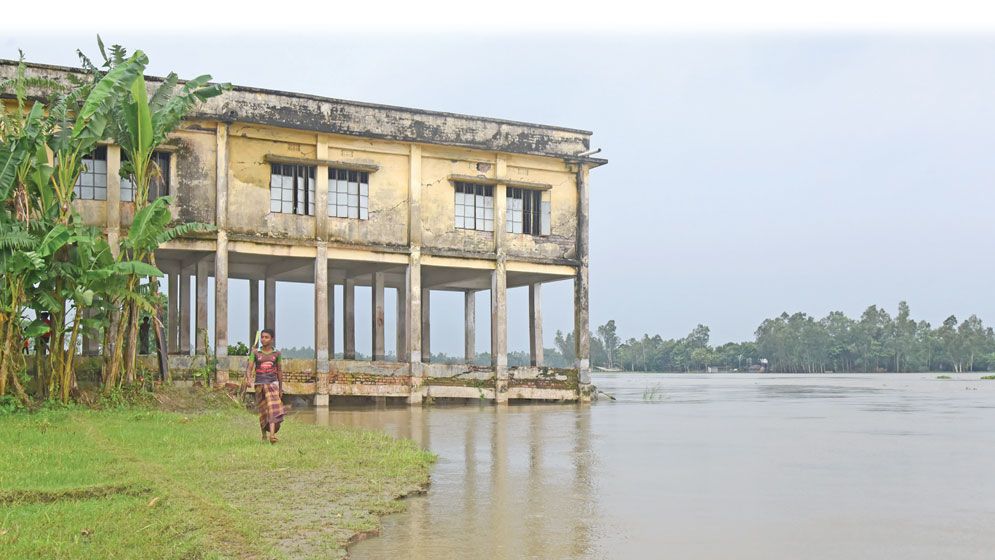
Char Godagari Government Primary School in Sariakandi upazila, Bogura, stands dangerously close to the swelling River Jamuna in this photo taken a year ago. The school building has since been completely swallowed by the relentless riverbank erosion. Photo: DAILY SUN
At just twelve, Sharmin knows the acrid, metallic taste of saline water long before she understands the global diplomacy of climate finance.
In her village near Gabura in Shyamnagar, Satkhira, on the muddy fringes of the Sundarbans in south-western Bangladesh, freshwater tubewells have long been useless because tidal water has intruded into the groundwater.
Every morning at dawn, before opening a textbook, Sharmin walks three kilometres across damaged embankments carrying a heavy plastic jerrycan to fetch drinking water.
Her routine is shared by many women and girls across the disaster-prone coastal belt, where salinity, water scarcity and recurring cyclones have turned basic necessities into daily struggles.
Even in semi-urban centres, the collapse of groundwater and surface water sources has made safe water an expensive necessity.
Saikat Ahammed Uchchas, a banker in his mid-twenties from Chitalmari upazila in Bagerhat, said ponds have been filled, wetlands have dried and deep tubewells are almost universally contaminated by arsenic.
“Installing new deep tubewells has become nearly impossible because drilling is thwarted by dense stone and sand layers,” Saikat said.
“Bottled or jarred water is now the only safe option, but it remains unaffordable for most of the populace. Those who cannot afford it are compelled to drink arsenic-contaminated water. If this is the reality at the upazila headquarters, the situation in the surrounding villages is far more severe, where fragile soil and geo-bag embankments repeatedly collapse against the surging River Poshur,” he maintained.
For children, the crisis extends far beyond the hours spent collecting water.
According to UNICEF’s “Children’s Climate Risk Report”, released in June 2026, an estimated 59 million children in Bangladesh are exposed to at least one major environmental hazard, while nearly 90% face multiple overlapping shocks at once.
Coastal salinity is also damaging traditional livelihoods and farmland.
In Bagerhat, soil and water degradation has hit food security and child nutrition.
“A decade ago, local families relied on fresh, organic vegetables and native fish,” Saikat said, recalling his childhood in Chitalmari. “Now, as salinity and soil degradation destroy traditional agriculture, farming and aquaculture have become heavily dependent on hybrid crops, chemical fertilisers, and heavy pesticides, creating an acute crisis of nutritious food.”
The burden falls unevenly on girls.
A study in the journal Utilities Policy, “A Cross-Sectional View of the Drinking Water Scenario in a Climate-Stressed Setting: Case Study from Southwestern Bangladesh”, found that safe drinking water is unavailable for an average of four and a half months a year in climate-stressed areas of the south-west, and for more than seven months in the worst-hit pockets.
Women and girls are responsible for collecting water in roughly 80% of households, which cuts into girls’ study time and contributes to school absence, according to the findings.
Rafia, an eighth-grader from Chalna village in Dacope, makes a four-kilometre round trip every day, before or after school, to collect drinking water because her mother is unwell.
“Sometimes we have to filter the water multiple times, yet we still fall sick,” she told the Daily Sun, describing how her family is forced to consume contaminated pond water whenever illness prevents her from making the trek.
The health consequences are equally stark.
Along the River Baleshwar in Sarankhola upazila of Bagerhat, Reba Begum of Bogi village lost her husband Nur Islam Talukdar and her eight-year-old daughter Rahima Khatun to Cyclone Sidr in 2007.
She now lives on a government embankment.
Surrounded by water that is too saline to drink, her family walks two kilometres every day to a distant pond for drinking water and uses brackish river water for other household needs.
“Because we are forced to use saline water, my family suffers from constant diarrhoea and stomach ailments. My hair is falling out, skin blisters have spread across our bodies, and we are perpetually ill,” Reba said.
Pavel Hawlader, 30, a fisherman from Chalitabunia village in Sarankhola, said salinity rises in the winter months.
His wife, Champa, 25, and their two sons, aged nine and three, suffer skin lesions, chronic fever and respiratory infections, he said.
Ruma Begum, 33, a poultry farmer in Bogi who lives with her fisherman husband and three children, said saline exposure leaves the family’s skin dark and covered in painful allergic rashes.
Local health and engineering officials said these cases reflect a wider public health problem.
Dr Pradeep Kumar Bakshi, upazila family planning officer for Bagerhat Sadar, said daily use of saline water has both short- and long-term consequences.
“We are observing severe impacts on women’s menstrual cycles and reproductive health, with pregnant women facing acute risks,” he said, adding that “saline water exposure triggers skin diseases, gastrointestinal illness, hypertension, stroke, and heart attacks, while increasing the risk of infertility and reducing overall life expectancy.”
Jayanta Mallick, executive engineer at the Bagerhat Department of Public Health Engineering (DPHE), said climate change is overwhelming the region’s water and sanitation infrastructure.
“Cyclones and floods frequently submerge latrines and breach pipelines, tubewells, and water tanks, causing widespread waterborne disease outbreaks like cholera, typhoid, dengue, and malaria,” he said.
He added that an estimated 20 million people across Bangladesh are currently suffering from climate-induced health conditions.
Syed Mahabubur Rahman, focal person at the Community Development Centre (CODEC) in Bagerhat, said nearly 95% of coastal residents in the worst-affected zones have some form of skin allergy or chronic sore because of extreme salinity.
“When open freshwater sources collapse, the loss of agricultural yield, vanishing aquatic life, and constant disease burden force families into a corner,” he told the Daily Sun, adding, “Communities are left with no choice but to migrate, push young girls into early marriage, or see disenfranchised youth drift into online gambling and informal exploitation.”
Javed Parvez, executive engineer at the DPHE in Satkhira, said waterlogging now threatens children’s health and schooling.
“Waterlogging is no longer just an environmental crisis; it has become a severe threat to children’s health and schooling,” he said.
“Prolonged water stagnation leaves students suffering from chronic waterborne illnesses, skin infections, and fever, forcing many to miss classes and eventually drop out entirely. To safeguard their future, we urgently need rapid drainage systems, secure sanitation, and school-based healthcare. All agencies, including DPHE, must work in tandem so every child in Satkhira can learn in a safe, healthy environment.”
The coast is not the only front line.
Around 300 kilometres north, in the Jamuna River basin in Sirajganj, Bogura, and Gaibandha, climate change is pulling children out of school via a different route altogether – not through saline water seeping into the ground, but through riverbanks that simply vanish. The mechanism changes; the outcome does not.
The disappearing schools of the Jamuna basin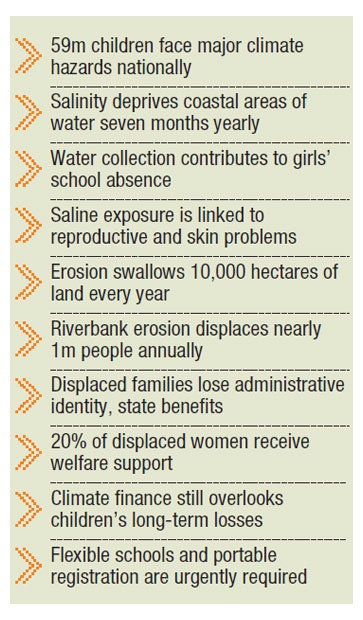
When the Jamuna eats into a char, riverbank or settled island, primary schools – often the only public institution in these isolated communities – can disappear within hours.
It happened to KK Jotpara Government Primary School in Khashkaulia union, Chauhali upazila, at 11:45pm on 25 July 2026.
“The school was washed away by river erosion,” Head Teacher Md Riaz Uddin told the Daily Sun, adding, “As a result, educational activities were severely disrupted.”
Classes stayed suspended for roughly 20 days before resuming, with the help of the upazila nirbahi officer, in two borrowed rooms at nearby Janata High School.
For the school’s own students, the disruption was less an abstraction than a daily fact.
“As our school was washed away by river erosion, we are continuing our studies temporarily at Janata High School,” said Khadija Khatun, a Class-V student.
Her sister Asiya Khatun, in Class-III, described the gap before that arrangement began: “After our school was washed away by river erosion, our studies were almost completely disrupted. We are currently continuing our studies at Janata High School.”
Children are left severed from education even as shifting silt creates new, unstable land elsewhere.
According to official statistics from the Department of Disaster Management (DDM), riverbank erosion swallows approximately 10,000 hectares, or 100 square kilometres, of land across Bangladesh every year.
DDM data shows that this relentless land loss directly or indirectly affects around one million people annually, triggering long-term homelessness, extreme poverty and widespread structural devastation.
The effects vary across the Jamuna corridor.
The Vulnerable Women Benefit (VWB) Social Protection Study, a 2026 field study of 392 climate-displaced women in Kazipur upazila of Sirajganj and Saghata upazila of Gaibandha, was authored by Shahadat Hussein, additional deputy commissioner (ADC) of Sirajganj, with researchers affiliated with Cornell University. The research is currently under review for publication in international academic journals. It found that while seasonal flooding in Kazipur allows some land to re-emerge, riverbank erosion in Saghata is permanent.
In Saghata, 95.8% of displaced families permanently lose their land, 95.3% lose their homesteads, and 100% report losing their primary source of income, according to the research summary obtained by the Daily Sun.
For families there, permanent erosion can end children’s schooling altogether.
Momin Mia, not his real name, lost all of his farmland and his homestead in Saghata to the river three years ago.
He now pulls a rickshaw in Dhaka and supports his family, who remain in Saghata.
His wife, 12-year-old son and 16-year-old daughter live on a remote Jamuna char with nine or ten other displaced families. The nearest school is more than five kilometres away, across sandbars and river crossings.
Both children have dropped out.
Momin said he is preparing to marry off his daughter and move his wife and son to Dhaka, where his wife would work as a domestic worker and his son in a bakery.
Families in other riverine upazilas, including Kazipur, Chouhali and Belkuchi, describe similar patterns.
ADC Shahadat, who spoke to the Daily Sun for this report, said that when a riverbank collapses, families lose not only their homes and crops but also the administrative identities that connect them to social protection.
“National Identity Cards get buried in river mud, and union beneficiary lists fail to track mothers who have shifted to embankments three kilometres away,” he said.
At a stakeholder workshop organised by SHARP NGO in Kazipur upazila, char residents listed their most pressing problems on paper: loss of social identity, lack of education, absence of clean water and near-total isolation from emergency medical facilities.
One entry said a snakebite victim died on the slow journey to Sirajganj Sadar because transport depended on hand-pulled boats.
The residents’ main demand was not only relief but formal recognition.
Cut off from the mainland, they said, they feel like stateless refugees in their own country.
Rahela Begum, 41, from Kazipur, was interviewed for the VWB study after the Jamuna flooded for seven consecutive weeks and she lost her homestead, paddy and cattle.
“Life was a calculation of loss. We sold the tin from our roof, then the goats, then my wedding jewellery. By the time any help arrived, we had nothing left to protect. We weren’t just displaced; we were erased,” she said.
Fatema Khatun, 44, from Saghata, whose homestead is now under water, described being unrecorded by official systems.
“They ask for a permanent address on the form, but my address is a boat today and a roadside tomorrow. The system isn’t made for people whose land has turned into water. The government computer says I don’t live here, so I am a ghost in the system,” she said.
Standing on the embankment at Kazla union in Sariakandi upazila of Bogura district, Osman Goni, 48, pointed to the river where his village stood six months ago. He has been a victim of river erosion four times over the last decade.
“When the river took our primary school, it took our children’s future with it,” he said over the sound of the water.
“We can rebuild a tin shed for shelter within days, but how do you rebuild six years of lost schooling when the nearest remaining school is two hours away across open river?”
Education in these settlements follows the rising waters and seasonal work rather than the school calendar.
Findings from the 2026 Jamuna Corridor Research Programme show that 11.9% of displaced mothers in Kazipur reported children dropping out of school in the period after a disaster before support arrived.
In Saghata, 6.3% of displaced families sent their children to work – four times the rate among flood-affected families.
“When the disaster hits, the men often go to the city to find work as rickshaw pullers to send money back. I am left behind to handle the empty pot. My eldest daughter stopped school to help me with the younger children,” one displaced mother in Kazipur said.
In a companion survey of 625 children across Sirajganj and Gaibandha, researchers found that domestic care burdens, psychosocial discouragement and perceived inequality of opportunity were the three strongest predictors of whether a child continued their education.
ADC Shahadat said services in char areas need to be designed for local conditions.
“There should be schools on raised platforms with residential facilities for teachers during the flood season, healthcare outreach that can arrive by boat, and sanitation solutions that function when the water level rises by two metres,” he said.

When displacement makes children invisible
Official loss assessments tend to count damaged crops and infrastructure.
Non-economic loss and damage (NELD) – interrupted schooling, trauma, child labour, lost cultural connections, and early marriage are frequently overlooked in these evaluations.
Climate adaptation planning, including the National Adaptation Plan, has focused largely on physical works such as embankments, sluice gates and polders.
The gap shows in social protection delivery under the Vulnerable Women Benefit (VWB) programme.
According to the VWB Social Protection Study, 92.5% of displaced women in Kazipur know the programme exists, helped by social networks that survived displacement.
In Saghata, where permanent erosion scatters families, only 20.4% of displaced women have heard of it.
Overall, fewer than one in five eligible displaced women receives benefits.
The study also found that 88.5% of displaced women surveyed across the corridor named one reform as most urgent: updating beneficiary lists immediately after each major disaster, rather than keeping static lists that leave newly displaced families unrecorded.
For families already pushed from their homes, the loss of an official address can mean losing access to the support meant to protect them.
That gap is increasingly drawing attention to what climate finance misses: the education, health and future children can lose when displacement takes hold.
Bangladesh accounts for less than 0.5% of global historical greenhouse gas emissions, yet it is on the front line of climate displacement.
Dr Farah Kabir, country director of ActionAid Bangladesh, emphasised that non-economic loss and damage deeply affects children, who are among the most vulnerable to climate change.
“Their vulnerability deepens when climate change forces them into displacement, undermining their rights to education, health, safety, and a secure environment, while disrupting their social and cultural connections,” Farah said, adding, “These constitute significant non-economic losses that are often overlooked.”
She noted that global climate finance has yet to adequately address non-economic Loss and Damage and the specific vulnerabilities of children.
“We therefore call for a child-sensitive Loss and Damage Fund that protects the rights, dignity, cultural identity, and future of children affected by climate change,” Farah Kabir told the Daily Sun.
She added that climate-related disruptions disproportionately affect girls by restricting their regular school attendance, time for rest, personal development, and community participation, while heightening the risk of early marriage and school dropout.
“To mitigate these impacts, climate policies must prioritise climate-resilient and accessible education, reliable access to safe water and essential services, and gendered recognition of unpaid care burdens,” Farah explained.
What would keep children in school?
Internationally, advocates such as Farah Kabir have urged governments to establish child-sensitive social protection mechanisms to prevent climate shocks from forcing families into negative coping strategies like child marriage and child labour.
She also advocated for the meaningful engagement of children and adolescents in climate planning as rights-holders and agents of change, while calling for predictable funding windows for displacement rehabilitation within international loss and damage arrangements.
Nationally, ADC Shahadat said welfare registration should be decoupled from fixed addresses so displaced people do not lose entitlements. Enrolment should be portable across union parishad boundaries, while mobile units should restore National Identity Cards after disasters.
Some community-level measures are already in place.
Rainwater harvesting systems, solar-powered desalination units and modular classrooms have been introduced in flood-prone areas.
Under initiatives such as the UN Women-supported EmPower project – implemented by Initiative for Right View (IRV) with support from Manusher Jonno Foundation (MJF) and UN Women Bangladesh – the installation of rainwater harvesting systems in coastal upazilas such as Koyra and Dacope has meant local families no longer spend hours walking along broken embankments to collect water.
The time saved allows women to take up local income-earning work and helps girls stay in school.
These measures can ease some of the pressures climate shocks place on families, but keeping children in school ultimately depends on whether essential services can survive alongside them.
For Sharmin, the future still depends on whether a school can remain standing and whether the water she carries home can be made safe.
Back in Gabura, she stands on the embankment overlooking the saline river that threatens her home.
She still carries water every morning.
“I don’t want to move to a slum in Dhaka and work as a maid,” she says, looking toward the horizon.
“I want to stay here, finish my studies, and become a doctor. But to do that, we need a school that doesn’t wash away, and water that doesn’t make us sick.”
[Note: The names of the children cited in this report have been changed to protect their identities.]