



 For all latest news, follow the Daily Sun's Google News channel.


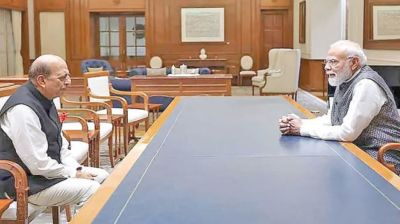
The prime minister of Bangladesh received an invitation to visit Delhi soon after taking the oath in February. After assuming power, he visited Malaysia and China and went to New York to attend the UN General Assembly session, but he did not make the much-discussed Delhi visit. He did not even receive an invitation to attend the BRICS summit held in Delhi. As a result, discussions and speculations about his possible visit are still ongoing.
During the BRICS summit, Bangladesh’s State Minister for Foreign Affairs Humaiun Kobir said with a smile that Tarique Rahman was not invited as Bangladesh’s prime minister, so he did not go. Well, would he have gone if he had been invited as the prime minister?
Whenever Humaiun Kobir faces journalists, a question is thrown at him again and again: when will the prime minister visit India? Kobir answers in different ways at different times, depending on his mood. Occasionally he says that discussions are ongoing. Sometimes he says that progress is being made in the talks; you will know when the time is right. He sometimes says that the visit will not take place unless Sheikh Hasina, who took refuge in India, is extradited. Journalists never ask him any additional questions. No one asks why the prime minister will go to Delhi. What is his business there?
The exchange of high-level visits is a natural outcome between the two countries. Frequent visits can be a measure of warmth in relations. But that is not the only benchmark. Bangladesh’s achievements from the prime minister’s visits to Malaysia and China are not yet visible. Courtesies are exchanged during the visits. True. But expectations always run beyond that, especially when a government declares ‘Bangladesh First’ as its foreign policy thrust. The Bangladesh-China Joint Declaration, signed immediately after the said visit, includes what Bangladesh will provide to China. But what China will offer remains very vague and abstract. That ambiguity has not disappeared till today.
Now the question is, what would the prime minister do when he goes to Delhi? Establish amity between the two leaders? Establish goodwill to improve relations between the two countries? Certainly. What is next? Would the prime minister then talk about substantive issues between the two countries – water sharing, border killings, smuggling, security, bilateral trade, communication systems, transit and transshipment, energy assistance, power generation and trade, disaster management, technology and education, tourism – all these? Are these important issues for Bangladesh?
The Indian foreign secretary had visited Dhaka to attend the Foreign Office Consultations, a foreign secretary-level meeting between the two countries. This time, the Bangladesh foreign secretary is supposed to go to Delhi for such consultations. Why is the foreign secretary not going? Is there no need for such consultations? The commerce secretaries of the two countries also used to meet regularly. That meeting has not been held for a long time. Who can say when the Joint Rivers Commission met last? The same is true of the meeting of the home secretaries. Points to note: the political turmoil did not stop military and intelligence engagements. It is as if they are carrying out track-two diplomacy.
There is no end to the topics of discussion between Bangladesh and India. If Tarique Rahman goes to Delhi, there will be no shortage of agenda for him at the negotiating table. But what is Tarique Rahman’s, or Bangladesh’s, preparation for these discussions? Whenever the visit takes place, or whenever the meeting is scheduled, preparations should be made every day. Even if top leaders are not meeting, why are there no official-level meetings? Why are there no expert-level meetings? If there are issues for discussion between the two countries, and if Bangladesh’s interests are involved in those discussions, why are they stalled? If discussions on all issues are stalled, what would Tarique Rahman discuss when he goes to Delhi? And if everything is stalled because the prime minister does not visit Delhi, would we pay the price for it forever?
The interim head of government did meet the Indian Prime Minister in Bangkok, on the sidelines of BIMSTEC. It is heard that he requested his counterpart to ensure that Shaikh Hasina does not speak publicly about Bangladesh while sitting in Delhi. At that time, the issue of extradition did not come up. The issue of the two prime ministers not meeting, if extradition is not forthcoming, did not come up either. Dr Khalilur Rahman was not absent then.
Humaiun Kobir has told reporters several times, “Any issue can be resolved through dialogue.” That is absolutely true. I would be happy if he could reflect that in his deed. In diplomacy, many discussions take place behind closed doors. Many of these never come to the public sphere. Perhaps such discussions are also taking place with Delhi. But there is a superstructure of that informal communication and discussion. That structure also needs to be activated. Unfortunately, this activation is not visible in Bangladesh. Rather, stagnation is noticeable everywhere. If activation and motivation are created, the prime minister’s visit will be meaningful. I expect to see vigorous preparations in the two countries, especially in Bangladesh. We can then be assured that if the top leaders meet, we will effectively present our views in that meeting. We will then be sure: what will Tarique Rahman do when he goes to Delhi? What will he say? The more prepared we are, the more we will gain from the visit.
___________________________________________
The writer is a former Bangladeshi Ambassador