


 For all latest news, follow the Daily Sun's Google News channel.


The number of road accidents and deaths on the Dhaka-Chattogram highway has fallen since AI-powered cameras were installed along a 250km stretch of the road, according to Highway Police figures.
The system, which automatically detects traffic offences and issues fines, was launched on 18 August. Police said the sharp rise in prosecutions reflects improved detection rather than an increase in violations.
Accidents and deaths down
In July, before the system began operating, 47 people died in 47 accidents on the highway.
There were 31 accidents and 43 deaths in August, followed by 34 accidents and 41 deaths in September.
Compared with July, accidents were about 28% lower in September, while deaths fell by six, or about 13%.
Highway Police data for the same three months of 2025 show 45, 42 and 40 accidents, in which 50, 48 and 43 people died respectively.
Rise in prosecutions
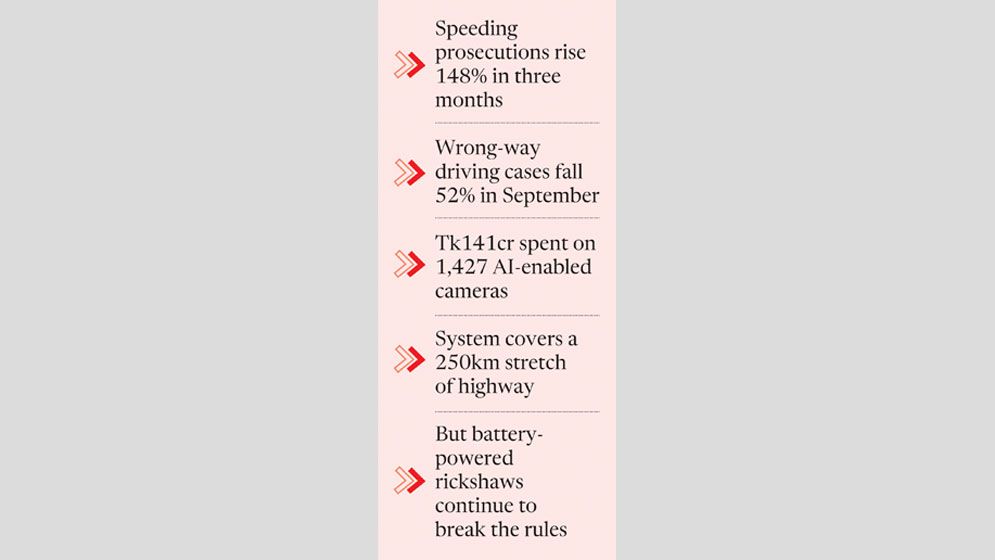
Prosecutions for speeding rose from 326 in July to 765 in August and 807 in September, an increase of about 148% between July and September.
Deputy Inspector General (Admin) of Highway Police Shamsul Alam told the Daily Sun that the rise should not be taken as evidence that more people were breaking the law.
He said violations that had previously gone undetected were now being picked up automatically, so a higher number of detections and penalties was expected.
Wrong-way driving prosecutions also changed after the system was introduced. No such prosecutions were recorded in July, but 42 were recorded in August. The figure fell to 20 in September, a drop of 22, or about 52%, from August.
Shamsul Alam said drivers had become more careful after receiving fines through the system.
Private sector employee Rasel Mahmud, who works for a company in the capital’s Vatara area and regularly travels on the highway, said he had often seen drivers speeding.
He said that in September he was travelling on a Saudia Paribahan bus whose driver ignored passengers’ requests to slow down.
However, as the bus approached an area covered by the AI cameras, the driver reduced his speed, Rasel said.
The government spent Tk141 crore installing 1,427 cameras on 490 poles. The system comprises 924 bullet cameras, 471 PTZ dome cameras, 16 long-vision cameras and 16 AI checkpoint cameras.
Additional Inspector General Faruk Ahmed, also head of the Highway Police, said the impact of the system should not be measured only by the number of cases and prosecutions.
“Taken together, the early message from the automated fine system on the Dhaka-Chattogram highway is a strong one,” he said. “It is hard to escape the eye of the camera if you break the law, and if that surveillance changes drivers’ behaviour, accidents will fall too.”
He said accidents and deaths could fall further in the longer term.
Rickshaws still flouting rules
However, battery-powered auto-rickshaws continue to violate traffic rules, and the cameras have not stopped the practice, reported our correspondents.
The vehicles are most common near markets, bus stands and junctions with link roads.
Many drivers travel on the wrong side of the road instead of using designated U-turns, disrupting traffic and increasing the risk of collisions.
Quoting locals, the correspondents reported that some U-turns are far apart, prompting drivers to use the wrong side of the road to reach their destinations more quickly.
Passengers and pedestrians are put at risk as a result, they added.
On wrong-way driving, DIG Shamsul Alam said police were continuing to monitor such violations manually.