


 For all latest news, follow the Daily Sun's Google News channel.


Four mutual funds trading way above asset values
BSEC, industry people flag risk of huge capital losses if prices fall

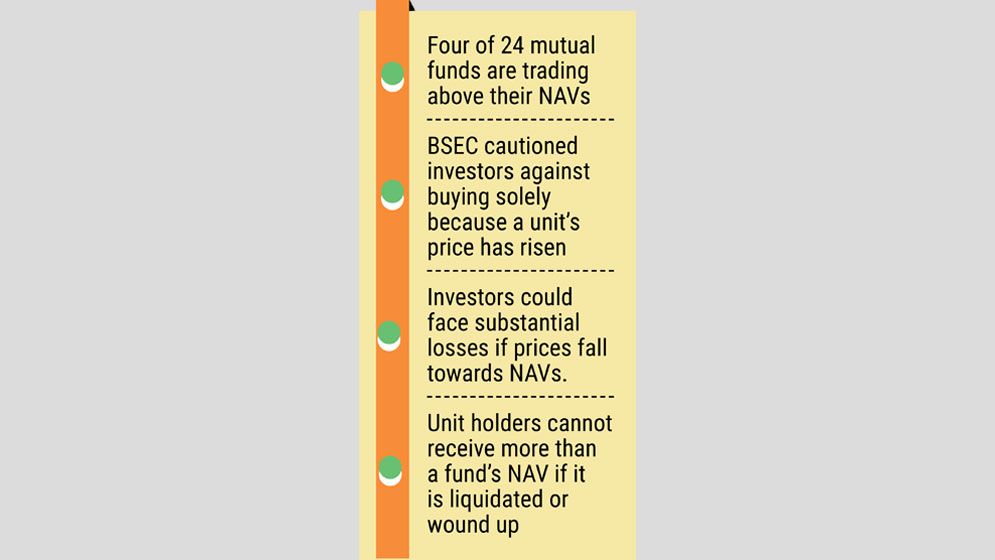
A significant gap has emerged between the market prices of four out of 24 listed mutual funds and their net asset values (NAVs), raising concerns over potential capital losses for investors.
An analysis of the latest NAVs published by the Dhaka Stock Exchange (DSE) on Monday and the funds’ market prices on the same day shows that at least four of 24 mutual funds were trading above their NAVs. In one case, the market price was nearly three and a half times the NAV, while several others were trading at nearly twice their asset values.
According to DSE data, the NAV of 1st Prime Finance Mutual Fund was Tk9 per unit, against a per unit market price of Tk32.20 — about 258% higher than its NAV. The ICB AMCL Second Mutual Fund had an NAV of Tk9.12 and a market price of Tk10.10, while PF First Mutual Fund’s NAV was Tk8.49 against a market price of Tk18. CAPM IBBL Mutual Fund had an NAV of Tk7.95 and a market price of Tk16.90.
The Bangladesh Securities and Exchange Commission (BSEC) has urged investors to exercise caution. BSEC spokesperson Abul Kalam said investors should be particularly careful when there is a significant and abnormal gap between a mutual fund’s market price and underlying NAV, and should not invest solely because a unit’s market price has risen.
Why NAV matters
A mutual fund pools investors’ money and invests it in shares, bonds, financial instruments and other assets. The NAV is the total value of those assets after deducting liabilities. Dividing the NAV by the total number of units gives the NAV per unit, which indicates the proportional value of the assets backing each unit.
Risk for investors
Capital market analyst and ICB Chairman Abu Ahmed told the Daily Sun that the biggest risk of a large gap between market price and NAV is that investors who buy at inflated prices could suffer substantial losses if the market price later moves closer to the NAV.
For example, an investor buying a unit of 1st Prime Finance Mutual Fund at Tk32.20 when its NAV is Tk9 could face a large loss if the market price falls towards the underlying asset value.
He said investors could also pay an excessive premium from the outset if they fail to assess the fund’s assets against its market price. BSEC has cautioned investors on the same issue.
According to the Commission, if a mutual fund is liquidated or wound up, unit holders cannot receive more than the fund’s NAV. Thus, a market price significantly above NAV does not mean the underlying assets have increased in value by the same amount.
Two types of NAV
Many funds report NAVs based on both current market prices and cost prices. For example, 1st Prime Finance Mutual Fund’s market price-based NAV is Tk9, compared with Tk15 on a cost basis. ICB AMCL Second Mutual Fund’s figures are Tk9.12 and Tk13.01, respectively.
Industry stakeholders said the current value of a fund’s assets is more relevant for investment decisions, as the market price-based NAV reflects their current valuation. Assessing a unit’s value based on its historical purchase cost could be risky.
Why prices can exceed NAV
Abu Ahmed said a mutual fund trading above its NAV does not necessarily mean the fund is poor. Demand and supply, liquidity, future expectations, dividend prospects, fund tenure, management quality and investor sentiment can push the market price above NAV.
However, an abnormally large gap raises questions about whether the price increase is supported by an actual rise in the value of the fund’s assets.
BSEC has therefore advised investors to check the latest published NAV per unit, the fund’s financial condition, tenure, investment pattern or portfolio and other available information before investing. It has also cautioned against making decisions based on rumours, social media information or inducements by individuals or groups.
Interest rises after reforms
The mutual fund sector is undergoing regulatory reforms. In 2026, BSEC introduced a new framework for converting closed-end mutual funds into open-end funds or liquidating them at the end of their tenure.
Investor interest has subsequently increased in many funds that had long traded at discounts. Market analysis shows that several mutual fund units recorded rapid price increases in August, with some outperforming the broader market by a significant margin.
Read More