



 For all latest news, follow the Daily Sun's Google News channel.


As Bangladesh marks World Habitat Day today under the theme “Adequate Housing for All”, the nation’s pledge to guarantee basic shelter is colliding with a deepening urban crisis, leaving low- and middle-income families increasingly squeezed out of the capital by soaring rents and speculative land prices.
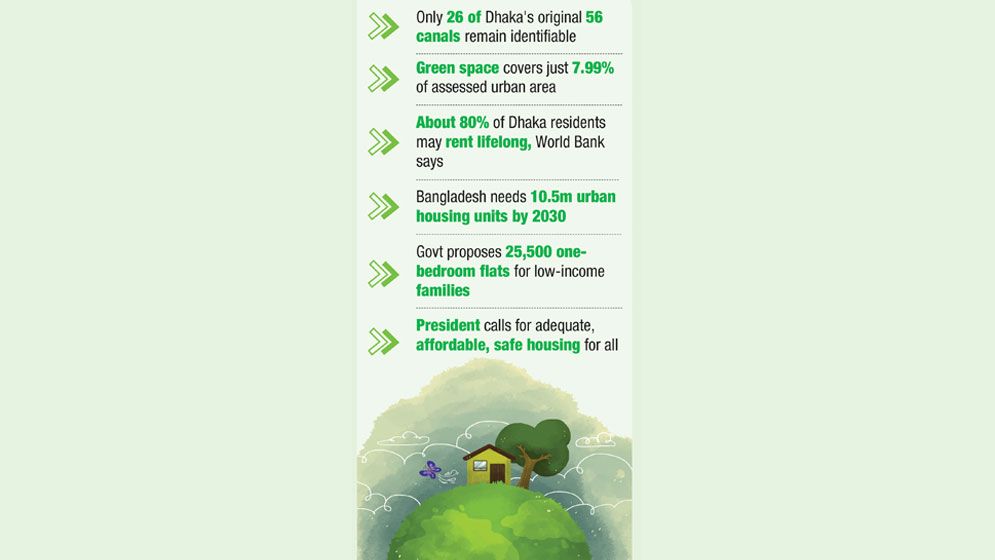
Across Dhaka, up to 40% of lower-income residents now live in substandard housing or informal settlements, according to urban planners, while an estimated 80% of the capital’s population face spending their entire lives in rented accommodation without realistic access to home ownership.
Though a series of high-profile infrastructure and transport initiatives have altered the city’s skyline, residents continue to contend with severe traffic congestion, rampant air and noise pollution, recurring waterlogging, and a rapidly shrinking supply of green spaces.
Data presented by the Bangladesh Institute of Planners (BIP) underlines the extent of the degradation: natural drainage systems have collapsed, reducing the city's identifiable canals from 56 to just 26, whilst 48 urban zones are now classified as chronically prone to waterlogging. Green spaces account for merely 7.99% of the capital’s assessed area.
Adil Mohammed Khan, professor of urban and regional planning at Jahangirnagar University, warned that the deficit is worsening daily due to structural policy failures.
“Although the government has a constitutional responsibility to ensure housing, it has largely turned away from that obligation and left the sector to private developers,” Professor Khan told the Daily Sun.
“The few state-backed initiatives taken so far are minimal compared to the true scale of demand.”
He noted that private developers cater almost exclusively to high-end or upper-middle-income markets, pushing lower-income groups into cramped neighbourhoods devoid of playgrounds, footpaths, or essential civic facilities. High land prices remain the single largest barrier, prompting calls for state-allocated land for social housing.
“No matter how much economic growth we achieve, the housing challenge grows day by day. The government must move beyond acting purely as a facilitator and become an active provider,” he added.
According to a 2024 World Bank report, Bangladesh faces a massive structural deficit, with the “Country Climate and Development Report” estimating that around 10.5 million urban housing units must be constructed or renovated by 2030 to keep pace with demand.
Addressing concerns over the capital's declining liveability and housing deficit, State Minister for Housing and Public Works Ahammad Sohel Monzoor maintained that turning the situation around requires a joined-up approach across government.
“Improving the quality of life requires a coordinated effort involving not only our ministry, but also the Ministry of Environment and other relevant agencies. We have to work together to improve the overall environment, including air and noise pollution and other factors that affect people's quality of life,” he said.
The state minister noted that the government is actively cleaning and restoring water bodies, planting trees, installing public lighting, and expanding camera surveillance in high-density civic zones such as Hatirjheel.
He added that local master plans are currently being drawn up at upazila level to designate suitable sites for industries, cottage crafts, markets, Eidgahs, and other civic amenities.
On the critical issue of affordable shelter, Monzoor emphasised that schemes tailored for middle- and lower-income groups, including long-term payment facilities, are already underway in Dhaka and other urban centres.
“We are working to provide affordable housing for middle and lower income people through our department. We are taking forward various projects in Dhaka as well as other cities,” he said.
He highlighted that apartments have already been constructed for slum dwellers in Kuril, whilst a proposal is currently being processed to build approximately 25,500 one-bedroom apartments for low-income and slum-dwelling families.
He added that development work on various infrastructures in Purbachal, including convention centres, central park, central mosque and educational institutions, is being accelerated.
In a message marking the day, President Mirza Fakhrul Islam Alamgir stressed that ensuring safe, affordable shelter remains a fundamental prerequisite for inclusive national development.
“The housing crisis in the country is becoming increasingly acute due to rapid urbanisation, population growth, high land prices, and the impacts of climate change,” the President said, reiterating the government’s resolve to tackle the shortage for the most vulnerable.