



 For all latest news, follow the Daily Sun's Google News channel.


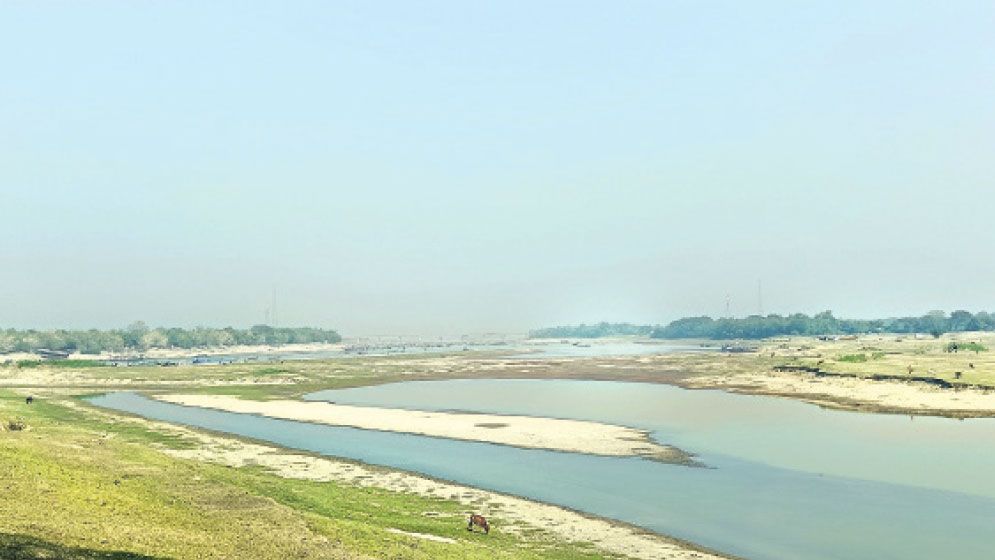
The approaching Boro season has renewed concerns among Sunamganj’s haor farmers as a long-delayed river dredging project, aimed at protecting crops from flash floods, remains stuck in the approval process.
The rivers proposed for dredging are the Surma, Boulai, Boulai-Dhanu Link, Ghora Utra, Upper Meghna, Old Surma, Chamati, Darin, Abua, Boulai-Patlai-Gong (part), Kaunai and Someshwari.
The Water Development Board (WDB) took up a project in 2024 to re-excavate 13 rivers in Sunamganj, Netrokona and Kishoreganj at an estimated cost of more than Tk1,500 crore. However, the project proposal is still awaiting approval from the Ministry of Water Resources, even as the next Boro season approaches.
Farmers fear that the continued decline in the navigability of rivers due to siltation, waste dumping, encroachment and sand and stone extraction will worsen waterlogging and disrupt irrigation in the upcoming season. According to WDB sources, the project was planned for implementation over three years from 2026. Its objectives include improving water drainage during the monsoon, reducing flood pressure, protecting Boro crops, ensuring irrigation during the dry season and restoring fish habitats.
Farmers in Sunamganj have long demanded river dredging as the district faces a peculiar water-flow problem. During the dry season, river water often fails to reach the haors because of the lack of sufficient elevation difference between the rivers and haor areas. During the rainy season, however, river water can enter the haors rapidly, submerging standing Boro crops.
The proposed dredging would also restore navigability on several waterways connecting Sunamganj with Azmiriganj, Kishoreganj, Bhairab and Netrokona, which were once important routes.
Meanwhile, several rivers in Sunamganj are already facing severe navigability problems. The Boulai, Patlai, Rakti and Surma rivers are losing depth, while the Monai and Sarmora rivers in Madhyanagar and Dharmapasha upazilas are also gradually filling with silt.
The Utharia River in Shantiganj is in a critical condition. Once, surplus water from the haors flowed through the river into the Mahasingh River. However, its natural flow was disrupted after a permanent embankment was built near a canal connected to Barodai Beel.
There are also allegations of a permanent embankment being constructed by dumping soil into a canal connecting the Patlai River and the Ganges near the Golabari Watch Tower in Tanguar Haor, which stretches across Tahirpur upazila.
Locals also allege that shops and houses have been built on the river after an embankment was constructed on the Kalagang River in Uttar Sreepur Union.
Jamal Mia, a farmer living on the bank of Tanguar Haor, said he takes loans every year to cultivate Boro rice.
“As the river water does not recede quickly, we cannot maintain the proper schedule for preparing land and planting seedlings. If rain occurs at the beginning of Baishakh, water accumulates in low-lying fields, increasing the risk of extensive crop damage,” he said.
Abdul Hamid, a farmer from Shani Haor, said his entire crop was once destroyed after water suddenly entered the fields before the rice matured.
“Such losses not only wipe out our capital but also increase our debt burden. It takes several years to recover from the loss of a single crop season,” he said.
Bijan Sen Roy, general secretary of the central committee of Haor Bachao Andolan, said Boro seedbeds would be prepared in the haor areas from December. “If the river dredging project is not approved, thousands of farmers will suffer again this season,” he said.
Imdadul Haque, executive engineer of the Sunamganj WDB, said the project would bring significant changes to the haor areas if approved.
“The water drainage system will become much more effective, while irrigation problems will also be reduced,” he said.