



 For all latest news, follow the Daily Sun's Google News channel.


Savers squeezed as deposit rates fall below inflation
Excess liquidity, weak credit demand push rates lower as inflation erodes real returns

For Aminul Islam, keeping money in the bank once meant earning a little extra to help with household expenses. That benefit is steadily disappearing. The private-sector employee has Tk20 lakh deposited with a private bank. Not long ago, a one-year fixed deposit could earn him 9%-10% interest.
Now, with banks cutting deposit rates while inflation remains high, the return on his savings is losing its value.
“There was a time when keeping money in the bank was profitable. Alongside my salary, the return from savings helped ease the burden of running the household. But with high inflation, bank returns are no longer enough,” Aminul said.
His experience reflects a growing concern among savers as banks reduce deposit rates amid excess liquidity, weak private-sector credit demand and falling yields on government securities.
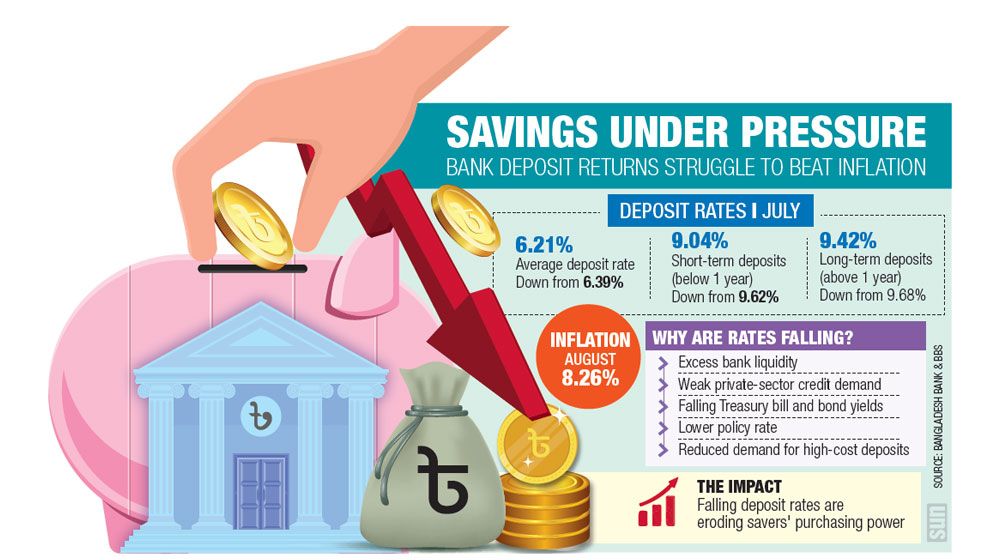
Bangladesh Bank data show that the average deposit rate across banks stood at 6.21% in July, down from 6.39% a year earlier.
Meanwhile, inflation remained significantly higher, at 8.32% in July, leaving many depositors with negative real returns.
Bankers said pressure to lower lending rates, coupled with Bangladesh Bank’s recent policy rate cut, is expected to push lending rates down further.
Anticipating this, banks have begun reducing rates on different types of deposits. Falling yields on government treasury bills and bonds and sluggish private-sector credit demand have also contributed to the trend.
Weak credit demand has left many banks with surplus liquidity, reducing their need to attract additional deposits.
Banks that cannot deploy their funds profitably face higher interest expenses on deposits, prompting some to cut deposit rates.
Stronger banks with ample liquidity and greater depositor confidence have been particularly willing to reduce rates, while weaker banks facing liquidity shortages continue to offer higher returns.
Private-sector credit growth fell to single digits, at 9.84%, in the fiscal 2023-24 and remained sluggish, averaging around 4-6% during FY25 and FY26.
At the end of July, private-sector credit growth stood at 4.62%, according to Bangladesh Bank data.
Government securities yields have also fallen sharply. The yield on 15-year treasury bonds dropped to 9.09%, nearly 1.25 percentage points lower than previously, while the 20-year bond yield fell by more than 1.25 percentage points to 9.12%. Yields on treasury bills have fallen below 9%, with the 91-day bill yielding 8.72%, the 182-day bill 8.81% and the 364-day bill 8.89%.
However, some weaker banks facing liquidity shortages are still offering deposit rates of 11%-12% to attract funds.
For these banks, maintaining a four-percentage-point spread between deposit and lending rates remains difficult.
Why deposit rates are falling
Amid persistently high inflation, Bangladesh Bank has taken several steps aimed at lowering interest rates.
After nearly two years, the central bank cut its policy rate from 10% to 9.5%. It has also set a four-percentage-point spread between deposit and lending rates.
Following the policy shift, most leading commercial banks began reducing deposit rates by 50-100 basis points from the beginning of August. Excess liquidity and weak private-sector credit demand have reduced banks’ need to mobilise fresh deposits, encouraging them to lower rates.
The trend is squeezing savers. With inflation still hovering above 8%, further cuts could push deposit rates to around 8.5%-9%, leaving many depositors with little or no positive real return after accounting for inflation.
Mustafa K Mujeri, former chief economist of Bangladesh Bank, said a bank’s financial strength and credibility have become increasingly important considerations for depositors.
“For depositors, a bank’s financial strength and credibility have now become more important than high interest rates. Weaker banks still have to offer relatively higher rates to attract deposits, but stronger banks no longer need to offer the high rates they previously did,” he said.
Mujeri said reducing the cost of funds would give banks greater flexibility in managing their investments. Relatively weaker banks, however, still need to offer higher rates to retain existing deposits and attract new ones.
Commenting on the policy rate cut, he said investment momentum in the country had stalled while official inflation had eased somewhat. Against this backdrop, Bangladesh Bank lowered the policy rate to support investment.
Syed Mahbubur Rahman, managing director of Mutual Trust Bank, said lower yields on treasury bills and bonds, ample banking-sector liquidity and satisfactory deposit growth had reduced the need for banks to mobilise funds at high rates.
Earlier, higher deposit rates helped banks attract funds and maintain strong deposit growth. But leading commercial banks now have excess liquidity while credit demand remains weak, reducing the need for high-cost deposits, he said.
Rahman added that treasury bill and bond yields have fallen while banks continue to hold surplus liquidity and deposits are still growing. As a result, deposit rates could decline further, potentially falling below inflation and further eroding savers’ real returns.