



 For all latest news, follow the Daily Sun's Google News channel.


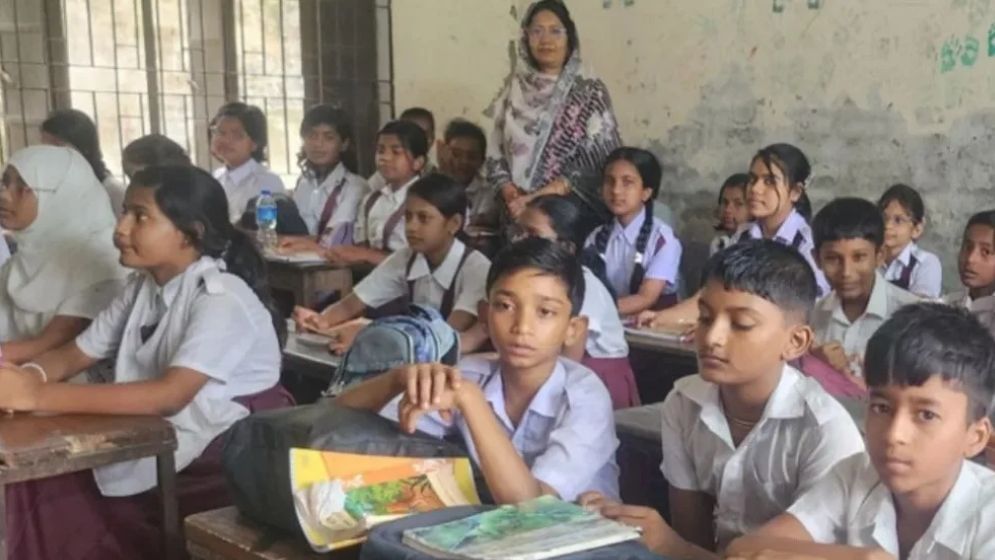
File Photo: UNB
Mazharul Islam Munna, a research assistant at a private organisation, often needs data for education-related research. He previously faced difficulties in using primary education data as different surveys often provided different figures, but recently he found out about IPEMIS, a single, integrated platform that enables researchers and other users to access a wider range of primary education data.
The Integrated Primary Education Management Information System (IPEMIS) was opened for public use on 31 March 2022. Since then it has been playing an important role in monitoring the schools’ activities in real-time and gathering vital information like how many students of a school are participating in or being absent from different activities.
The platform stores and manages key information on officials and employees, schools, teachers, students, school infrastructure, annual statistics and textbook distribution within an integrated framework, all of which are necessary for policymaking and development.
IPEMIS currently contains profile information of 6,054 officials and employees and has 112,483 active primary schools registered across the country, including 65,569 government primary schools, said sources.
The system also contains data on 738,774 active teachers, including 372,537 teachers of government primary schools, as well as student data on a total of 21,217,723 learners. Of them, numerical data on 10,039,048 students of government primary schools are available in the system.
The system belongs to the Directorate of Primary Education under the Ministry of Primary and Mass Education. It is funded by UNICEF and the Asian Development Bank under the Fourth Primary Education Development Programme (PEDP-4), while Dynamic Solution Innovators Ltd (DSi) designed, developed and maintains the system.
IPEMIS is transforming primary education governance in Bangladesh by providing real-time, school-level data to support more equitable planning, resource allocation and service delivery, Deepa Sankar, chief of education at UNICEF Bangladesh, told the Daily Sun.
She said that by making information on students, teachers, infrastructure and learning conditions readily available, IPEMIS helps identify and address disparities, particularly among schools in remote and underserved areas.
Deepa said that the integrated system helps policymakers target resources, strengthen classroom support and create more responsive learning environments, ultimately improving student participation and learning outcomes.
Currently, IPEMIS has 24 modules covering personnel, school, teacher, scholarship, learning, training, statistics, book distribution, student assessment, pre-primary education, emergency education, e-monitoring, school improvement, special needs and disabilities, equipment, non-government school registration, property management, completion exams, remote learning, complaints, user management, citizen services, dashboard and reporting.
The system was also used to prepare the results of the Primary Scholarship Examination 2025, with scholarships awarded to 79,246 students. On the other hand, online transfer processes for 60,653 government primary school teachers were successfully completed between 2023 and 2025 based on applications submitted online.
Mushraful Hoque Anik, director (technology) of Dynamic Solution Innovators (DSI), told the Daily Sun there were separate systems for various functions in primary education, including teacher management, school management and census management.
As a result, the same information had to be entered five to seven times. Since the systems were not interconnected, one system would contain one type of information, while another system would show different information. This resulted in a large amount of inaccurate and inconsistent data.
He added that IPEMIS has centralised these separate systems.
IPEMIS is also helping improve textbook distribution by reducing the scope for inflating student numbers to obtain excess books. Its Book Distribution module uses school, teacher and student data to determine actual textbook demand and tracks deliveries to schools, helping curb misuse and ensure books reach the intended recipients.
The official platform describes IPEMIS as a digital system covering the major pillars of primary education, allowing users to analyse information, support decision-making and prepare reports from a common platform. This can reduce dependence on paperwork and make administrative processes more structured.
IPEMIS also provides a data repository through which users can search for education offices and schools. The system includes searches for facilities and characteristics such as electricity, internet connectivity, playgrounds, libraries and special-needs schools.
Josna Begum, head teacher of Abdul Bari Government Primary School (140478) in Chandgaon, Chattogram, told the Daily Sun that the software is very helpful for entering and managing data.
“Previously, we faced difficulties in submitting data through different platforms,” she added.
Mohammed Shahidul Islam, director of the Information Management Division (IMD) of Directorate of Primary Education, also echoed this comment.
The system is also designed to strengthen communication between the ministry, the Directorate of Primary Education and field-level officials. According to the official website, the scale of the primary education sector makes digital communication and information management essential for ensuring speed and transparency.
The platform has also opened a channel for citizen participation. Parents and citizens can provide suggestions, comments and complaints concerning school development through the system. The citizen-service section currently lists 84 documents, including laws and policies, reports and publications, ICT equipment-related documents, training materials, development activities and government orders.