


 For all latest news, follow the Daily Sun's Google News channel.


A total of 187 factories have been shut down over the past two years following the political changeover in August 2024, leaving 29,739 workers jobless in Chattogram.
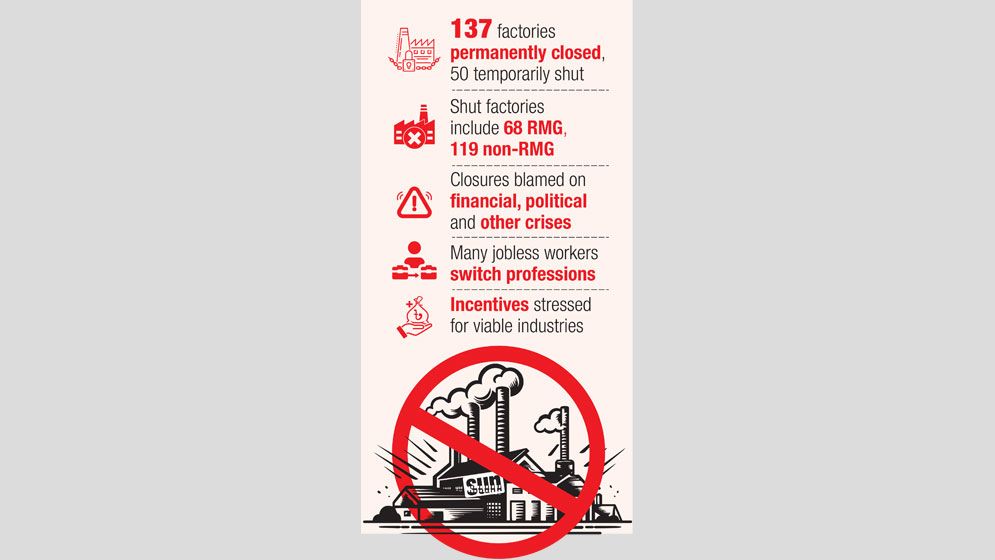
According to sources at Industrial Police-3 in Chattogram, 137 of the factories, employing 21,976 workers, have been closed permanently, while the remaining 50, with 7,763 employees, have suspended operations temporarily.
Available data show that 105 factories were permanently closed and another 30 temporarily shut between August 2024 and December 2025.
In addition, 32 factories have been permanently closed and 20 others temporarily shut between January and September this year.
The affected establishments include 68 readymade garment (RMG) factories and 119 non-RMG general and export-oriented industries, including jute mills, pharmaceutical plants, edible oil and vegetable oil factories, cement and steel factories, sugar mills, power plants and ship-breaking yards.
Industry insiders attributed the closures to the global economic downturn, declining orders from foreign buyers, failure to pay workers’ wages and allowances, disputes among owners, owners fleeing the country following the political changeover, cases filed against them, power shortages, loan-related problems and difficulties in opening letters of credit (LCs).
In July this year, 11 factories of S Alam Group were shut down simultaneously as the business conglomerate failed to import raw materials amid various legal complications.
Md Sohel, owner of Sun Garments in the city’s Pahartali area, shut down his factory in December last year amid what he described as undue political pressure, extortion demands and problems related to bank loans.
“There were around 450 workers at my factory, which was run as a partnership business. I had to shut it down due to various problems created by local political leaders and loan-related issues, resulting in huge losses,” he said.
“I resumed production on a limited scale in June with only 150 workers under the name SR Garments,” said Sohel, urging the authorities to ensure a strict law-and-order situation for the smooth operation of factories.
Industrial Police-3 Chattogram Superintendent of Police (SP) Mahmuda Begum told the Daily Sun that the factories had been closed over the years for various reasons, including some owners going into hiding.
Many workers who lost their jobs have switched professions, while many others have found similar jobs in other factories, she said.
However, there are no specific statistics on the current status of the workers who lost their jobs, the SP said.
“We also frequently face troubles at different factories, mainly over delays in paying workers’ wages. Instigation by troublemakers is one of the main reasons behind unrest in some factories,” she said.
“We are keeping a close watch on the factories to ensure workers receive their wages on time to avert any unrest,” Mahmuda added.
Contacted, Bangladesh Garment Manufacturers and Exporters Association (BGMEA) Director Rakibul Alam Chowdhury said some factories, which had been grappling with multiple challenges since the Covid-19 pandemic, could not withstand financial pressures stemming from loans and order cancellations for various reasons.
Besides, some owners shut their factories for political reasons, including fleeing the country and facing cases after the political changeover on 5 August, he said, adding that they were also struggling to run their businesses amid various crises, including the ongoing conflict in the Middle East.
Bangladesh Institute of Labour Studies (BILS) Chattogram Chapter Coordinator Fazlul Kabir Mintu said many skilled workers who lost their jobs are now engaged in informal activities such as driving battery-run auto-rickshaws, street vending and hawking.
The lack of employment opportunities could push some of them towards criminal activities to maintain their livelihoods, he feared.
As most industries lack effective trade unions, workers ultimately turn to police and other government agencies to seek payment of their outstanding wages and benefits, he said.
Mintu called for proper scrutiny of the reasons behind factory closures and incentives for viable enterprises so that new employment opportunities can be created and economic activities accelerated.
However, industrialists involved in corruption and money laundering should be brought to justice following proper investigations, he added.
Chattogram Chamber of Commerce and Industry (CCCI) President Mohammed Amirul Haque also stressed the need for government initiatives to revive sick industries and bring them back into mainstream production to keep the economic wheel moving.