





 For all latest news, follow the Daily Sun's Google News channel.


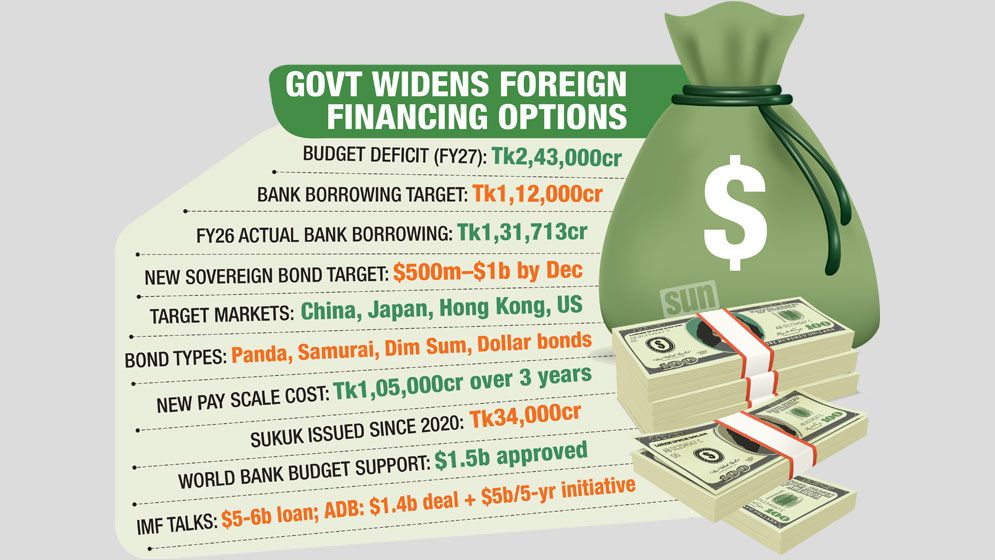
Faced with a widening budget deficit and revenue collection that continues to trail targets, the government is working to steer away from heavy reliance on bank loans, turning instead to a broader mix of financing tools, including sovereign bonds, sukuk and multilateral support, to fund the budget while easing pressure on the domestic banking system.
As part of this shift, Bangladesh plans to issue its first-ever sovereign bonds in international markets, targeting $500 million to $1 billion by December through issuances in China, Japan, Hong Kong and the United States. Budget support from the IMF, World Bank and Asian Development Bank (ADB) is being pursued in parallel, alongside an expanded sukuk programme.
The national budget for current 2026-27 fiscal year (FY27) sets total expenditure at Tk9,38,000 crore against a revenue target of Tk6,95,000 crore, leaving a deficit of Tk2,43,000 crore. Of this, Tk1,12,000 crore is earmarked to come from bank borrowing.
In the previous fiscal year, actual bank borrowing came in at Tk1,31,713 crore, somewhat above target – underlining why the government is now keen to widen its options.
In the first two months of the current fiscal year, the government borrowed Tk16,601 crore from scheduled banks while repaying Tk3,728 crore to Bangladesh Bank, taking net borrowing to Tk12,872 crore.
Officials say reducing this kind of dependence on the banking system is a key aim of the new financing push, since heavy government borrowing can otherwise squeeze credit available to the private sector.
Adding to the pressure is the cost of the newly approved pay scale, expected to require around Tk1,05,000 crore over three years, with Tk44,000 crore already allocated in this year's budget for partial rollout.
Bond options on the table
Officials say the government is weighing several bond types as it looks beyond conventional borrowing: Panda bonds (yuan-denominated, issued in China), Samurai bonds (yen-denominated, in Japan), Dim Sum bonds (offshore yuan bonds typically issued in Hong Kong) and conventional dollar-denominated bonds in the US market. The size and terms for each are yet to be finalised.
A high-level committee has been formed to assess feasibility and shape the strategy, and has received the go-ahead from Finance Minister Amir Khosru Mahmud Chowdhury, with final approval said to be imminent. Sources close to the process indicate a preliminary decision has already been taken to proceed with a Panda bond issuance, given China's deep domestic investor base.
Sukuk and multilateral routes
Alongside sovereign bonds, the government is looking to scale up sukuk issuance, including instruments backed by bridges and other infrastructure built or under construction by the Bangladesh Bridge Authority.
Bangladesh has issued long-term sukuk since 2020, raising around Tk34,000 crore for infrastructure, water, education and rural development projects, though most remain non-tradable.
A tradable sukuk worth roughly Tk10,000 crore was recently issued in favour of Sammilito Islami Bank, and officials are now looking to broaden the tradable sukuk market further.
On the multilateral front, the World Bank has approved $1.5 billion in budget support, while talks continue with the IMF on a fresh three-year loan facility worth an estimated $5–6 billion, with detailed discussions expected on the sidelines of the World Bank–IMF annual meetings in Bangkok from 12 to 18 October.
A $1.4 billion agreement has also been signed with the ADB, which has separately launched a five-year, $5 billion Integrated Growth Network Development Initiative, expected to channel an additional $1 billion annually.
Other options under consideration include offshore banking mechanisms, mortgage loans against domestic treasury bonds, and thematic green and blue bonds.
What economists say
Economists broadly welcome the push to diversify but urge care in execution.
Dr Zahid Hussain, former lead economist at the World Bank’s Dhaka office, told the Daily Sun that raising funds internationally carries higher costs and risks than concessional lending from institutions such as the World Bank or ADB, and cautioned that lessons from Sri Lanka's experience should inform decisions on pricing and maturity.
He added that such borrowing cannot substitute for stronger domestic revenue mobilisation, and that improving the tax-to-GDP ratio alongside spending discipline remains essential.
Dr Mustafa K Mujeri, former chief economist of Bangladesh Bank, said the success of the bonds would hinge on their structure, pricing and investor base.
While dollar-denominated bonds could offer a useful alternative to domestic bank borrowing, he noted that exchange-rate movements and repayment obligations in foreign currency would need careful management.
He added that international investors would weigh Bangladesh's macroeconomic stability and debt-servicing capacity closely, and that maintaining a balanced mix of external and domestic borrowing would help keep obligations manageable over the long run.
Officials say the broader strategy reflects an effort to widen the government's financing toolkit at a time of tightening fiscal space, rather than a departure from prudent debt management.