



 For all latest news, follow the Daily Sun's Google News channel.


AI (artificial intelligence) is bringing sweeping changes across different sectors, with its use rapidly expanding in our everyday lives and professional activities.
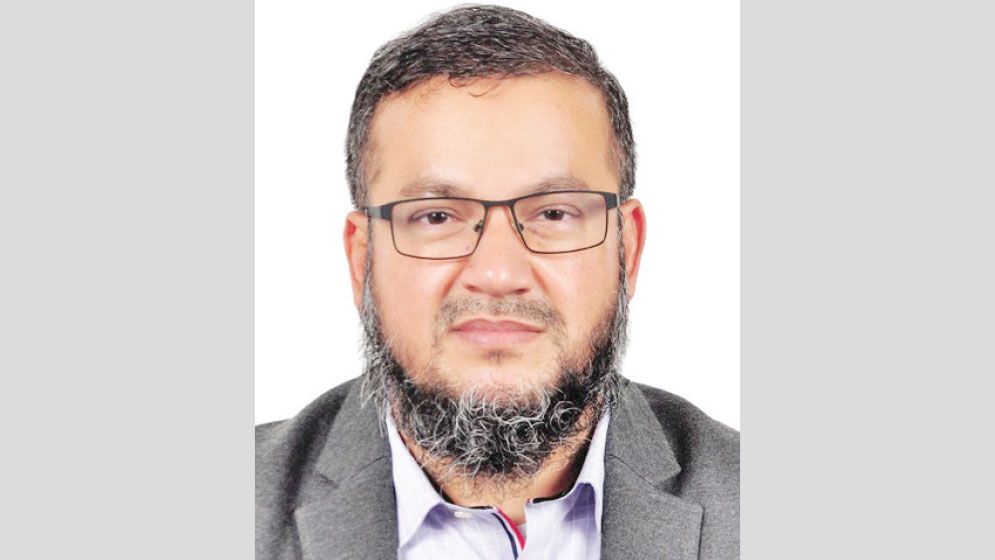
The future job market, preparation of graduates, curriculum reform, challenges in adapting to AI, its impact on Bangladesh, and the need for practical skill-based education were among the issues discussed with the Daily Sun by renowned wireless communication engineer and Bangladesh Satellite Company Limited (BSCL) Managing Director & CEO Dr Muhammad Imadur Rahman.
Human creativity will remain indispensable
Amid reports of companies worldwide laying off employees due to the growing use of AI, what could the situation look like in Bangladesh in the future? Asked about the potential impact on the country’s job market, Dr Muhammad Imadur Rahman said that the rise of AI would not necessarily mean the disappearance of jobs but rather a major shift in the skills required in the job market.

“AI will not directly take your job; rather, your job could be taken by someone who knows how to use AI effectively,” he said.
According to him, by 2035, machines and AI systems will perform most routine tasks that do not require deep thinking or creativity. Humans, meanwhile, will increasingly be engaged in areas requiring creative thinking, complex judgment and instant decision-making.
He explained that human decision-making often depends on subtle changes in circumstances.
“For example, you may make one decision in the morning, but change it in the afternoon because the situation has changed slightly. Understanding these subtle differences and responding accordingly is where humans will continue to have an important role,” he said.
AI impact will go beyond IT
The impact of AI would not remain limited to information technology or other technology-related sectors.
Dr Muhammad Imadur Rahman said that it will affect almost every field from linguistics, Islamic studies and economics to medicine and other professional services.
To relate this to Islamic Studies, AI could provide users with comparative information from different schools of thought instead of presenting information from only one particular perspective.
Similarly, linguistics experts would remain important even in an AI-driven world, he said, because machines need to understand language, culture and context accurately.
He recalled an experience from his time studying in Denmark to illustrate the problem.
“We once wrote ‘Brothers and Sisters’ on an invitation for non-Muslim guests. Google Translate misunderstood the word ‘sisters’ and translated it into Danish in a way that meant ‘nurses’.
This shows why understanding linguistic context and culture will remain important even when AI becomes more advanced,” he said.
The healthcare sector, too, is likely to experience a major transformation.
AI could initially assess patients with relatively minor or temporary problems and help identify cases requiring further medical attention, while doctors would increasingly focus on complex cases, critical
decisions and surgeries, he said.
All students need AI skills for future jobs
To prepare for this transformation, Bangladesh must bring a fundamental cultural shift in its approach to education.
Dr Imadur Rahman said, “Education should not end with university. Learning must become a lifelong process.”
He stressed the need to introduce artificial intelligence and machine learning into university curricula immediately.
“Computer science students should learn how to develop AI solutions, while students of social sciences and humanities should learn how to use AI effectively in their respective fields,” he said.
He also called for a shift from output-based education to outcome-based and skill-based learning.
“Future opportunities will not be determined simply by how much CGPA a student achieves at the end of a programme,” he said. Instead, schools should focus on practical assignments, creativity, problem-solving and critical thinking from an early stage, he added.
Teacher training and policymakers’ key challenges
The expert identified a lack of proper teacher training and motivation, along with the mindset of policymakers and decision-makers, as two major obstacles to education reform.
“Our teachers need proper training and motivation to adapt to the changing environment,” he said. He also criticised the tendency among some university administrators and policymakers to prioritise infrastructure and administrative matters over academic curriculum reform.
“Many vice-chancellors and policymakers appear more concerned with building infrastructure or dealing with administrative files than updating academic curricula according to changing global needs,” he said. He said that awareness about AI among policymakers themselves also needs to improve.
“I have heard even educated decision-makers say, ‘If AI comes, people will lose their jobs.’ If decision-makers themselves do not have proper awareness about AI, it will be difficult to bring meaningful change,” he said.
Retraining is the key
Dr Imadur said technological disruption had historically changed jobs rather than simply eliminated employment. He recalled that when motor vehicles became available to ordinary people in Europe in the early 20th century, horse-carriage drivers feared losing their livelihoods and protested against the new technology.
“But the arrival of cars could not be stopped. Those who learned to drive found new employment as drivers, while those who refused to adapt eventually disappeared from the profession,” he said.
The same principle, he argued, applies to the AI revolution. “The main mission now is to retrain, reskill and upskill people so that they can adapt to the changing job market,” he said.
He stressed that Bangladesh’s priority should therefore be preparing its workforce for the next decade rather than protecting jobs that may disappear because of technological change. “Instead of asking whether AI will take jobs, we should ask whether our people have the skills to work with AI,” he said.
Skill-based education is needed to compete in the global AI economy
According to Dr Imadur Rahman, Bangladesh’s education system must therefore move beyond memorisation and examination-oriented learning and focus on producing graduates capable of thinking creatively, solving problems and continuously acquiring new skills.
He warned that failure to make these changes could leave a large section of the workforce unprepared for the 2035 job market. At the same time, he said, timely reforms could allow Bangladesh to turn the AI transformation into an opportunity by developing a skilled workforce capable of competing in the global economy.