



 For all latest news, follow the Daily Sun's Google News channel.


Last week, young inventors from across the country, from university students and technology enthusiasts to researchers, showcased a range of locally developed technologies at the Bangladesh Innovation Fair 2026 at the Novo Theatre in the capital.
The three-day fair, held on 12-14 September, featured more than 1,000 innovations submitted by over 50 universities, more than 100 industry experts and over 50 corporate organisations.
Organised under the theme “Innovation Ecosystem Toward Trillion Dollar Economy,” the fair was inaugurated by Prime Minister Tarique Rahman as the chief guest.
From a wearable apron that monitors a patient’s heart to an app that delivers fuel to the doorstep, the fair offered a glimpse into what Bangladeshi inventors and student teams are building for the future.
Here are some of the innovations that caught my eye.
An Apron That Monitors Your Health
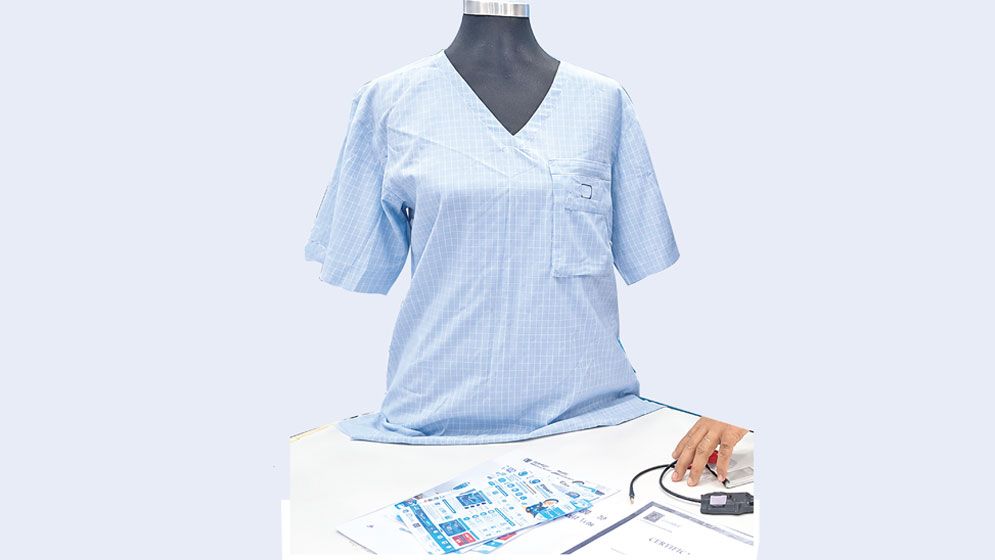
One of the more unusual exhibits was the Smart Medical Apron developed by a team from Southeast University.
The apron is a wearable garment embedded with sensors that continuously track a patient’s heart rate, breathing, body temperature and ECG readings.
The patient wears the apron, and the readings are sent directly to the doctor in real time through a cloud-based dashboard.
The doctor can then monitor the patient remotely and provide medical advice without the patient needing to be physically present.
The apron is built in four layers: a textile sensor layer, conductive yarn, a flexible middle layer and a skin-contact layer at the bottom. The layers work together to capture readings.
It connects to the internet via Bluetooth or Wi-Fi and can send instant alerts if it detects an abnormal reading.
A prototype has already been tested, with its readings showing 92% similarity to those of a conventional medical machine.
The device is designed for use in hospitals and clinics, as well as for home care, elderly care, post-surgery recovery, chronic disease management and emergency and intensive-care situations.
A Device That Speaks for Mothers Who Cannot
During pregnancy, childbirth or post-delivery complications, there may be times when a woman finds it difficult to communicate her needs clearly to her partner, caregiver or medical staff.
To address this problem, Team DuoSpark presented ARBOR, which it describes as the world’s first AI platform capable of communicating on behalf of mothers who are unable to speak during or after a difficult childbirth.
The device takes the form of a large body pillow fitted with sensors that read physical signals.
A medical-grade microphone picks up sounds, a contactless sensor measures temperature, another sensor detects muscle activity and sub-vocal movements, and a motion sensor tracks physical movement.
An AI system then analyses these signals together and translates them into actionable alerts for caregivers or medical staff through a dashboard interface.
Its listed features include a silent emergency system, a false-alarm filter, a daily birth-safety guide, a relaxation mode and doorstep care delivery.
The device has been designed with a comfort-first approach specifically for women.
Fuel Delivered to Your Door
FuelX is a fuel-delivery application that works much like a food-delivery service.
A customer places an order through the app for the amount of fuel they need, and a nearby rider collects the fuel and delivers it to their location.
The delivery charge ranges from Tk50 to Tk100, in addition to the cost of the fuel itself.
The app is location-based, meaning it automatically connects the customer to the nearest available rider. The service is designed for people in the city who need fuel without having to visit a petrol station.
An AI-Powered Security Camera System
SmartData Technologies Limited showcased VisionX, an AI-powered video surveillance system that operates entirely on-site.
It processes video footage locally on dedicated hardware rather than sending it to a remote cloud server.
The system can analyse up to 33 camera channels simultaneously on a single appliance, drawing fewer than 10 watts of power per inference engine.
It can detect and classify more than 20 types of events, including people crossing restricted lines, vehicles parking illegally, workers not wearing safety helmets, excessive crowd density and people falling. It can also recognise number plates in Bengali and English. Alerts can be sent to a dashboard, phone or connected monitoring software in less than one second.
According to the company, the system costs 94% less to operate than cloud-based AI surveillance services. It is built on chips made by two technology partners, DEEPX and SiMa.ai.
AI That Spots Road Damage Before It Becomes Dangerous
A team from Daffodil International University’s Quantum Robotics and Automation Research Group presented an AI-powered road-damage detection system.
The system works by capturing photographs or video footage of roads and running them through an AI model that automatically identifies different types of damage, including longitudinal cracks, transverse cracks, alligator cracks and potholes.
It then generates a report showing the location, severity and type of damage through a web-based interface that road authorities can access without specialised training.
The system was trained on a dataset of annotated road images captured across different environments and lighting conditions in both urban and rural areas. Its performance metrics showed a precision rate of 91.8% and an mAP50 score of 91.84%.
The team envisions the technology being used by city corporations, the Roads and Highways Department and local government engineering bodies as a faster and cheaper alternative to manual inspection.
Future plans include integrating GPS mapping, drone feeds and a mobile application.
Tracking Every Plastic Bottle from Collection to Recycling
TrackerTech addressed a specific problem in Bangladesh’s plastic recycling industry.
When recycling company Bangladesh Petrochemical Company Limited (BPCL) buys used PET bottles, the type commonly used for drinks and beverages, it purchases them by weight from informal collection points.
The problem is that up to 10% of what it buys can turn out to be the wrong type of plastic, with non-PET materials such as polypropylene (PP) and polyethylene (PE) mixed into the batch.
By the time these materials are identified during manual sorting, money has already been lost.
TrackerTech’s solution uses an AI-powered camera to analyse each load of bottles before purchase.
The camera identifies individual bottles, distinguishes PET from non-PET materials, counts the bottles and identifies their brands.
Any bottle the system does not recognise is flagged for human verification, and the information is then added to the database for future reference.
Once verified, the data is recorded on a blockchain, a tamper-resistant digital record that tracks the bottles through six stages: collection, baling, shipment, arrival at the recycling plant, the recycling process and, finally, the finished product.


Circuit Boards Made from Jute Fibre
Researchers at the World University of Bangladesh (WUB) have developed a circuit board using jute fibre in a project titled “Natural Fiber Based PCB: A Sustainable Green Electronics Platform Using Bangladesh Jute Fiber.”
The aim is to reduce the environmental impact of electronic waste.
Printed circuit boards (PCBs) are used in almost all electronic devices to connect and support different components.
Conventional PCBs are largely made from non-biodegradable materials that can remain in landfills for years and contribute to environmental pollution.
The researchers used jute fibre and epoxy to create the base of the new board. Copper was then added to form the circuits, allowing the board to perform basic electronic functions.
A working prototype was demonstrated by lighting an LED on the jute-based board, showing that the material can be used in electronic applications.
According to the project details, the board has good mechanical strength and can withstand heat and flames. It also has the potential to break down naturally after disposal, unlike conventional circuit boards.
The researchers believe the technology could eventually be used in smart textiles, wearable devices, smart packaging, low-power electronics and educational equipment.
The project aims to promote the use of natural, locally available materials in electronics while reducing electronic waste and supporting more sustainable manufacturing.