



 For all latest news, follow the Daily Sun's Google News channel.


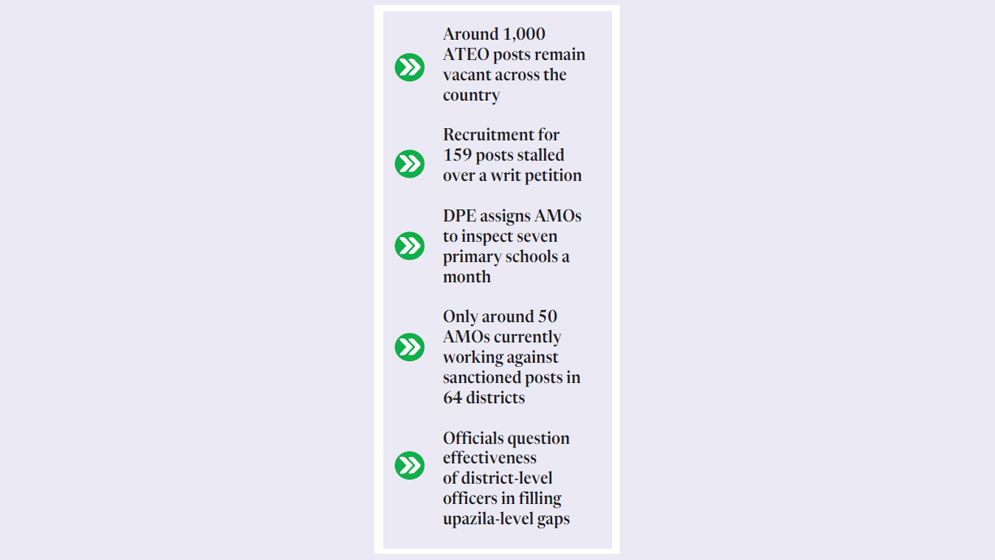
A large number of vacant posts for assistant thana education officers (ATEOs) are hindering the monitoring and supervision of government primary schools, prompting the Directorate of Primary Education (DPE) to involve assistant monitoring officers (AMOs) in school inspections to help fill the gap.
There are 2,607 sanctioned ATEO posts, of which around 1,600 are currently filled, leaving about 1,000 posts vacant, according to officials concerned.
Meanwhile, the recruitment process for 159 ATEO posts had progressed to the preliminary examination conducted by the Public Service Commission (PSC), but the written examination has been postponed due to a writ petition, further delaying efforts to address the shortage.
S M Sirajuddoha, deputy director (Admin) of the DPE, told the Daily Sun, “The recruitment process has been hampered due to a writ petition. Our legal wing is working on the matter.”
Against this backdrop, the DPE has set a monthly target of inspecting seven government primary schools for each AMO working at district primary education offices.
According to a DPE directive issued on 17 September, the measure was taken to expand field-level inspections and improve the quality of primary education.
The directive said monthly targets for office and primary school inspections had previously been set for officials under 12 categories working at the field level under the DPE. As part of efforts to further expand school inspections, a target of visiting seven government primary schools per month has now been fixed for AMOs.
The directive, signed by Mohammed Rakib Uddin, director of the Monitoring and Evaluation Division of the DPE, said approval from the director general had been obtained in this regard.
However, Rakib Uddin could not be reached for comment despite several attempts.
Dr Md Rabiul Islam, assistant director (Monitoring & Evaluation) of the DPE, said AMOs are currently being involved in school inspections to help address the shortage of ATEOs.
He said AMOs prepare designated monitoring reports after interviewing teachers during school visits, following instructions issued by the DPE through its divisional offices.
There are sanctioned AMO posts in all 64 districts, although not all positions are currently filled. Around 50 officers are currently working across the country, he added.
He said the primary responsibility of ATEOs is to inspect and monitor schools, while around one-third of the total sanctioned posts remain vacant.
“Since schools need to be inspected regularly, assistant monitoring officers have been assigned to school inspection duties to help address the shortage of ATEOs,” Dr Rabiul Islam said.
However, officials concerned questioned the effectiveness of relying on district-level monitoring officers to fill the gap at the upazila level.
An ATEO, speaking on condition of anonymity, said AMOs are posted at district headquarters, while many ATEO posts remain vacant at the upazila level. The move to fill the gap through district-level officers is therefore unlikely to make a significant difference, the official said.
The official also said many AMOs joined the service as accounting assistants and later received an upgrade to the position.
Meanwhile, Al Amin Hawladar, member secretary of the central committee of the Bangladesh Assistant Upazila Education Officers Association, told the Daily Sun that ATEOs have limited opportunities for promotion and career advancement.
“There is no promotion or upgradation for ATEOs. The file related to the assignment of additional responsibilities is also stuck, and human resource development is not taking place,” he said.
Highlighting other concerns, he said ATEOs and headteachers are on the same pay scale, creating a “psychological discomfort” for ATEOs while monitoring headteachers.
“We want the government to make the right decision regarding ATEOs,” he said.