



 For all latest news, follow the Daily Sun's Google News channel.


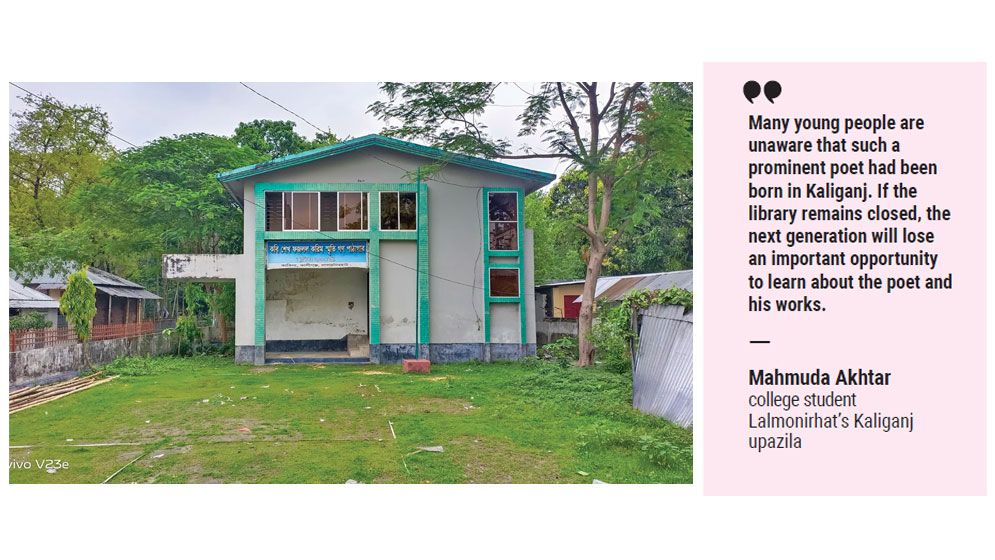
The memorial library dedicated to renowned Bengali poet Sheikh Fazlul Karim in Lalmonirhat’s Kaliganj upazila has remained closed for nearly two decades, denying students and general readers access to an important centre of learning established in his memory.
Located near Kakina Bus Stand beside the Lalmonirhat-Burimari highway, the library was established in 2005. It has remained closed for years due to a lack of proper management and inadequate government support, according to local residents. A recent visit found shops set up on both sides of the library gate, while piles of dirt had accumulated around the premises. The building has not been repainted for years and its signboard has also become dirty. Meanwhile, concerns are growing over the poor preservation of the poet's birthplace and memorabilia at Kakina.
At the poet's ancestral home, some of his belongings are kept in a semi-pucca tin-shed room. The preserved items include wooden cots, armchairs, a hat, inkpot and pen, a small Quran, a magnifying glass, buttons and other personal belongings. Family members are trying to preserve the items through their own efforts, but financial and manpower shortages have made the task increasingly difficult.
Literature enthusiasts from different parts of the country, including Dhaka, Bogura and Cumilla, visit the poet's home, but there is no proper seating arrangement or regular exhibition of his memorabilia. Sheikh Feroze, a grandson of the poet, said many visitors from Bangladesh and India come to the house to see the poet's belongings. “Due to a lack of manpower and funds, it has become difficult for us to preserve these memories.
The government should take the initiative to establish a museum and properly preserve the poet's belongings,” he said.He also called for the inclusion of the poet's poem ‘Where Is Heaven, Where Is Hell’ in school textbooks, saying it had previously been included in the curriculum.
Kabir Hossain, a university student from Kakina, said it was distressing to see the poet's memories neglected. “The library should be reopened soon and initiatives should be taken to preserve his memorabilia,” he said.
Mahmuda Akhtar, a college student from the area, said many young people were unaware that such a prominent poet had been born in Kakina. “If the library remains closed, the next generation will lose an important opportunity to learn about the poet and his works,” she said.
Local businessman Abu Taleb Milu said programmes are occasionally organised on the poet's birth and death anniversaries, but there is no regular initiative throughout the year to preserve his legacy or operate the library.
Kaliganj Upazila Nirbahi Officer Saiful Islam said necessary steps would be taken to reopen the library. He said the higher authorities would also be informed in writing about the need to preserve the rare belongings of the poet.
Sheikh Fazlul Karim was born on 14 April 1882, in Kakina of Kaliganj upazila.
He began his education at Kakina school and later studied at Rangpur District School, but did not complete his formal education. He became involved in literary activities and social work from an early age.
The poet established Sahabiya Printing Works in Kakina and edited the monthly magazine Basna from 1908 to 1919. His printing press also published Zamzam, Kallolini and Ratnapradeep.
He wrote around 45 books in prose and verse. His notable works include Trishna, Pritran Kavya, Bhagnaveena, Laili-Majnu, Path O Pathey and History of Afghanistan. He received the titles ‘Nitibhushan’ and ‘Kavyaratnakar’ in recognition of his literary contributions. Sheikh Fazlal Karim died in Kakina on 28 September 1936.
Local residents and cultural activists have urged the government, local administration and cultural organisations to work together to reopen the library, preserve the poet's memorabilia and establish a museum dedicated to his life and works.