




 For all latest news, follow the Daily Sun's Google News channel.


CASH TO DIGITAL
Bank cards rise by 25.7m in five years
Monthly card transactions more than double to Tk47,480cr as prepaid cards record fastest growth

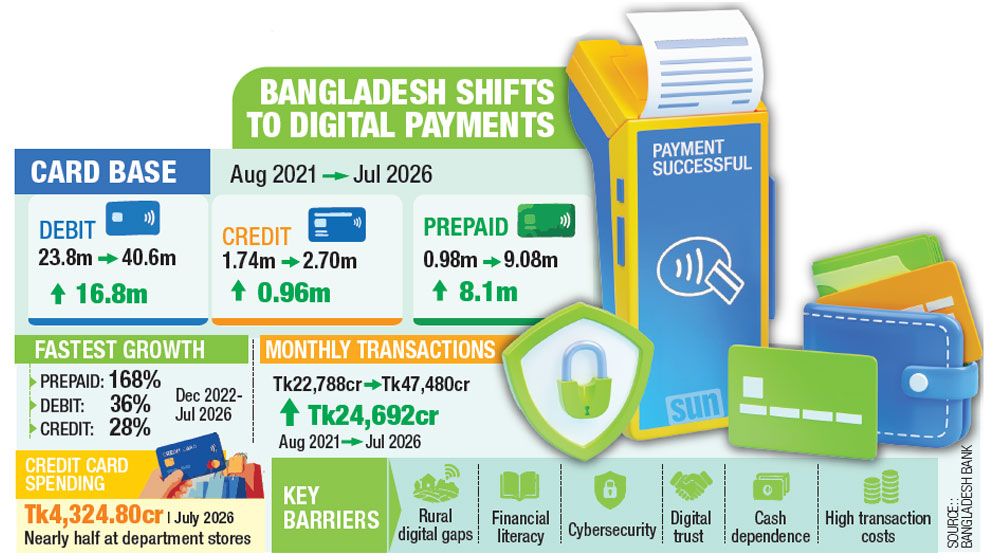
The number of debit, credit and prepaid cards in Bangladesh has increased by around 25.7 million over the past five years as consumers increasingly turn to card-based payments.
Debit cards recorded the largest increase in absolute numbers, while prepaid cards emerged as the fastest-growing segment, according to a Bangladesh Bank report.
The central bank’s recently published report, “An Overview of Card Usage Patterns Within and Outside Bangladesh”, shows that the number of debit cards rose from 23.8 million in August 2021 to 40.6 million in July 2026.
Credit cards increased from 1.75 million to 2.70 million, while prepaid cards surged from 980,000 to 9.08 million during the period.
The number of debit cards increased by around 16.8 million over the five-year period, while credit cards increased by around 960,000 and prepaid cards by 8.10 million. Together, the three categories recorded an increase of around 25.7 million cards.
Despite the expansion, Bangladesh Bank identified several obstacles to moving towards a fully cashless economy, including limited digital infrastructure in rural areas, low financial literacy, cybersecurity concerns, a lack of trust in digital platforms, a cash-dependent culture and informal economy, high transaction costs and limited smartphone use.
The central bank said fraud prevention and security measures need to be strengthened as card-based transactions continue to grow.
It also stressed the need for regular customer education and training on the benefits and risks associated with card usage.
Debit cards see largest expansion
Debit cards recorded the largest expansion in absolute numbers, increasing by around 16.8 million over the five-year period and accounting for the largest share of cards in circulation.
Prepaid cards, however, expanded at the fastest rate.
According to Bangladesh Bank, the number of debit cards increased by 36% and credit cards by 28% between December 2022 and July 2026. During the same period, prepaid cards increased by 168%.
The central bank identified prepaid cards as the fastest-growing segment, saying the expansion reflects increasing demand for flexible digital payment systems.
Alongside the increase in the number of cards, transaction volumes have also grown significantly.
According to Bangladesh Bank’s five-year data, total monthly transactions through debit, credit and prepaid cards stood at Tk22,788 crore in August 2021. By July 2026, the amount had increased to Tk47,480 crore.
Monthly card transactions therefore increased by around Tk24,692 crore over the period.
Central bank initiatives
The Bangladesh Bank report highlighted the central bank’s long-term initiatives and policy framework behind the expansion of card usage.
According to the report, Bangladesh Bank took initiatives in 2012 to introduce various types of cards, or “plastic money”, as part of efforts to develop an information technology-based cashless banking system.
Subsequently, the Payment and Settlement System Act, 2024 came into effect on 4 November 2025, providing a legal basis for the payment and settlement system and strengthening protection of customer interests.
The Payment Systems Department has also developed guidelines and legal frameworks for the sector.
Bangladesh Bank said these initiatives have contributed to steady growth in the number of card users as well as the volume and diversity of card-based transactions.
Cards used mostly for shopping
Credit card transactions in Bangladesh amounted to Tk4,324.80 crore in July 2026, down from Tk4,461 crore in June.
Department stores accounted for the largest share of transactions, with nearly half of the country’s total credit card spending taking place at such outlets, according to Bangladesh Bank.
Industry insiders and an official of City Bank’s card division told the Daily Sun that City Bank cardholders can get up to 45 days to pay their bills, while some banks allow up to 60 days.
The official said the extended payment period is one of the main reasons consumers are increasingly using credit cards. Offers and discounts on purchases of electronic products are also attracting customers, he added.
In its June report, Bangladesh Bank identified several possible reasons for the high use of credit cards at department stores, including purchases of essential goods amid inflation, promotional offers from banks, the convenience of buying daily necessities at such stores and the widespread availability of card payment facilities.
Credit cards popular abroad
Bangladeshi cardholders spent Tk984.70 crore abroad using credit, debit and prepaid cards in July, down from Tk1,037 crore in June.
Of the total overseas spending, Tk525.90 crore was made through credit cards, Tk401.10 crore through debit cards and Tk57.80 crore through prepaid cards.
According to Bangladesh Bank, Bangladeshi credit cardholders made 830,000 transactions abroad in July. Debit card transactions stood at 790,000, while prepaid card transactions totalled 123,000.
Foreign cards also used in Bangladesh
The report also highlighted transactions in Bangladesh using cards issued by foreign institutions.
Transactions through foreign-issued cards amounted to Tk234.30 crore in July, down from Tk241.50 crore in June, representing a month-on-month decline of around 3%.
The year-on-year picture, however, showed growth.
According to Bangladesh Bank, card-based spending by foreign nationals in Bangladesh increased by 24.14% in July 2026 compared with July 2025.
Over the same period, credit card usage abroad by Bangladeshi cardholders increased by 9.71%, while domestic credit card usage rose by 40.24%.
Upward trend over 12 months
Bangladesh Bank’s 12-month analysis shows that domestic credit card transactions generally followed an upward trend between August 2025 and July 2026.
Transactions increased from August through December before declining until February 2026. They rose sharply in March, fell in April and increased again in May and June, followed by a slight decline in July.