


 For all latest news, follow the Daily Sun's Google News channel.


Experts stress controlling 3-wheeler production, import, charging installation
Daily Sun Report, Dhaka
Published: 17 Sep 2026, 12:00 AM
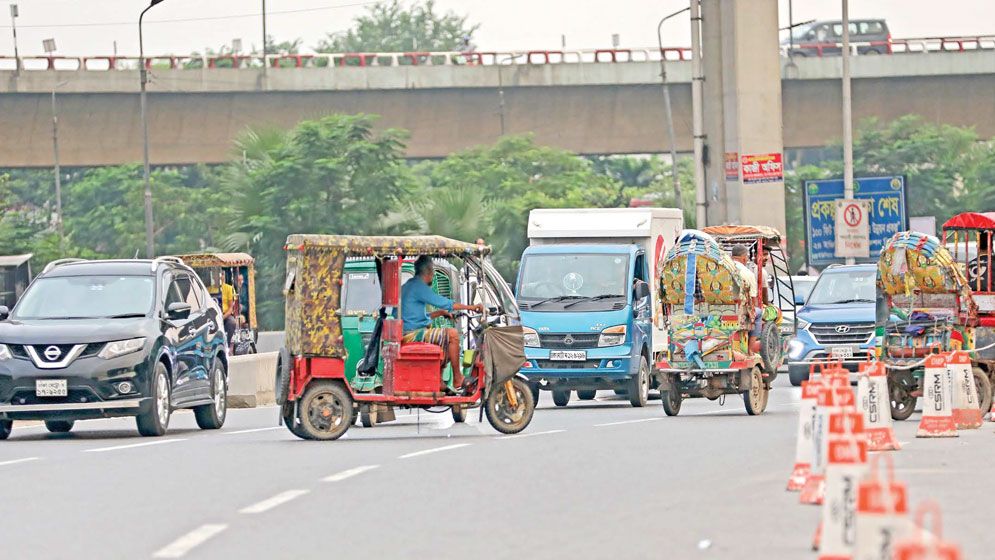
Despite repeated discussions and regulatory debates, the battery-run auto-rickshaw chaos continues unabated across the capital’s major thoroughfares. Plying the wrong side of the road recklessly, these unregulated three-wheelers trigger frequent accidents, severely disrupting traffic flow and leaving commuters vulnerable on a daily basis. This photo was taken from the Kuril Biswaroad area on Wednesday. - KAMRUL ISLAM RATAN
Experts have underscored the importance of controlling production, supply and charging systems of the battery-powered auto-rickshaws as they have been creating problems in the city streets.
They came up with the views at a seminar on “Battery-operated Three-wheelers and Sustainable Public Transport Planning and Management,” organised jointly by the Bangladesh Institute of Planners (BIP) and the Department of Urban and Regional Planning of Bangladesh University of Engineering and Technology (BUET) at the BIP conference hall in Banglamotor, Dhaka.
Speaking on the occasion, DMP Deputy Commissioner (Dhaka-Tejgaon) Md Rafiqul Islam said that the widespread presence of battery-powered three-wheelers had become a major challenge for traffic management.
“It is difficult to control these vehicles through traffic police alone without regulating their production, supply and charging,” he said.
He also pointed to the shortage of adequate bus bays and parking spaces on Dhaka roads and congestion and disorder caused by poorly planned intersections.
The DMP official stressed that the issue should be addressed not only through law enforcement but also through proper planning and management.
In the keynote presentation, BIP General Secretary Prof Dr Md Mosleh Uddin Hasan and planner Tahsin Reza said that the battery-operated three-wheelers should be treated as a separate motorised vehicle category based on their speed, movement patterns and road use rather than being considered equivalent to traditional rickshaws.
The presentation also highlighted differences in speed and headway between battery-operated three-wheelers and conventional rickshaws. It said that the headway for battery-operated three-wheelers was around 1.3 seconds, compared with two seconds for conventional rickshaws, potentially creating road safety risks during sudden situations.
Speakers at the seminar called for a clear policy framework for the vehicles instead of abruptly removing them from the roads.
Prof Dr SM Sohel Mahmud, a researcher at BUET’s Accident Research Institute, said that reliable research was needed to determine the actual extent of the negative impacts of battery-powered three-wheelers. He also stressed regulating the import of components, related factories and charging points while ensuring affordable alternative public transport.
Transport planner Syed Waliullah said that battery-powered three-wheelers had spread across almost the entire Dhaka metropolitan area and were not compatible with the desired structure of the city’s transport system.
He called for better public bus services so that people would naturally shift towards improved transport options.
BIP Adviser Prof Dr Adil Mohammed Khan called for bringing battery-powered rickshaws under licensing and regulating all types of vehicles, including private cars and motorcycles, to restore discipline on the roads. He also stressed regulating vehicle suppliers, owners, charging-station operators and importers.
Road Transport and Highways Division Additional Secretary Md Anisur Rahman said that the government was working to increase the number of buses, introduce women-friendly and electric buses and create opportunities for cycling around metro stations.
State Minister for Road Transport and Bridges Habibur Rashid said that battery-powered three-wheelers could not be removed suddenly and that a committee had been formed to develop a policy on the vehicles.
He said that the proposed policy would cover issues including designated routes and taxation for battery-powered vehicles. He also stressed the need for proper feasibility studies before implementing transport projects.