




 For all latest news, follow the Daily Sun's Google News channel.


Maize emerges as key industrial crop as demand rises
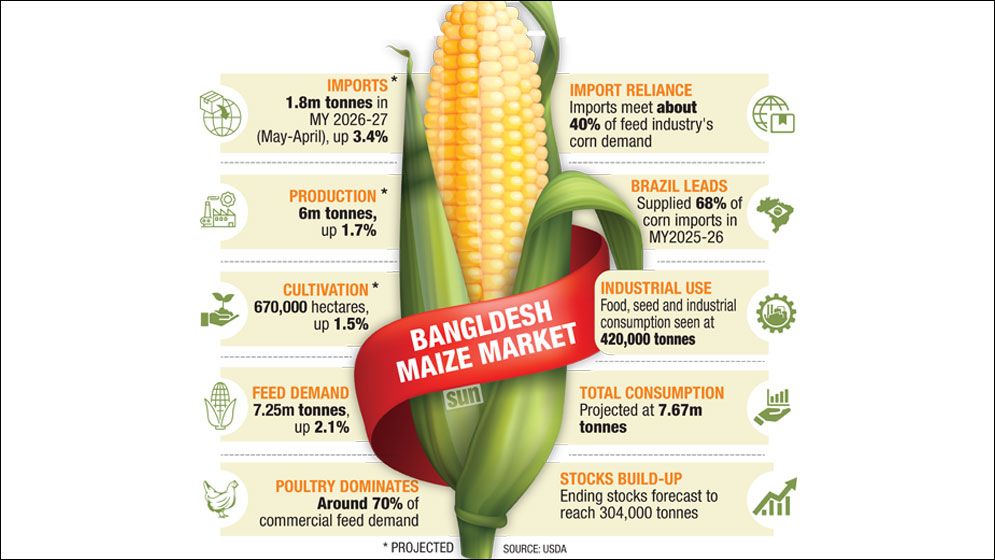
Imports projected at 1.8m tonnes in MY27 as domestic production reaches record 6m tonnes; feed industry drives growing demand

Maize is rapidly transforming from a traditional field crop into a vital raw material for Bangladesh's expanding poultry, aquaculture, and textile sectors, signaling a fundamental shift in the country's grain economy.
According to the latest Grain and Feed Update from the US Department of Agriculture (USDA) office in Dhaka, domestic maize production is forecast to reach a record 6 million tonnes in the 2026-27 marketing year (MY27).
Despite surging local harvests, booming industrial demand is simultaneously pushing import needs higher.
The USDA projects Bangladesh’s maize imports will rise to 1.8 million tonnes in MY27 – a 3.4% increase from 1.74 million tonnes in the previous marketing year.
The double-digit expansion in both production and overseas sourcing highlights the crop's evolving role, as feed mills and food processors increasingly depend on corn to power the country's broader industrial supply chains.
During the first three months of the current marketing year, Bangladesh imported roughly 115,000 tonnes of corn, driven by robust domestic demand from the feed industry.
Maize has solidified its place as Bangladesh’s second-largest grain crop in both acreage and yield, cultivated during both the summer and winter seasons.
According to the report, the winter crop accounts for approximately 85% of total annual production.
For MY27, domestic corn production is projected to grow 1.7% year-over-year to 6 million tonnes, up from 5.9 million tonnes in the previous marketing year. Harvested area is also expected to expand by 1.5%, covering 670,000 hectares.
High yields and favorable market prices have made corn an increasingly lucrative cash crop for local farmers.
At the same time, growing commercial demand across the poultry, livestock, and aquaculture sectors is accelerating the adoption of high-yielding hybrid seeds and modernized farming techniques.
Feed mills become biggest driver
The country’s expanding commercial feed industry is at the heart of the corn demand boom.
The USDA estimates that total feed and residual use of corn in Bangladesh will rise to 7.25 million tonnes in MY27, up 2.1% from 7.1 million tonnes in MY26.
According to the Feed Industry Association Bangladesh and Bangladesh Poultry Industries Central Council, around 150 registered feed companies collectively produce approximately 7.5 million tonnes of commercial feed annually.
Another estimated 500,000 tonnes is produced by numerous unregistered feed companies.
Poultry feed accounts for roughly 70% of total commercial feed production, while the remainder is used for aquaculture and cattle.
Maize is the principal raw material in poultry feed and is also an important ingredient in aquaculture and cattle feed.
The industry also uses soybean meal, fish meal, DDGS, broken rice, rice polish, rapeseed and mustard meal, corn gluten meal and de-oiled rice bran.
Feed formulations vary depending on nutritional requirements, ingredient prices and availability.
Moshiur Rahman, president of the Feed Industries Association Bangladesh (FIAB), told Daily Sun that demand for corn in the feed industry has increased manifold in recent times.
“Increasing demand of corn has raised the price in domestic corn to Tk38 per kg from Tk30 per kg in a month. Import is on process from Brazil which will reach in November and it will cost Tk42 per kg much higher than the local one,” he said.
Md Mahabub Hassan, executive vice president of Avon Animal Health, said the poultry feed industry has been expanding amid growing demand for poultry feed in the country.
“About 60% demand of corn in feed industries have been fulfilled by domestic production while 40% demand have been fulfilled by import,” he said.
Maize expands beyond animal feed
Corn’s role in Bangladesh is no longer limited to animal feed.
The USDA forecasts food, seed and industrial consumption of corn at 420,000 tonnes in MY27, up from 400,000 tonnes in the previous year.
There is no official government data on this segment, but industry contacts estimate that six starch-producing companies alone consume around 300,000 tonnes of corn annually.
The textile industry is the largest user of corn starch, which is used in fabric finishing and sizing.
Corn is also processed into corn syrup and glucose, which are widely used in the food and beverage industries.
Brazil dominates import market
Despite rising domestic production, Bangladesh continues to rely heavily on foreign supplies to meet rapidly expanding demand.
Brazil supplied 68% of Bangladesh’s corn imports in MY26, making it by far the largest supplier. India accounted for 24%, followed by the United States with 6% and Argentina with 2%.
The United States also returned to Bangladesh’s corn market in MY26 after an absence since 2018, exporting approximately 111,000 tonnes of corn to the country.
Over the past several years, Bangladesh has imported an average of approximately 1.5 million tonnes of corn annually, although the volume fluctuates depending on domestic production and market availability.
Corn prices in Bangladesh remain closely tied to the domestic harvest cycle.
Prices generally fall in May and June, when supplies increase following the winter harvest.
They normally start rising from August as available stocks decline and demand from the feed and food industries increases.
Prices tend to continue rising until new domestic or imported supplies reach the market.
According to the Department of Agricultural Marketing, the average wholesale price of corn was Tk30.09 per kg, while the average retail price stood at around Tk36.28 per kg in July 2025.
Unlike rice and wheat, Bangladesh has no public granaries specifically for storing corn.
Private feed companies maintain stocks ranging from several weeks to several months, with most major feed producers operating silos capable of storing corn for around two to three months.
The USDA forecasts Bangladesh’s corn ending stocks at 304,000 tonnes in MY27, significantly higher than the estimated 174,000 tonnes at the end of MY26.
The latest projections show that Bangladesh’s corn market is entering a period of sustained expansion.
Domestic production is expected to reach 6 million tonnes, but total consumption is projected at 7.67 million tonnes, leaving imports as an important source of supply.
With poultry, aquaculture and livestock production continuing to expand, the country’s dependence on imported corn is likely to remain significant.
The challenge for Bangladesh will be to increase domestic productivity and ensure a stable supply of competitively priced corn without exposing the feed and livestock industries to excessive volatility in global markets.