




 For all latest news, follow the Daily Sun's Google News channel.


Govt to roll out updated plan for $1t economy: Titumir
Says productive investment key to sustainable growth
Daily Sun Report, Dhaka
Published: 13 Sep 2026, 12:00 AM
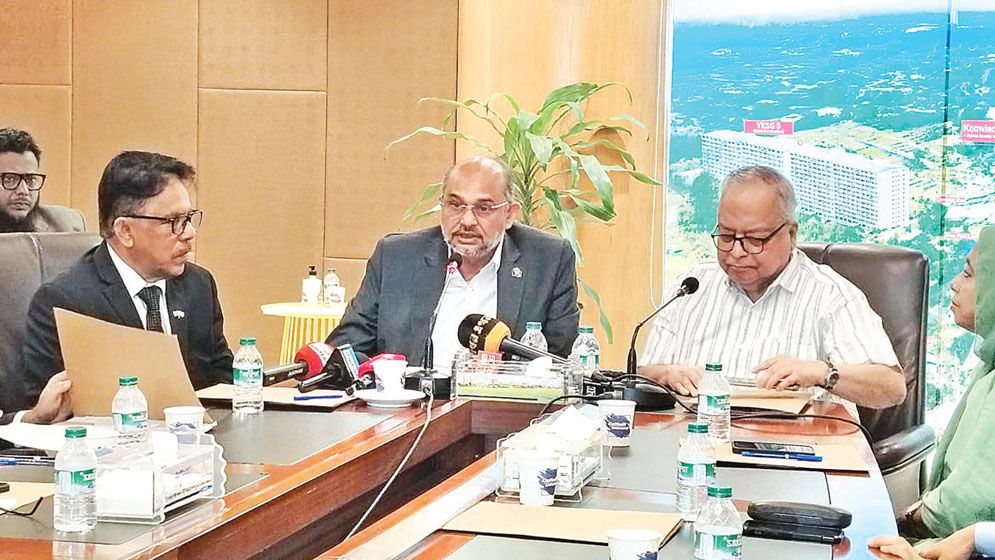
Prime Minister’s Finance and Planning Adviser Dr Rashed Al Mahmud Titumir on Saturday said that the government is rolling out coordinated short-, medium-, and long-term strategies – including an updated five-year plan – aimed at scaling the country into a US$1 trillion economy by 2034.
The government is pivoting toward productive investment and industrial growth to break Bangladesh’s reliance on debt and patronage-driven economics, he said.
“To put the economy on a sustainable footing, we must expand opportunities for both production and investment,” Titumir emphasised.
He made the remarks at the Daffodil International University in Savar while inaugurating its new Centre for Governance Studies (CGS).
The launch event, framed around the theme “Connecting Knowledge, Policy and Practice for Better Governance,” drew a wide range of researchers, policymakers, academics, and media professionals.
Titumir said Bangladesh needed to reduce inequality, ensure social justice and create opportunities for wider participation by building strong and accountable institutions.
He said the country’s state system had been affected by favouritism and inequality, while a culture of patronage had developed in almost every sector, including energy.
“This has increased unemployment on the one hand and inequality on the other,” he said, adding that the July movement had also reflected people’s aspirations for greater equality.
He said the government was also working to reduce public suffering caused by the power sector crisis through planned measures.
Titumir said the forced departure of the previous rulers had clearly exposed the weakness of the country’s institutions.
He said governance involved three key areas – power, policymaking and policy implementation. But even an institutionally efficient system might not produce socially inclusive outcomes.
“For a country like Bangladesh, the question of inclusion is extremely important,” he said.
Institutions, he said, were not limited to laws, regulations or organisational structures. Customs, practices and values were also part of institutions.
Research was therefore needed on both formal and informal institutions, he said, adding that the characteristics of the previous authoritarian period also needed to be studied.
Such research, he said, should help create a Bangladesh based on equality, human dignity and social justice and aligned with the aspirations of the Liberation War.
The economic and planning adviser said institutions had been weakened and accountability had not been ensured.
“Economic issues are important conditions, but the biggest condition is institutions,” he said.
He said it was necessary to examine who institutions served, who made laws, who benefited from them and who had the power to change them.
National Professor Dr Mahbub Ullah said good governance was not a new concept, with its elements found in the writings of figures such as Confucius, Nizam-ul-Mulk, Thiruvalluvar and Ibn Khaldun.
Investment was essential for establishing good governance, he said, stressing the need for greater investment in administration, education and training.
Bangladesh faces governance problems in almost every sector, including law and order, revenue, land, education, health and business, Mahbub Ullah said.
He said introducing digital systems alone would not eliminate corruption. Trust, fairness and accountability were also necessary.
A patronage-based system and oligarchy in the political and economic structures could make good governance difficult, he said. Bangladesh should therefore consider the idea of “good enough governance” alongside the broader concept of good governance.
Abdul Baki, director of the Centre for Governance Studies, presented the keynote paper at the event.
He said the changes taking place in Bangladesh posed major challenges for the country’s future, while public expectations were now much higher.
“Simply talking about good governance is not enough. People want to see and understand what is actually happening,” he said.
Bangladesh needed to reduce gaps in democracy, social change, international geopolitical relations, and public policy formulation and implementation, he said.
Major decisions were often taken but stalled at the implementation stage, he said, adding that reducing the gap between knowledge, policy and practice was one of the key objectives of the CGS.
Baki said the centre would examine how policies could be made more effective through research, policy dialogue, capacity building, professional education and a social innovation lab.
It would also examine Bangladesh’s issues from regional and global perspectives, he said.
Daffodil International University Vice-Chancellor Professor Dr M R Kabir said the establishment of the CGS was an important milestone in the university’s efforts to promote academic excellence, research, innovation and social impact.
Universities had a responsibility not only to provide education but also to create knowledge, develop responsible leadership and contribute to addressing national and global challenges, he said.
Effective governance requires strong institutions, knowledge-based leadership, innovative thinking and evidence-based public policy, Kabir said.
He added that the CGS would bring researchers, policymakers and development workers together through research, policy dialogue and knowledge exchange.