



 For all latest news, follow the Daily Sun's Google News channel.


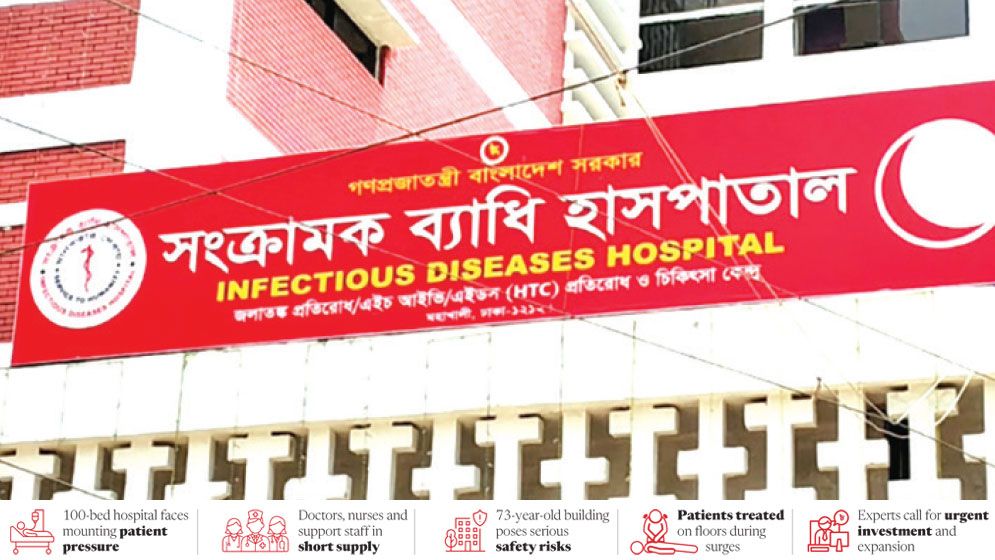
Bangladesh’s key specialised infectious diseases hospital is struggling to cope with rising patient pressure as shortages of doctors, nurses and support staff, a 100-bed ceiling and a deteriorating 73-year-old building expose patients and healthcare workers to mounting risks.
The Infectious Diseases Hospital in Mohakhali, established during the Pakistan period amid widespread outbreaks of cholera, smallpox, malaria, kala-azar and typhoid, was designed to isolate and treat infectious patients separately from the general population.
More than seven decades later, it remains a crucial frontline facility serving patients from almost every part of Bangladesh, but its capacity and infrastructure have failed to keep pace with demand.
Dr FA Asma Khan, superintendent of the hospital, told the Daily Sun that it currently treats patients suffering from HIV, tuberculosis, measles, tetanus, dengue, chikungunya, typhoid, influenza, pneumonia, chickenpox and various febrile illnesses.
The hospital has 100 beds, including a seven-bed intensive care unit (ICU) and an 11-bed high-dependency unit (HDU). Yet around 1,400-1,500 patients visit its outpatient department every day.
Around 700-800 of them come for rabies vaccination, either directly or after being referred by other healthcare facilities.
More than a ‘dog-bite hospital’
Despite its broad role, the hospital is still widely known as a “dog-bite hospital” because of its longstanding role in rabies vaccination.
Asma Khan said rabies-exposed patients need timely vaccination and, where indicated, rabies immunoglobulin (RIG). Patients arriving at night from distant districts may require immediate treatment, making round-the-clock readiness essential.
Although rabies deaths have declined substantially in Bangladesh, the large number of people seeking post-exposure vaccination continues to place a heavy workload on the hospital.
Frontline in measles response
The hospital has also become an important centre for treating measles patients during outbreaks.
Asma Khan said measles cases began rising around February and March, increased further in April and remained a concern in May. Thousands of children with measles have received treatment this year.
She said 46 suspected measles patients had died at the hospital, including 11 confirmed cases.
Different floors and sections are designated for different infectious diseases. The second floor houses an isolation unit for highly infectious patients, used mainly for measles cases, while the third floor is dedicated to HIV care. Other floors accommodate patients with tetanus, fever and other serious infections.
When outbreaks cause patient numbers to surge, the limited bed capacity becomes a major constraint.
Patients sometimes have to be treated on floors when all beds are occupied, creating additional challenges for infection control and patient care.
Only comprehensive HIV treatment facility
One of the hospital’s least-known services is specialised treatment for people living with HIV.
Hospital officials said it is the only facility in Bangladesh providing comprehensive treatment services for people living with HIV (PLHIV). The entire third floor is dedicated to HIV care.
Asma Khan said four to six HIV patients had died at the hospital in recent days, although the precise number of HIV-related deaths could not yet be stated.
She stressed that HIV is not transmitted through ordinary physical contact or through the air.
Transmission can occur through infected blood and sexual contact, while an infected mother can pass the virus to her child during pregnancy, childbirth or breastfeeding.
She also said HIV-positive patients can be cared for safely when appropriate precautions and infection-control measures are followed.
Doctors, nurses stretched thin
Manpower remains one of the hospital’s biggest problems.
Only 21 doctors are currently working there, including five provided by a university. The five doctors, trained in anaesthesia, are also involved in ICU services.
The hospital has 71 nurses, around 10 of whom are working on deputation.
Although the existing workforce is keeping the hospital functioning, Asma Khan said services are being provided “with considerable difficulty”.
The shortage extends to medical technologists, ward attendants, cleaners and other support staff. Laboratory and diagnostic services also come under pressure when patient numbers rise, forcing existing personnel to work longer hours.
Public health expert Dr Mohammad Mushtuq Husain said manpower and infrastructure should be strengthened before outbreaks occur.
He recommended filling vacant sanctioned posts, recruiting specialised healthcare professionals and strengthening laboratory, isolation and infection-control facilities.
73-year-old building poses safety risks
The manpower shortage is compounded by the condition of the hospital building.
According to Asma Khan, the structure is around 73 years old and has developed serious problems, particularly during heavy rainfall. Rainwater enters different parts of the building, while drainage remains a recurring concern.
More seriously, part of the building’s interior structure once collapsed onto a pathology consultant’s work area while the doctor had stepped outside for about two minutes to have tea.
The falling debris damaged the table, computer monitor and microscope, as well as the chair where the consultant had been sitting.
Asma Khan said the consequences could have been serious had the consultant remained there.
Encroachment hampers expansion
The hospital is also facing land encroachment.
Asma Khan said a significant portion of its land had been illegally occupied and legal action had been taken.
The encroachment is making expansion more difficult at a time when the hospital urgently needs additional space and modern facilities.
Patients come from across Bangladesh
The hospital’s role extends far beyond Dhaka. Asma Khan said patients from almost every part of the country, including distant districts such as Barguna, had received treatment there.
She said the hospital had treated patients referred from around 64 districts.
It recently organised a programme to introduce a protocol and guideline for treating measles patients, with authorities seeking to ensure appropriate treatment without unnecessary difficulties in referral or admission.
Too many attendants raise infection risk
Large numbers of patient attendants pose another infection-control challenge.
Asma Khan said a single patient is sometimes accompanied by six or seven family members. Such crowds can increase the risk of transmission, particularly when children are involved.
She cited the example of a family bringing two children to hospital, one seriously ill and the other relatively healthy.
When relatives move between the two children to provide food, water or medicine, the healthy child may also be exposed to infection.
She urged families not to bring unnecessary numbers of people to hospital and to maintain strict hygiene.
Hospital needs urgent attention
Despite the constraints, Asma Khan said doctors, nurses and other employees continued to provide services with dedication.
The government provides support for cleaning, food and other essential services, she said, but more resources are needed to address the ageing infrastructure, manpower shortage and limited capacity.
Public health specialists have called for urgent recruitment, increased bed capacity, stronger laboratory and isolation facilities and better resource allocation.
After more than seven decades on the frontline of Bangladesh’s infectious diseases response, the hospital remains a lifeline for thousands – but its own ageing infrastructure, inadequate capacity and staff shortages are increasingly putting that role at risk.