



 For all latest news, follow the Daily Sun's Google News channel.


POWER CRISIS EXPOSES WEAK BACKUP
Daily Sun Report, Dhaka
Published: 13 Sep 2026, 12:00 AM
Bangladesh’s power system is running with little room to absorb a major generation loss as shortages of gas and coal and problems at several plants have already squeezed electricity supply.
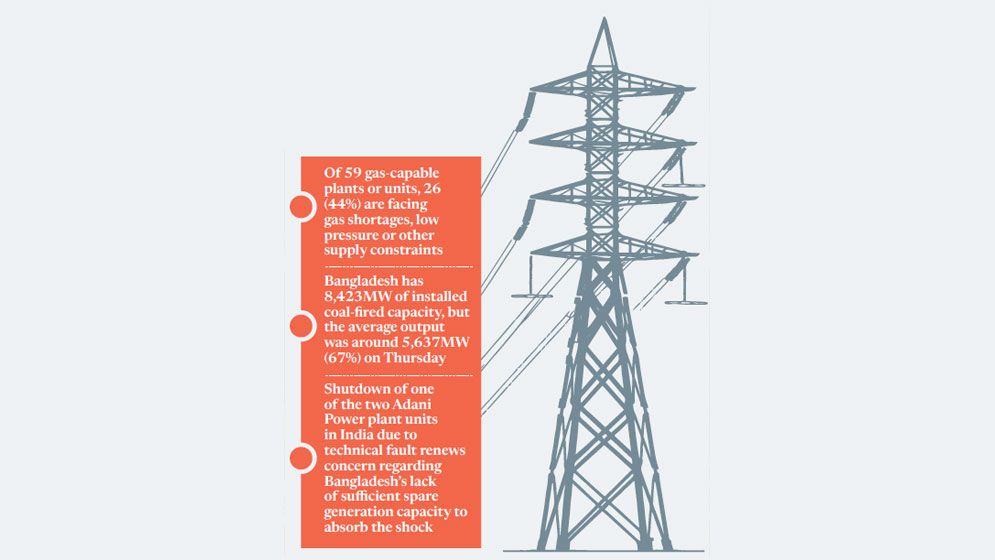
The vulnerability became more apparent after one of the two units of Adani Power’s Godda plant in India shut down following a boiler-related problem around midnight on Thursday, cutting the plant’s supply to Bangladesh by roughly half, according to officials of the Bangladesh Power Development Board (PDB).
Generation from the plant fell below 750 megawatts (MW), from around 900MW during the daytime and up to 1,200MW during evening peaks since the end of August, according to Power Grid Corporation of Bangladesh data.
The affected unit needs about 48 hours to cool before repair work can begin. Full restoration could take three to four days, PDB officials said.
The outage came as the country was already struggling to meet demand. Average hourly load shedding reached 2,657MW on Thursday. At around 3pm, demand rose to 16,345MW, leaving a shortfall of 3,557MW, nearly 22% of demand.
The situation eased somewhat on Friday as weekend demand fell. At 9pm, demand stood at 15,905MW against supply of 14,879MW, resulting in 1,026MW of load shedding at that time.
PDB officials warned that the situation could remain difficult or worsen if demand rises in the coming weeks.
Gas, coal shortage aggravates power crisis
The country has 29,593MW of installed capacity, but generation during high-demand periods has remained around 13,000MW-14,000MW against demand of roughly 16,000MW–17,000MW.
Currently, gas supply is around 2,300 million cubic feet per day (mmcfd), compared with the usual 2,650mmcfd.
Of 59 gas-capable plants or units listed in the latest generation status data, at least 26 – around 44% – are facing gas shortages, low pressure or other supply constraints. Several major plants are either idle or operating well below capacity.
Meanwhile, Bangladesh has 8,423MW of installed coal-fired capacity across eight plants, but the average output was around 5,637MW on Thursday, equivalent to about 67% of combined capacity.
Payra, with a capacity of 1,244MW, generated around 570MW amid a machine problem that has continued for about two months.
RNPL’s 1,244MW Patuakhali plant produced around 715MW because of a coal-supply constraint. Rampal generated about 1,045MW against 1,234MW, while SS Power averaged around 1,050MW against 1,224MW.
Matarbari was operating closer to capacity at around 1,130MW against 1,150MW.
The 307MW Barishal Electric Power plant generated around 171MW. The Power Division’s status sheet separately cited “bad quality coal” as a constraint.
Higher generation from Rampal helped cushion the immediate impact of the Adani outage. Coal-fired generation reached around 4,800MW at 4pm on Friday.
But the system is increasingly relying on liquid fuel to fill the gap.
Under a September plan, furnace oil generation was expected to rise to around 4,000MW on average from 53 public and private plants. The aim was to compensate for lower gas-fired generation and allow more gas to be supplied to industries.
So far, heavy fuel oil generation has averaged around 2,200MW, rising to about 3,500MW during peak periods.
The pressure has been building for some time. Average hourly load shedding remained above 1,700MW during the seven days through Thursday, before the Adani unit went offline.
Adani outage adds to concerns
Adani Power’s 1,600MW Godda plant has two 800MW units and supplies electricity to Bangladesh under a long-term agreement signed in 2017.
The company had already reported coal transportation problems earlier this month. On 2 September, Adani informed the PDB that congestion on India’s railway network, loading restrictions and disruptions to coal transportation had affected supplies to the plant. It said it was working with Indian Railways to resolve the problem.
The latest reduction in generation, however, was attributed to a technical failure.
For Bangladesh, the bigger concern is not only the loss of 800MW but the lack of sufficient spare generation elsewhere to absorb the shock, said people involved in the sector.
Political questions emerge
The timing of the outage has also triggered political debate.
Bangladesh had been discussing a possible visit by Prime Minister Tarique Rahman to India. On 10 September, Dhaka clarified that he would not attend the BRICS outreach programme in New Delhi on 12 and 13 September, while saying any bilateral visit should take place in a favourable environment.
The shutdown of the Adani unit was reported immediately afterwards.
The sequence has prompted questions about whether the disruption was entirely technical or whether wider political tensions could have an impact on electricity relations between the two countries.
However, there is no publicly available evidence establishing that Adani Power or the Indian government deliberately reduced electricity supplies because of the prime minister’s decision not to travel to India.
The timing alone cannot establish such a connection.
The more immediate concern is the resilience of Bangladesh’s own power system, said experts.
The 25-year Adani agreement makes the reliability of the Godda supply important for Bangladesh’s energy security. The government needs to assess the supplier’s obligations during outages, the time required for restoration and the contractual remedies available under the power purchase agreement.
At the same time, Bangladesh needs to strengthen its own dependable and flexible generation capacity.