



 For all latest news, follow the Daily Sun's Google News channel.


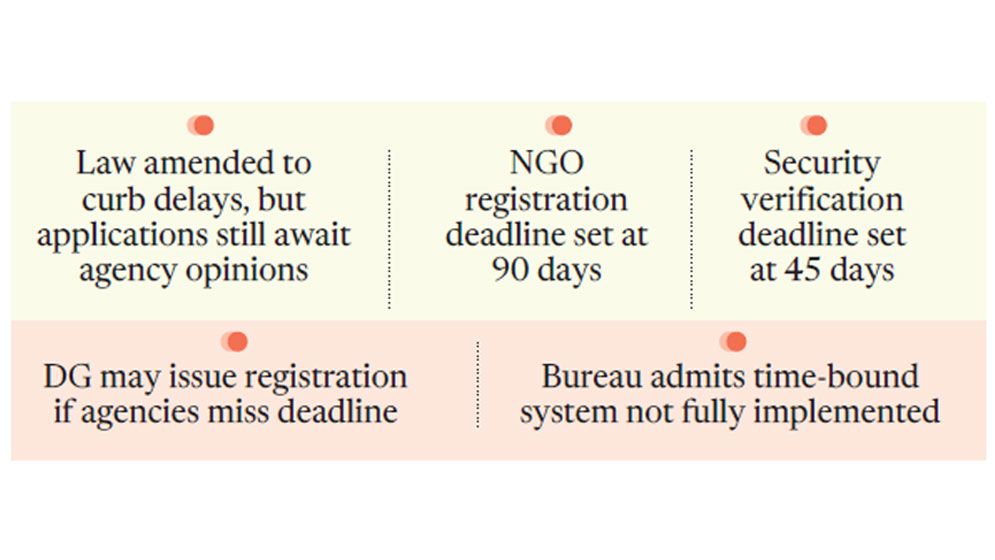
Despite an amendment to the law aimed at reducing delays in the registration of non-governmental organisations (NGOs) and easing the release of foreign donations, applications remain pending for long periods awaiting opinions or recommendations from government agencies.
The interim government issued the Foreign Donations (Voluntary Activities) Regulation (Amendment) Ordinance, 2025, introducing several changes to the 1978 law to simplify the NGO registration process and ease conditions for releasing donations. The current government retained the changes by passing the Foreign Donations (Voluntary Activities) Regulation (Amendment) Act, 2026.
Quazi Mahfujul Hoque Supan, a law teacher at Dhaka University, said the core objective of the amendment — streamlining NGO registration and curbing procedural delays — has yet to be fully achieved.
Under Section 4 of the amended law, an organisation seeking registration to conduct voluntary activities with foreign donations must apply to the director general (DG) of the NGO Affairs Bureau after paying the prescribed fee and submitting relevant documents.
If the application and documents are found genuine, the DG sends them to the home ministry and the Financial Institutions Division for their opinions or recommendations. Under subsections (4), (5) and (6), the ministry or division must conduct necessary inquiries and provide their opinion or recommendation within the prescribed period. If a favourable opinion is received, the DG shall issue the registration certificate within the prescribed period.
If no opinion or recommendation is submitted within the stipulated period, the DG may issue the registration certificate in favour of the applicant.
The amended law provides for completion of investigation or security verification within 45 days and NGO registration within a maximum of 90 days.
The provision was intended to prevent applications from being held up indefinitely because of delays by government agencies. However, legal experts and NGO-sector stakeholders said the problem persists because the DG is not legally bound to issue registration when an agency fails to respond within the deadline.
Barrister Md Khalilur Rahman, a director of the NGO Affairs Bureau, acknowledged that the time-bound system has not yet been fully implemented.
“We send the applications and related documents to the home ministry and the Financial Institutions Division. The 45-day time limit is mentioned in the amended law. It is true that in many cases we don’t get the necessary opinions and recommendations within the timeframe. However, we are trying to practise giving registrations according to the time limit. We have already given one or two,” he told the Daily Sun on Friday.
The delays can affect project implementation, donor commitments, recruitment, financial planning and the delivery of programmes to beneficiaries.
Supan said the effectiveness of the system depends largely on how independently and efficiently bureau officials work and whether they have the necessary skills to process applications without unnecessary complications.
“Then there would be no such hassle in getting an organisation registered after applying,” he said.